
School Dropouts Win Legal Battle: Will National Academic Assessment Opportunities Expand?
Daniel Kim Views
Translation result.
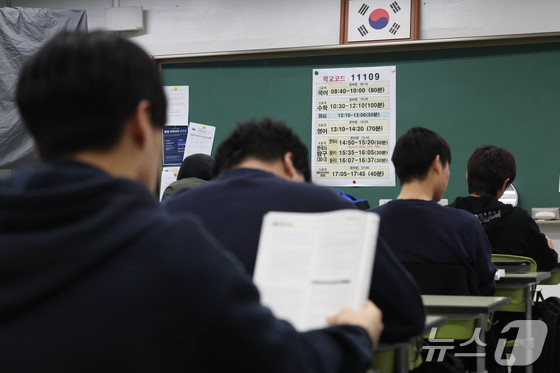
After a court issued a partial ruling in favor of out-of-school youths who had challenged restrictions on taking the National Joint Academic Assessment, the likelihood that those students will gain broader access to the exam has increased. Still, officials face significant practical hurdles — including how to determine grade levels and how to secure testing sites — so further discussion will be necessary before any policy is formalized.
On the 26th, the Seoul Administrative Court, Administrative Division 5 (Presiding Judge Lee Jeong-won) delivered a partial victory for the plaintiffs in their lawsuit seeking to annul decisions that denied their applications to sit the National Joint Academic Assessment.
The court ruled that the defendants — the Seoul Superintendent of Education, the Gyeonggi-do Superintendent of Education, and the director of the Busan Office of Education’s Academic Development Center — unlawfully infringed the plaintiffs’ rights to education and learning by rejecting their applications, and it annulled those rejection decisions. The court dismissed separate claims against the chair of the Association of Provincial Superintendents and rejected the argument that the assessment’s basic plan is itself unlawful.
The National Joint Academic Assessment is administered jointly by 17 provincial and municipal education offices under Article 9 of the Elementary and Secondary Education Act and its enforcement decree. The plaintiffs brought the suit in response to a rule limiting eligibility to current high school students. Last year, out-of-school youths asked local education offices for permission to take the exam, but their requests were denied.
The Seoul Metropolitan Office of Education said it respects the ruling and will consult with the Korea Council of Superintendents and the 16 other education offices to review the court’s reasoning before preparing support measures. The office will decide whether to appeal after reviewing the written judgment; if it does appeal, an appellate court will reassess whether out-of-school youths should be permitted to take the assessment.
Even if officials do not appeal and open the exam to out-of-school youths, they will confront practical challenges. There is no clear standard for assigning grade levels to students who are not enrolled, and authorities do not yet have an accurate count of eligible candidates. Additional coordination and information-sharing with the agencies responsible for related administrative tasks will also be necessary.
Securing test sites is another major obstacle. The assessment is typically administered at schools, but regular classes run on exam days, making it difficult to find separate space. If separate testing centers are established, officials will also need additional resources to safeguard test booklets and answer sheets and to maintain exam security.
Accordingly, the Seoul Education Office is considering a pilot that would allow out-of-school youths to take the October assessment this year. A Seoul education official said, “We will pilot the program in Seoul first, then review support measures based on actual demand and operating conditions.”














Most Commented