
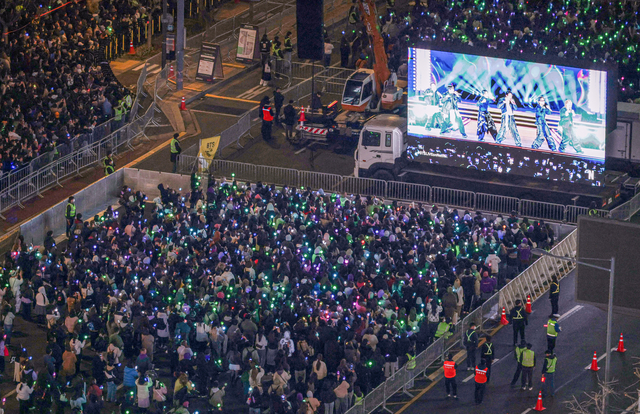
Fewer people than expected showed up for the BTS comeback concert in Seoul’s Gwanghwamun, prompting criticism that authorities over-deployed public servants. The crowd was less than half of the government’s projection, raising questions about whether mobilizing more than 10,000 public-sector workers for a private weekend concert was justified.
On March 22, the Ministry of the Interior and Safety and the National Public Officials’ Labor Union said that, according to the event organizer HYBE, about 104,000 people attended the Gwanghwamun-area concert.
That figure combines real-time connection data from the three mobile carriers—KT, SKT and LG Uplus—along with estimates for prepaid (MVNO) users and foreign attendees.
The crowd-management system run by the Ministry of the Interior and Safety estimates attendance from the carriers’ connection counts; it estimated roughly 62,000 people in the Gwanghwamun area during the concert. That estimate included 10,000 public servants but did not account for foreign attendees or prepaid-phone users.
Compared with HYBE’s estimate, the police and Seoul city projections missed the mark by a wide margin. The police had warned that up to 260,000 people might gather, while Seoul projected roughly 200,000–300,000 visitors from Gwanghwamun to City Hall to see BTS.
The police based their estimate on a standard of two people per square meter. They calculated the crowd could reach 260,000 if it stretched from Gwanghwamun Square, where the stage stood, to the area near Sungnyemun.
Using those agency projections, the ministry drew up a safety response plan for the comeback show and deployed 15,500 safety personnel on site that day.
Two-thirds of that staff were public servants: 6,700 police officers, 2,600 Seoul city workers, 800 firefighters, 400 Seoul Metro employees and 70 Ministry staff—more than 10,000 public-sector personnel in total. The remaining roughly 4,800 were private contractors mobilized by HYBE.
Since the Oct. 29, 2022, Itaewon crowd disaster, authorities have placed greater emphasis on safety at mass gatherings, and deployments by local governments, police and fire services have become noticeably larger.
Still, critics argue that officials likely over-deployed personnel based on inaccurate crowd estimates.
Beyond mobilizing more than 10,000 public servants on a Saturday holiday, critics raised concerns about wasted tax money and potential gaps in emergency coverage elsewhere.
Rank-and-file public employees (grades 9–6) receive roughly 11,000–13,000 KRW per hour for overtime (about $8.25–$9.75 per hour). Unless the deployment is classified as an emergency, overtime pay is generally limited to four hours per day.
If authorities paid up to four hours to 10,000 people, the total payout would be at least 440,000,000 KRW (about $330,000).
Some fire departments and local governments announced they would recognize up to eight hours of overtime for personnel assigned to the BTS event, so the total wage and tax costs are likely to far exceed that estimate.
A ministry official defended the deployment, saying officials expected large crowds from around the world for the comeback of one of the world’s most popular groups and that tensions in the Middle East raised concerns about possible terrorist threats. “We believe it is the government’s duty to do everything possible to prevent any potential accidents,” the official said.










Most Commented