Quick access to main page (top) Direct access to main contents Quick access to main page (bottom)

Construction Industry Reform: Will Direct Payment System Protect Daily Wage Workers?

Daniel Kim Views  

Translation result
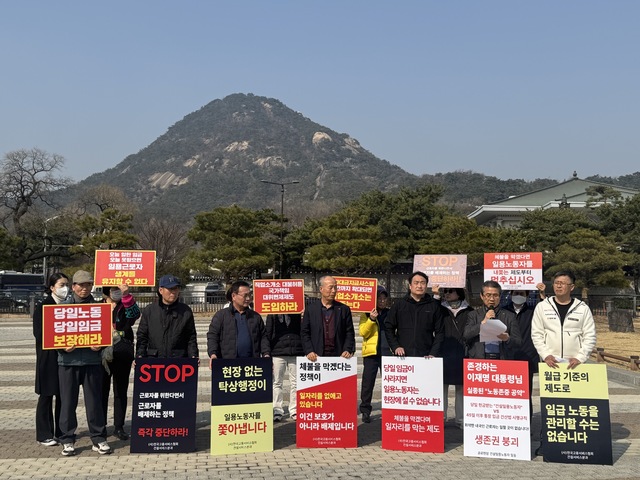
    On the 17th, officials from the National Employment Service Association held a press conference in front of Yeonpungmun at the Blue House in Seoul\'s Jongno District, urging supplementary revisions to the enforcement rules of the Construction Industry Basic Act while holding placards with slogans. (Provided by the National Employment Service Association)
  On the 17th, officials from the National Employment Service Association held a press conference in front of Yeonpungmun at the Blue House in Seoul’s Jongno District, urging supplementary revisions to the enforcement rules of the Construction Industry Basic Act while holding placards with slogans. (Provided by the National Employment Service Association)

Critics say the Democratic Party’s Euljiro Committee proposal to institute “direct payment by project owner” under the Construction Industry Basic Act is only a partial solution that fails to reflect how construction day laborers earn and need cash on the same day.

On the 19th, the National Employment Service Association issued a statement saying it agrees with the proposal’s aims but warned that introducing an electronic payment system (such as Chebul e-Zero) could add administrative steps that delay wage disbursements by 15 to 30 days, potentially putting day laborers’ livelihoods at risk.

The association also noted that across the country, roughly 10,000 small construction employment agencies have effectively served as a private safety net by fronting same-day wages from their own capital—so-called advance payment or subrogation—but the current bill contains no protections for these small businesses.

To address that gap, the association proposed amending the Construction Industry Basic Act to guarantee firms’ rights to recover advance-paid wages and revising the Employment Security Act to formalize professional firms’ labor-management roles and the subrogation system. It also called for concrete measures to eliminate any wage-payment lag that could occur during implementation of the direct-payment model.

Under the direct-payment system, project owners pay subcontractors directly rather than routing funds through the prime contractor. Some public agencies already operate similar arrangements via the Chebul e-Zero platform.

The Democratic Party’s Euljiro Committee is pushing to codify the system into law to fundamentally prevent wage nonpayment on construction sites. It has filed amendments to three laws—the Construction Industry Basic Act, the Subcontracting Act, and the Labor Standards Act—with the goal of passing them by April.

The proposed legislation would make direct payment mandatory in the private sector as well, requiring project owners to pay wages directly to subcontractors to break the construction industry’s structural pattern of wage nonpayment.

On the 17th, the association also held a press conference in front of Yeonpungmun at the Blue House in Jongno District, Seoul, to press for additional revisions to the enforcement rules of the Construction Industry Basic Act.

The electronic payment–based direct-wage system is intended to speed up and increase transparency in wage payments by ensuring that public-contract funds and wages are paid directly to actual workers. The Ministry of Land, Infrastructure and Transport announced a draft revision to the enforcement rules containing this measure in December.

The association warned that changing the wage-payment structure through the enforcement-rule revisions could cause confusion on construction sites and undermine employment stability. It urged the relevant ministries to prepare safeguards and issue clear legal interpretations before the system is rolled out.

The association said, “Preventing wage theft is important, but lawmakers must also consider that many day laborers depend on same-day pay to make ends meet. Parliament should hold thorough discussions and refine the system so it protects both workers’ livelihoods and the small-business owners who support them.”

Reporter Park Yoo-jin (pyj@viva100.com)

Daniel Kim
content@tenbizt.com

[Social] Latest Stories

  • Starbucks Korea CEO Fired Over Controversial ‘Tank Day’ Promotion
    Starbucks Korea CEO Fired Over Controversial 'Tank Day' Promotion
  • 25,000 Robots vs. Human Workers: The High-Stakes Battle at Hyundai
    25,000 Robots vs. Human Workers: The High-Stakes Battle at Hyundai
  • Hotel Hygiene Scandal: Cleaner Caught Using Guest Towels to Wipe Toilets
    Hotel Hygiene Scandal: Cleaner Caught Using Guest Towels to Wipe Toilets
  • South Korea’s Tech Giant Kakao Faces First Major Strike in 20 Years
    South Korea's Tech Giant Kakao Faces First Major Strike in 20 Years
  • South Korea’s Aging Crisis: How One Leader Is Redefining ‘Well-Dying’
    South Korea’s Aging Crisis: How One Leader Is Redefining 'Well-Dying'
  • Stop Calling Them ‘Hey You’: South Korea’s New Push for Worker Respect
    Stop Calling Them 'Hey You': South Korea's New Push for Worker Respect

Weekly Best Articles

  • Choi Dong-seok’s Family Bond: How a Simple Engraving Reveals Deep Love for His Children
  • Kwak Sun-hee’s Stunning Wedding Photos: A Celebration of Love and Courage
  • Is ‘I Am a Natural Person’ Just a Big Lie? Comedian Yoon-taek Reveals Shocking Secrets!
  • Health Scare: Why Fans Are Worried About Go Ji Yong’s Dramatic Weight Loss
  • Discover the Winter Gongju Chestnut Festival: A Taste of Korea at H-Mart in the USA!
  • 2026 Spring Wildfire Prevention: How Gyeryong City is Cutting Response Time to 30 Minutes!

You May Also Like

  • 1
    Ukraine’s EU Bid Surges as Hungary Drops Opposition Amid Russian Attacks

    Politics 

    Ukraine’s EU Bid Surges as Hungary Drops Opposition Amid Russian Attacks
  • 2
    Trump Backs Colombia's 'El Tigre' — What It Means for U.S. Relations

    Politics 

    Trump Backs Colombia’s ‘El Tigre’ — What It Means for U.S. Relations
  • 3
    Trump Backs Colombia's Far-Right Outsider—What's at Stake?

    Politics 

    Trump Backs Colombia’s Far-Right Outsider—What’s at Stake?
  • 4
    12.5% Tariff Hit: South Korea Faces New U.S. Trade Penalties

    Politics 

    12.5% Tariff Hit: South Korea Faces New U.S. Trade Penalties
  • 5
    12.5% Tariff Alert: Why the U.S. Is Targeting South Korean Imports

    Politics 

    12.5% Tariff Alert: Why the U.S. Is Targeting South Korean Imports

Popular Now

  • 1
    Marta Kostyuk Makes History at French Open Amid Ukraine Crisis

    Politics 

  • 2
    37 Years in Exile: The Tiananmen Leader Who Just Wants to Go Home

    Politics 

  • 3
    South Korea's Cheongju Airport Faces Crisis as Passenger Numbers Explode

    Politics 

  • 4
    Nuclear Submarine Race: South Korea's High-Stakes Bid for U.S. Fuel

    Politics 

  • 5
    France Finally Admits Complicity in the 1994 Rwandan Genocide

    Politics 

Weekly Best Articles

  • Choi Dong-seok’s Family Bond: How a Simple Engraving Reveals Deep Love for His Children
  • Kwak Sun-hee’s Stunning Wedding Photos: A Celebration of Love and Courage
  • Is ‘I Am a Natural Person’ Just a Big Lie? Comedian Yoon-taek Reveals Shocking Secrets!
  • Health Scare: Why Fans Are Worried About Go Ji Yong’s Dramatic Weight Loss
  • Discover the Winter Gongju Chestnut Festival: A Taste of Korea at H-Mart in the USA!
  • 2026 Spring Wildfire Prevention: How Gyeryong City is Cutting Response Time to 30 Minutes!

Must-Reads

  • 1
    Ukraine’s EU Bid Surges as Hungary Drops Opposition Amid Russian Attacks

    Politics 

    Ukraine’s EU Bid Surges as Hungary Drops Opposition Amid Russian Attacks
  • 2
    Trump Backs Colombia's 'El Tigre' — What It Means for U.S. Relations

    Politics 

    Trump Backs Colombia’s ‘El Tigre’ — What It Means for U.S. Relations
  • 3
    Trump Backs Colombia's Far-Right Outsider—What's at Stake?

    Politics 

    Trump Backs Colombia’s Far-Right Outsider—What’s at Stake?
  • 4
    12.5% Tariff Hit: South Korea Faces New U.S. Trade Penalties

    Politics 

    12.5% Tariff Hit: South Korea Faces New U.S. Trade Penalties
  • 5
    12.5% Tariff Alert: Why the U.S. Is Targeting South Korean Imports

    Politics 

    12.5% Tariff Alert: Why the U.S. Is Targeting South Korean Imports

Popular Now

  • 1
    Marta Kostyuk Makes History at French Open Amid Ukraine Crisis

    Politics 

  • 2
    37 Years in Exile: The Tiananmen Leader Who Just Wants to Go Home

    Politics 

  • 3
    South Korea's Cheongju Airport Faces Crisis as Passenger Numbers Explode

    Politics 

  • 4
    Nuclear Submarine Race: South Korea's High-Stakes Bid for U.S. Fuel

    Politics 

  • 5
    France Finally Admits Complicity in the 1994 Rwandan Genocide

    Politics 

Share it on...