
Here’s the result with the numerical and financial data converted based on the information in [originContent]:
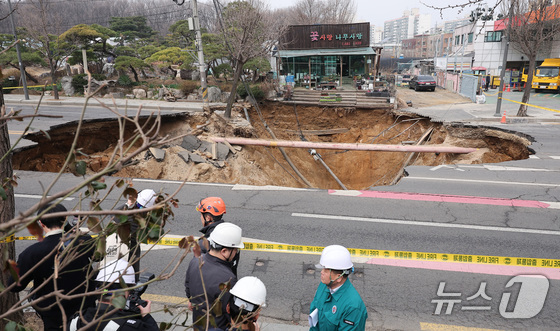
On March 4th, it was confirmed that the family of a delivery worker who died in a sinkhole accident in Myeongil-dong, Gangdong-gu, Seoul last March has filed a complaint against Seoul Mayor Oh Se-hoon and Daewoo E&C CEO Kim Bo-hyun.
Lee Young-hoon, an attorney from the law firm Weon representing the bereaved family, filed the complaint at the Seoul Gangdong Police Station. The complaint accuses Mayor Oh and CEO Kim of violating the Serious Accidents Punishment Act (SAP Act).
The incident occurred on March 24 last year when a sinkhole approximately 20 meters in diameter opened up in the middle of a road in Gangdong-gu, Seoul. A man in his 30s was buried in the collapse. Rescuers found him in cardiac arrest about 17 hours later, roughly 50 meters from the center of the sinkhole. A tunnel excavation project led by a Daewoo E&C consortium was underway nearby.
In the complaint, Attorney Lee argued that the accident qualifies as a major civilian disaster under the SAP Act because it resulted in at least one death due to design and installation defects in a public facility. He noted that the Act includes railway tunnels in its definition of public facilities.
Lee acknowledged potential counterarguments that the tunnel shouldn’t be considered a public facility under the SAP Act because it wasn’t completed. However, he insisted that basing public facility status on completion or opening contradicts the law’s intent.
He further explained, “The primary aim of the SAP Act is to prevent major accidents and protect the lives and safety of citizens and workers. Bridges and tunnels inherently carry higher collapse risks than ordinary roads. These risks exist regardless of completion or opening status, so the SAP Act must apply.”
The family also filed charges against CEO Kim and the site manager of the Seoul Metro Line 9 Stage 4 extension project for violating the Special Act on Underground Safety Management.
A recent report from the Ministry of Land, Infrastructure and Transport’s Central Underground Accident Investigation Committee revealed that the sinkhole formed when unstable soil layers beneath the road collapsed simultaneously. This collapse was attributed to a combination of factors, including groundwater depletion, sewer leaks, and tunnel excavation activities.














Most Commented