
Incheon City Council member Kim Dae-jung addresses the council during a temporary session on February 10th. Photo courtesy of Incheon City Council
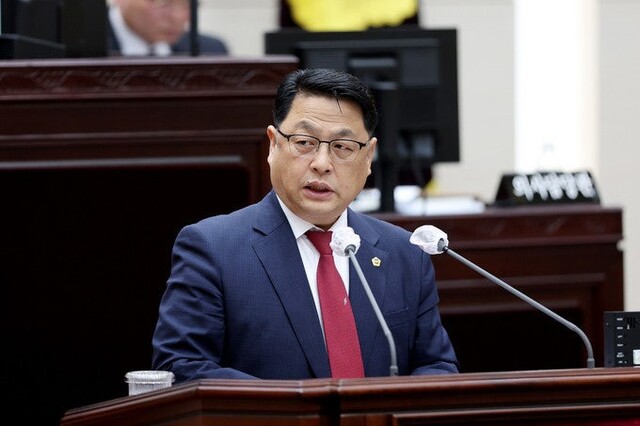
Kim argued for policy changes to guarantee citizens’ mobility rights, enhance public transit quality, and improve working conditions for transportation employees.
Using Incheon’s bus route 4 as an example, Kim highlighted the inconveniences faced by residents due to extended routes and long operating hours, as well as the deteriorating work environment for bus drivers.
“Despite high passenger numbers per vehicle, this route operates with medium-sized buses, creating a structural imbalance where supply fails to meet demand,” he stated.
Kim also criticized the criteria for changing bus types, noting that they focus excessively on operational profitability rather than actual ridership and public benefit.
“If these criteria remain anchored in outdated operational models, they will inevitably fail to adapt to evolving transportation needs and public expectations,” he pointed out.
The councilman stressed that the semi-public system must evolve beyond mere financial support to embody true accountability as a public transportation service.
He asserted that the city administration must take responsibility for ensuring adequate rest periods for transit workers and addressing safety concerns arising from extended operating hours.
Kim also noted that the additional cost of upgrading to larger buses is relatively small compared to the overall semi-public transit budget, arguing against delaying policy decisions due to misplaced financial concerns.
In a related matter, Kim proposed measures to increase local construction firms’ involvement in the Incheon Daero project, emphasizing the need to protect the local construction industry.
He suggested that the Incheon Regional Construction Association recommend companies based on a comprehensive assessment of subcontracting capabilities, financial stability, and eco-friendly equipment ownership.
“The semi-public bus system is a vital public service that directly impacts citizens’ daily lives,” Kim stated. “It must balance three key factors: minimizing public inconvenience, ensuring worker safety, and maintaining fiscal responsibility. Now is the time to redefine our criteria to align with current realities and make responsible policy decisions.”
Kim’s remarks underscore the pressing need for structural reforms and systemic improvements in Incheon’s public transportation network, given its significant impact on residents’ daily lives.
His assertions highlight the necessity for a policy shift to safeguard citizens’ mobility rights, enhance public transit quality, and improve working conditions for transportation employees. Kim urged the Incheon City Council and relevant agencies to thoroughly review and implement these changes.
Incheon – Lee Chun-man, Reporter (lcm9504@viva100.com)













Most Commented