
@@@
@@@
The Hyundai Motor branch of the National Metal Workers’ Union declared, “Not a single robot can enter the workplace without labor-management agreement.” However, some media outlets are portraying this stance as union “tantrums” or collective selfishness. Critics argue that while political circles and conservative media attack with the same narrative, the union’s actual demands have been erased from media coverage.
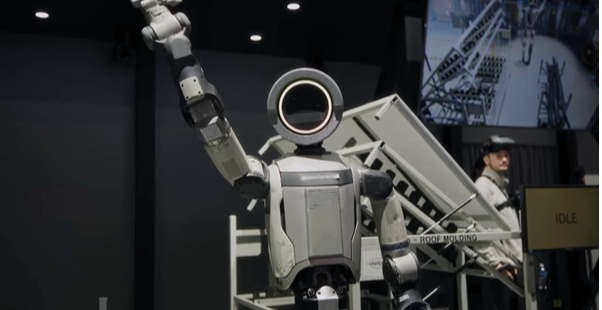
The controversy began with Hyundai’s unveiling of ‘Atlas’ at CES 2026. On January 6, Hyundai showcased its mass-production humanoid robot ‘Atlas’ at the CES exhibition in Las Vegas. Hyundai announced plans to deploy Atlas at the Hyundai Motor Group Meta Plant America in Georgia starting in 2028. They also aim to establish a system capable of producing 30,000 Atlas units annually by 2028.
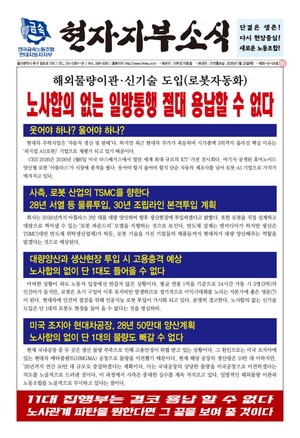
On January 22, the Hyundai Motor branch of the Metal Workers’ Union warned, “We absolutely cannot accept unilateral actions without labor-management agreements.” They stated, “The introduction of AI robots for cost-cutting at Hyundai is becoming apparent,” asserting that “not a single robot can enter the workplace without an agreement between labor and management.”
Conservative media have framed this position as a “total war against robots” or “rejection of robots.” The core context – that the union demands adherence to collective agreements, including labor-management agreements – is largely absent from these reports.
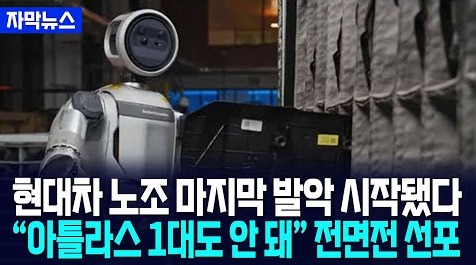
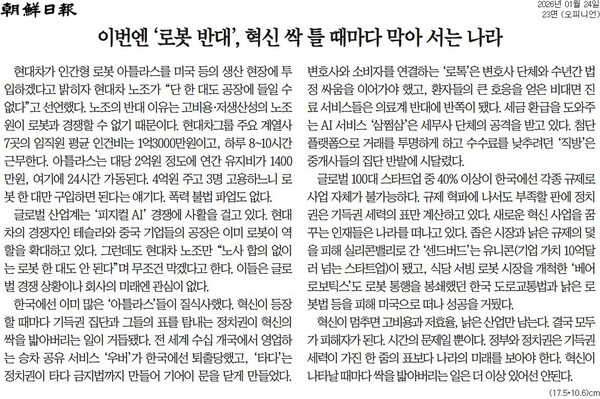
The Chosun Ilbo’s January 23 front-page headline, “Hyundai Union Declares Total War on Robots: ‘Not a Single Unit Can Enter the Factory,'” omitted the union’s key demand for labor-management agreements. The following day’s editorial, “This Time, ‘Opposition to Robots’: A Country That Blocks Innovation at Every Turn,” stoked anti-union sentiment by claiming, “There would be no violent illegal strikes if Atlas is introduced.” The Dong-A Ilbo published an editorial titled, “Hyundai Union: ‘Not Even One Robot Can Enter’… Are They Suggesting We All Go Down Together?” TV Chosun, part of the Chosun Ilbo group, used the caption “The Final Struggle of the Hyundai Union Has Begun” in a YouTube news thumbnail.
@@@
Hyundai Motor Group YouTube
@@@
▲TV Chosun reported on the Hyundai Motor branch of the Metal Workers’ Union’s stance on Atlas with headlines like “Final Struggle” and “Obstructing Robot Introduction.” Image: TV Chosun YouTube screenshot
@@@
Hyundai Motor Group YouTube
@@@
▲The Chosun Ilbo’s editorial on January 24
Demand for compliance with labor-management agreements on new technology introduction
These articles fail to mention that the collective agreement between Hyundai and the union stipulates that “the introduction of new machinery and technology, development of new models, work process improvements, and personnel changes due to management or technical reasons must be promptly communicated to the union, and an employment stability committee must be formed to deliberate and decide on these matters.” Since the late 1990s, Hyundai’s collective agreement has required ‘consultation’ for new technology introduction, which was strengthened to ‘agreement’ in the 2000s.
Labor relations expert Lee Moon-ho, director of the Work Innovation Research Institute, stated, “The effects of AI introduction in the workplace and its ability to replace humans remain uncertain. In such situations, human involvement is crucial. The demand that robots cannot be introduced without union agreement is entirely reasonable.” He added that framing the union’s stance as rejecting innovation is inappropriate.
@@@
Hyundai Motor Group YouTube
@@@
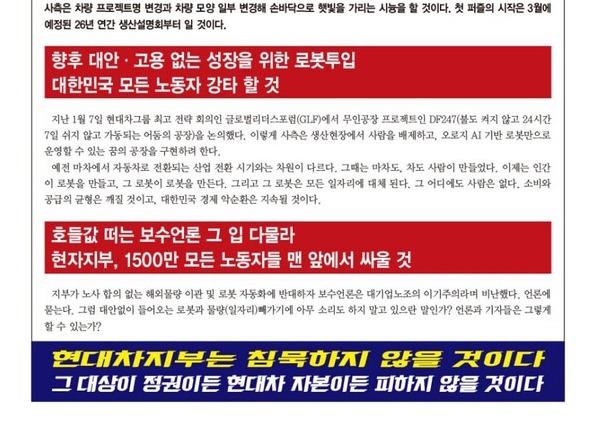
▲The Hyundai Motor branch of the Metal Workers’ Union issued a newsletter on January 22, stating, “We absolutely cannot accept unilateral actions without labor-management agreements” regarding Hyundai’s plans for Atlas production and introduction. Source: Metal Workers’ Union
Lee emphasized, “Introducing robots without worker agreement risks AI being used to monitor and control workers or as a pretext for layoffs. It’s socially beneficial to hear the union’s concerns and specific demands.” He questioned why conservative media insist on excluding dialogue when everyone emphasizes ‘social dialogue.’
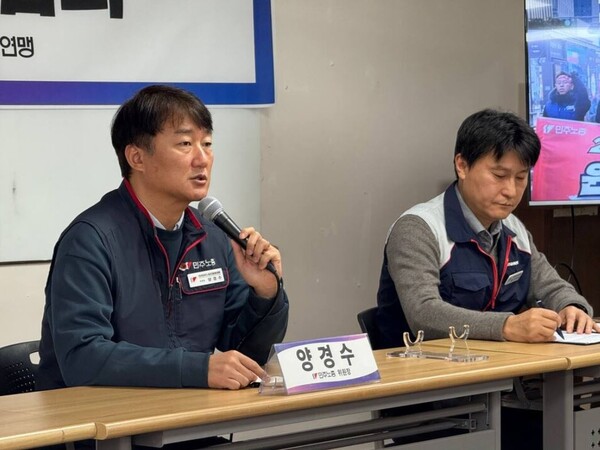
On January 5, Yang Kyung-soo, chairman of the Korean Confederation of Trade Unions (KCTU), proposed ‘labor impact assessments’ for AI-related policies to the government. At a press conference, Yang stated, “Introducing AI without labor-management agreements will rapidly destroy jobs and create extreme poverty,” asserting that “changes affecting unions and workers must proceed with mutual agreement.”
@@@
Hyundai Motor Group YouTube
@@@
▲KCTU Chairman Yang Kyung-soo speaks at a New Year’s press conference in Seoul on January 5. Photo: Labor and World
Conservative Media and Political Circles Spread ‘Dialogue Exclusion’ Frame
As political circles label the union’s demands as ‘resistance to change,’ media coverage has aligned with this narrative. On January 23, the People Power Party criticized the Hyundai union as “21st-century Luddites” and “robot isolationists.” They used this to argue for rolling back the revised labor union law (Yellow Envelope Law), which grants direct negotiation rights to subcontracted and non-regular workers. Former Democratic Party lawmaker Park Yong-jin, a potential Seoul mayoral candidate, also criticized the union on social media, stating, “You can’t achieve anything by just opposing.”
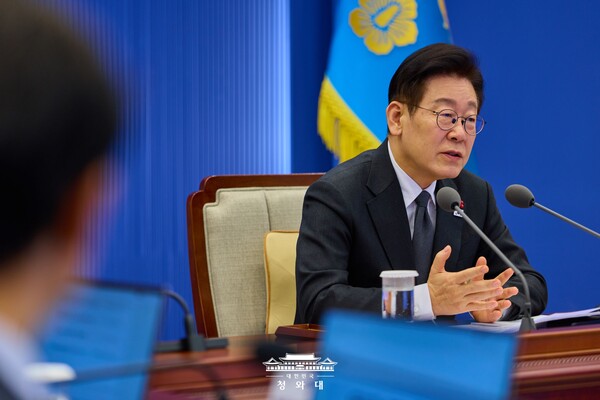
The narrative shifted after President Lee Jae-myung’s remarks at a senior staff meeting on January 29, where he said, “You can’t avoid the massive wheel that’s coming,” referencing the Luddites of the industrial revolution. Subsequently, media coverage linking the Hyundai union to Luddites surged. According to the Korea Press Foundation’s Big Kinds, over 100 reports mentioned the Hyundai union and Luddites between January 22 and February 10, with more than 60 articles published after Lee’s comments on January 29.
Lee Moon-ho commented, “If the Lee administration aims to hear from the field through work reports, the president’s remarks should reflect a thorough understanding of the union’s actual demands.” He noted that the current statements seem influenced by media narratives.
@@@
Hyundai Motor Group YouTube
@@@
▲President Lee Jae-myung speaks at a senior staff meeting at the Blue House on January 29. ⓒBlue House
Media Oversimplifies Complex Issues as ‘Collective Selfishness’
There are criticisms that media oversimplifies multifaceted issues as “collective selfishness.” Kim Han-joo, head of the Metal Workers’ Union’s media department, stated, “This issue involves various factors like capital’s overseas strategies, supply chain changes, and domestic production volumes, which significantly impact workers. The union can’t remain silent on these issues.” He also noted that media often fails to correct narratives even after acknowledging previous misreporting. Kim observed, “Journalists often ask, ‘Do you think you can stop the robots?’ When we provide original materials, they admit previous reports were distorted but rarely change their reporting angle.” He believes this is because framing unions negatively sells in Korean society.
The Hyundai Motor branch of the Metal Workers’ Union questioned journalists in a January 29 newsletter: “When we opposed overseas production transfers and robot automation without labor-management agreements, conservative media labeled us as selfish. We ask the media: Should we stay silent about robots and job losses without alternatives? Can journalists do that?” Photo: Metal Workers’ Union
@@@
Hyundai Motor Group YouTube
@@@
▲A Hyundai union representative noted a recent increase in interview requests, mainly asking, “How are union members reacting to the stock price drop?” He felt these questions implied blame, as Hyundai’s stock fell the day after the union’s newsletter was released.













Most Commented