
[Choice Times=Jin-an Kim, Former Executive Vice President, Samsung Electronics (Middle East Region)]
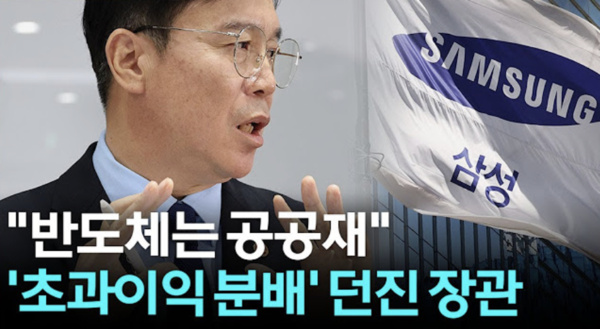
The market has grown increasingly uneasy over Labor Minister Kim Young-hoon’s recent actions and comments. His eleventh-hour intervention in wage talks between Samsung Electronics and its union—apparently timed to the local election calendar—produced what many view as a rushed, poorly considered settlement. It undermined corporate autonomy, deepened internal divisions, and sparked broader labor unrest across the industrial sector.
Now the minister has gone further, publicly asserting that semiconductors are a public good and that discussions should be held about redistributing excess profits.
Not long ago, similar comments from Presidential Chief of Staff Kim Yong-beom rattled markets. Hearing the same idea from the labor minister reinforces investors’ fears that this is not a slip of the tongue but a genuine policy orientation of the administration.
We should ask a straightforward, fundamental question: Is Samsung Electronics a state-owned enterprise? On what legal or moral basis can the government demand that a private company redistribute profits earned through years of investment, innovation, and fierce competition?
Public goods—policing, national defense, lighthouses, roads—provide benefits to everyone without direct payment. Semiconductors are categorically different. They are private goods produced by firms that deploy vast private capital, invest decades in research and development, and compete aggressively in global markets.
The idea that the state may appropriate private corporate profits merely because it offered some infrastructure support threatens constitutional protections for private property and corporate independence.
History offers numerous examples of politicians seeking to seize or heavily tax private-sector windfalls in the name of redistribution—and nearly all ended poorly.
Consider the United Kingdom’s 2022 Energy Profits Levy: London imposed a 25 percent windfall tax on North Sea oil and gas producers after Russia’s invasion of Ukraine, later raising it to 35 percent as the energy crisis persisted.
The British government argued that energy firms had reaped unexpected gains and thus warranted higher taxation. The result was harmful: firms cut or canceled domestic investments and shifted capital overseas. Britain’s energy self-sufficiency weakened, and ordinary consumers ultimately paid more through higher utility bills.
A similar approach applied to semiconductor profits would likely deter investment by Samsung Electronics and SK Hynix and incentivize relocation of production abroad. It would risk turning into a Korean version of the windfall tax curse, jeopardizing the entire semiconductor ecosystem.
Samsung Electronics is not merely a domestic firm; it is a global, publicly traded corporation, with foreign investors owning roughly half its shares. Corporate profits legally belong to shareholders.
If management were forced by the government to distribute profits without legitimate legal authority, executives could face breaches of fiduciary duty and shareholder value would be eroded.
Has the administration forgotten Australia’s experience in the 1970s, when attempts to treat mining profits as public resources and impose heavy controls drove away foreign capital and contributed to a prolonged economic slump?
If global investors begin filing lawsuits and withdrawing from Korea, stock prices would plunge and ordinary Koreans—especially small shareholders—would bear the financial damage.
These concerns also help explain growing skepticism about the government’s proposed 150 trillion KRW (approximately 112.5 billion USD) National Growth Fund.
Officially, the fund is positioned to nurture strategic industries such as semiconductors and artificial intelligence and to broaden investment opportunities. Yet many investors fear the fund’s true purpose is to expand direct government influence over private companies through large-scale capital deployment.
The fund earmarks 50 trillion KRW (approximately 37.5 billion USD) for direct and indirect equity investments. Under that structure, a government-backed strategic-industry fund could become a significant shareholder in private firms. Earlier this year, the fund began rolling out low-interest loans and investment programs aimed at financing foundries and new semiconductor industrial complexes.
That is precisely where market anxiety intensifies.
Once 150 trillion KRW (approximately 112.5 billion USD) in public capital—combined with government-controlled pension assets—starts buying stakes in major corporations like Samsung Electronics and SK Hynix, it risks becoming a vehicle for pension-fund socialism or government-directed corporate governance cloaked in legality.
The government could exploit its position as a major shareholder or creditor to influence board composition or pressure executives into pursuing politically driven goals such as redistributing excess profits or mandating contributions to social programs.
These risks are not hypothetical.
Korea has already seen politically motivated funds under prior administrations disappoint—from Lee Myung-bak’s overseas resource funds to Park Geun-hye’s Unification Jackpot Fund to Moon Jae-in’s New Deal Fund.
Those initiatives were promoted as political achievements rather than managed under market discipline. The outcomes were weak returns, distorted pricing signals, and unsustainable bubbles.
Attempting to control private firms through a 150 trillion KRW (approximately 112.5 billion USD) mega-fund risks repeating these mistakes and wasting the semiconductor industry’s narrow window of opportunity.
To a progressive administration, Samsung Electronics and SK Hynix may appear as golden geese to be tapped whenever political needs arise.
But Korea’s chipmakers wage brutal technological battles every quarter. They must invest tens of trillions of KRW (tens of billions of USD) annually in R&D and manufacturing capacity merely to remain competitive.
Ignoring that reality while demanding profit redistribution and expanding government control through massive public funds is tantamount to slaughtering the goose that lays the golden eggs.
Governments that try to outmaneuver markets usually fail. Korea’s real-estate policies under the Moon Jae-in administration offered a clear illustration of that lesson.
The government’s role is not to own private companies or appropriate their profits. Its responsibility is to remove unnecessary regulatory burdens, ensure fair competition, and allow firms to compete freely on the global stage.
It is time to end this perilous political gamble of shaking down corporations for votes.
jinannkim@gmail.com
#SamsungElectronics
#SemiconductorIndustry
#GovernmentIntervention
* This article has been translated by ChatGPT.














Most Commented