
Translation result.
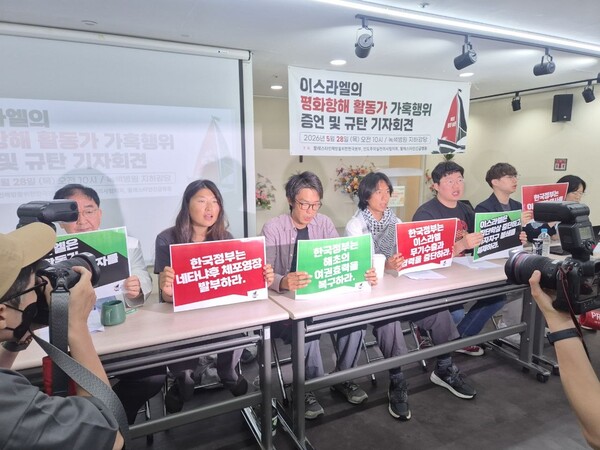
Korean activists who sailed on a Gaza aid flotilla and were illegally seized on the high seas by Israeli forces testified that they were beaten and tortured while detained. The activists, who returned to Korea on May 22, were diagnosed with injuries that include a perforated eardrum, fractured ribs, and rhabdomyolysis — a serious condition in which damaged muscle tissue breaks down and its components can be excreted in the urine.
On May 28, the Korea Headquarters for the Voyage to Liberate Palestine and the Korean Civil Society Emergency Action in Solidarity with Palestine convened a press conference in the basement auditorium of Green Hospital in Myeonmok‑dong, Seoul, to present testimony and condemn the alleged abuse. Organizers said the rhabdomyolysis diagnosis is potentially life‑threatening and that learning of it prompted the briefing.
The three activists had been sailing toward the Gaza Strip between May 18 and 22 when Israeli forces intercepted their relief vessel in international waters of the Mediterranean, detained them, and later deported them. According to Dr. Im Sang‑hyuk, director of Green Hospital, Kim Dong‑hyun was diagnosed with rhabdomyolysis after suffering beatings and repeated taser shocks. Dr. Im explained that rhabdomyolysis occurs when limb muscles break down and muscle cell components spill into the bloodstream — a condition typically seen in severe crush injuries or major traffic accidents.
Dr. Im added that Haecho (real name Kim Ah‑hyun) suffered a perforated eardrum after being struck in the face, and that Lee Seung‑joon showed circular burns where a taser contacted his skin and had fractured ribs. He warned that had they been released even a day later, their conditions could have deteriorated and emphasized the need for psychological counseling and stabilization measures after discharge.

Activists: Beatings, Tasers, Stress Positions and Repeated Flashbangs
All three activists described repeated beatings carried out with military gloves, combat boots, rifle butts and gun stocks. They said soldiers also used tasers and flashbangs, bound their hands behind their backs with cable ties, and forced them into stress positions with their heads and knees pressed to the floor.
Recalling the interception, Kim Dong‑hyun said they repeatedly told the soldiers they were unarmed and would not resist, but fully armed troops boarded the vessel and ambushed the passengers. According to Kim, soldiers used tasers and bound their hands behind their backs, then transferred everyone — hands secured with cable ties — to a prison ship. At the gangway, they were violently strip‑searched, had passports and personal items confiscated, and said 17 soldiers photographed the process with camera flashes.
On the converted prison ship, the abuse continued, the activists said. All three reported that their hands remained bound with cable ties while they were forced into positions with their knees and heads on the deck. They described symptoms consistent with concussion. Kim said he heard earlier detainees screaming in pain from torture; the sounds suggested repeated sexual assault, and requests for access to toilets or medical care were ignored.
“Soldiers Inserted Electrodes Directly into Necks,” Activists Say
Kim Ah‑hyun said that after a full‑body search by heavily armed soldiers, she was dragged alone into a dark container, the lights were switched on, and she was ordered to stare at the ceiling lights. Each time she looked away, she was struck in the face and forced to refocus. She added that almost all of the men appeared to be tasered and that many women appeared to have been sexually assaulted or raped. Upon returning to Korea, she was diagnosed with a perforation of her left eardrum.
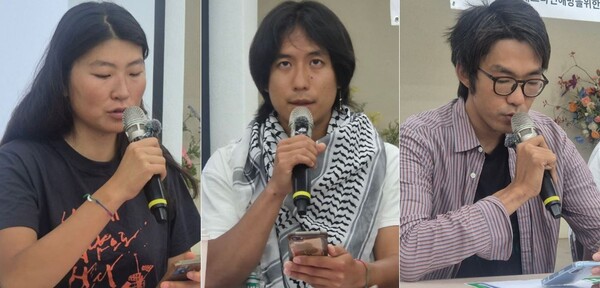
Lee Seung‑joon recounted that soldiers pulled his hair, forced him to watch a fellow crew member being beaten, then slammed his head back onto the floor. He said the crew member was beaten severely, tasered seven times, and that soldiers inserted electrodes directly into that man’s neck. “That image won’t leave my head,” Lee said.
“Israeli Journalists Observed but Did Not Intervene,” Activists Say
The activists described flashbangs used as a ritual of terror. Flashbangs produce intense light and a loud bang to disorient people. Lee said that when detainees asked for water or food, soldiers threw a flashbang into the center of the cramped space; after it detonated, an occupying officer lined detainees up behind a black line while armed soldiers stood in front of them with guns drawn. Non‑lethal rounds were fired and one comrade sustained very serious wounds, he said. Haecho added that they were taken outside the container roughly every half day, had guns pointed at them, and were subjected to additional flashbang detonations.
The activists also alleged that Israeli journalists present during the deportation watched these abuses without protesting. Kim said soldiers forced him into painful positions, erased the solidarity message on his T‑shirt and wrote “Israel” on it, and shouted insults while striking his head as they disembarked the prison ship. He said immigration officials and journalists wearing press badges witnessed these actions but did not intervene and ignored his requests to loosen the cable ties.
Lee Seung‑joon: “This Systemic Violence Reflects the Essence of Zionism”
Lee said he wanted to highlight the systematic character of the violence they endured. He asserted that all 184 detainees sustained systematic beatings. “This is not only the misconduct of individual soldiers or an abuse of power by Minister Itamar Ben‑Gvir or even Prime Minister Netanyahu,” Lee said. “It reflects a Zionist project that places the violent dehumanization of others at the core of state and national identity.”
The Israeli Embassy in Korea issued a statement on May 26 flatly denying the activists’ allegations. The embassy said the abuse claims have not been substantiated, alleging that some participants staged photos as injured while on stretchers and later appeared healthy in other images. The embassy called the reports an intentional attempt to damage friendly Korea‑Israel relations.
Kim Ah‑hyun said that after the first voyage Israel staged scenes suggesting ceasefire talks were advancing, but that Israel continues to violate ceasefire negotiations. “Israel has normalized lying and learned how to fabricate narratives to conceal mass killings,” she said. “That is why some in Korea doubt our injuries, but these are the physical facts we endured.”
Kim Dong‑hyun urged the Korean government to go beyond summoning the Israeli ambassador and to reassess economic ties that involve trading military resources with Israel. The activists chanted demands including “Expel the Israeli ambassador now” and “Israel, stop the genocide and lift the blockade of the Gaza Strip.”
On May 20, President Lee Jae‑myung called the seizure of Korean citizens for reasons that do not meet international legal standards “extreme and inhumane” at a Cabinet meeting. He referred to Israeli Prime Minister Benjamin Netanyahu — who faces an ICC arrest warrant — as a war criminal and instructed officials to consider enforcing the warrant. The Foreign Ministry summoned the Israeli chargé d’affaires on May 23 to raise the matter. Earlier, Israeli National Security Minister Itamar Ben‑Gvir posted videos mocking the detained flotilla activists and showing their mistreatment, drawing international criticism.
According to the Palestinian Prisoners’ Club and the Israeli human rights organization B’Tselem, about 11,000 Palestinians were detained by Israel as of 2025. Since October 2023, reported Palestinian fatalities attributed to Israeli actions have exceeded 72,000, with roughly one quarter of those killed identified as children.











Most Commented