
Translation result.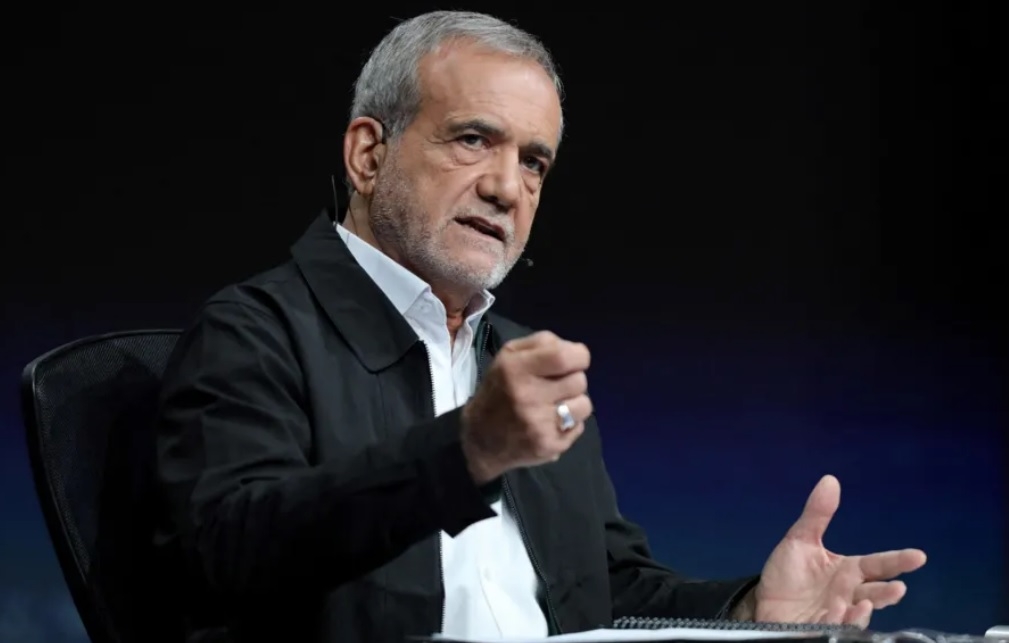 [Herald Economy=Reporter Seo Ji-yeon] Masoud Pezeshkian, Iran’s president, signaled a readiness to wage a prolonged struggle against the United States and Israel as talks with Washington over a ceasefire and nuclear issues continue, invoking a symbolic battle from the Iran–Iraq War. Even as momentum builds in negotiations over a ceasefire and a memorandum of understanding (MOU), Iran’s leadership has been broadcasting a hardline message abroad while emphasizing domestic unity.
On the 24th (local time), Pezeshkian posted on X (formerly Twitter), “Today, Khorramshahr stands for Iran, the Persian Gulf and the Strait of Hormuz.” He added, “Resistance, self-sacrifice and repelling invasion are rooted in this land’s culture.”
Khorramshahr is the city Iranian forces recaptured from Iraqi troops in 1982 during the Iran–Iraq War. That battle has become a potent symbol in Iran of national resistance and sacrifice, and it remains central to the Islamic Republic’s wartime narrative.
Because Khorramshahr was retaken at heavy cost, analysts interpret Pezeshkian’s remarks as a clear signal that Iran will not relinquish its claim to influence over the Strait of Hormuz and the Persian Gulf. The comment conveys the regime’s readiness to accept significant sacrifices to maintain control of the strait.
Pezeshkian’s remarks arrived at a sensitive moment as U.S.–Iran talks on a ceasefire and nuclear matters proceed.
U.S. President Donald Trump recently sought to pressure negotiations, saying much “depends on the talks” and warning he would “either sign a great and meaningful agreement or withdraw entirely.”
According to reports, both sides have continued discussions about a possible MOU covering an extended ceasefire, reopening the Strait of Hormuz, handling enriched uranium, and sanctions relief.
Domestically, Iranian officials have repeatedly cautioned against lowering their guard even as diplomacy advances.
On the 25th, Mohammad Baqer Zolghadr, secretary-general of Iran’s Supreme National Security Council, issued a statement declaring, “There will be no retreat.” He said that “on the battlefield and on the diplomatic stage — and through the heroic resistance of people filling the streets — we have neutralized the enemy.” He urged greater national unity and cohesion, calling on Iranians to “disappoint the United States and the Zionists (Israel).”
Observers view these statements as efforts to preserve regime cohesion by signaling continued resistance at home, even if talks with the U.S. make progress.
Experts say Pezeshkian’s reference went beyond historical recall to underscore regime-level resolve. Omar Mohamed, director of the Extremism Program at George Washington University, said, “This clearly evokes the Iran–Iraq War, and the timing itself is important.”
Mohamed added, “Khorramshahr is not just a city; it symbolizes civilian sacrifice, long-term resistance and the fight against invasion. Iran’s leadership is signaling that it will not yield easily to the United States and Israel.”
Recently, Tehran has framed control of the Strait of Hormuz and preservation of its nuclear program as matters tied directly to regime survival, sustaining a hardline posture. Analysts say that stance explains Tehran’s repeated assertion that “surrender is not an option” amid U.S. and Israeli military pressure.














Most Commented