
Translation result
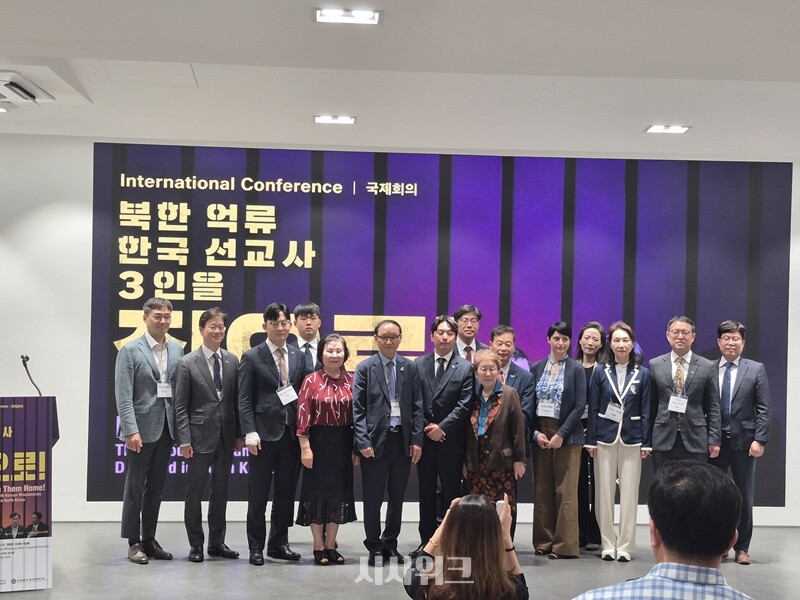
SisaWeek — Reporter Kwon Sin-gu Three South Koreans have been held in North Korea for more than a decade: missionaries Kim Jeong-wook, Kim Guk-gi and Choi Chun-gil, detained after helping North Korean residents and defectors. While successive South Korean administrations have made efforts, shifting inter-Korean relations have repeatedly stalled progress. Public attention has faded, leaving their families increasingly desperate. On May 21, domestic and international experts convened to identify solutions and called for a stronger governmental response and sustained public engagement.
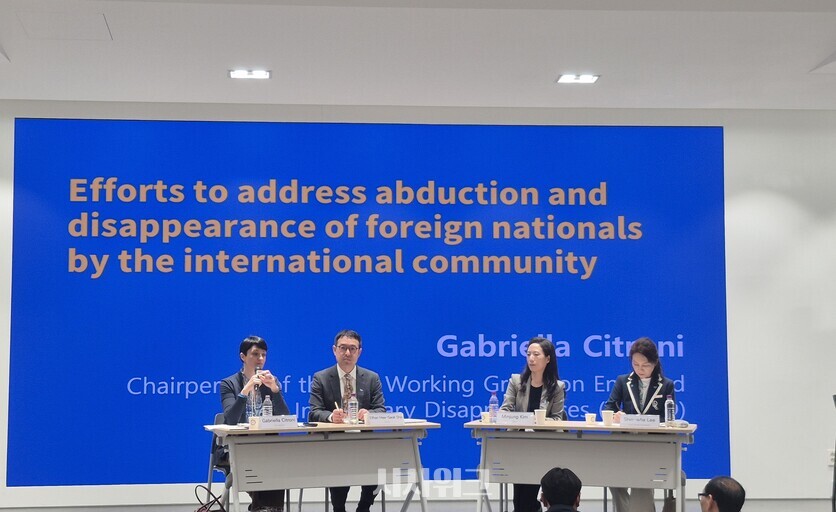
At the Yonsei conference, \”Bring Home the Three Korean Missionaries Detained in North Korea,\” hosted by ROKHFA, TJWG and IEWS, experts urged a whole-of-society approach to resolving the case. Gabriella Citroni, chair of the U.N. Working Group on Enforced or Involuntary Disappearances (WGEID), said, \”Failing to disclose that someone has been detained and withholding their location constitutes an ‘enforced disappearance.’ We must sustain efforts to secure their return, because cases can easily be forgotten amid the many issues on the international agenda.\”
Experts stressed that these efforts require both an active South Korean role and international solidarity. Raising the issue in multilateral forums like the U.N. can be especially effective, they said, in part because North Korea seeks some degree of international legitimacy. Shin Hee-seok, senior legal analyst at TJWG, noted that human rights concerns discussed at the U.N. are reported upward to Kim Jong-un, and he emphasized that \”raising the issue through the U.N. is important.\”
◇ People find hope when they are remembered… Families plead for attention
Some participants proposed leveraging U.S. executive orders to build a repatriation strategy. Kim Min-jung, director of the Advanced Technology Center at the Institute for National Security Strategy, pointed to an executive order from a potential second Trump administration titled \”Enhancing Efforts to Protect U.S. Nationals Unjustly Detained Abroad.\” That order permits U.S. authorities to consider patterns of unjust or unlawful detention of third-country nationals when U.S. interests are at stake, and Kim suggested that provision could be used to press the U.S. to act.
Panelists agreed that sustained diplomatic pressure must be accompanied by domestic institutional reforms. Both the executive branch and the legislature should treat citizen detentions abroad as a priority and demonstrate a clear, resolute commitment to securing returns. Kim explained that in the U.S., the State Department’s Office of the Special Presidential Envoy for Hostage Affairs, the White House Hostage Response Group, and the FBI’s Hostage Recovery Fusion Cell coordinate negotiations, provide family support, and manage interagency cooperation. Meanwhile, Congress exerts additional pressure through hearings, letters and resolutions. This coordinated framework helps explain why the U.S. has a track record of securing the return of detained nationals.
Experts warned the issue should not be reduced to a matter for government officials alone. Viewing it merely as the case of three missionaries risks obscuring a broader problem: cross-border abductions. Framing the matter as a national concern clarifies why the state—not only victims and their families—must respond proactively.
Kim Jeong-sam, co-chair of the North Korean Detainees’ Families Association and brother of missionary Kim Jeong-wook, said, \”People find hope when others remember them. We earnestly ask the international community and everyone here to join forces so these men can return to their families.\” Choi Jin-young, co-chair and son of missionary Choi Chun-gil, added, \”A state’s most basic duty is to protect the lives and safety of its citizens. We need more than expressions of concern—take concrete, practical diplomatic steps to bring these men home safely.\”












Most Commented