
Unlocking History: The Untold Stories of Kim Dae-jung and Lee Hee-ho’s Prison Memoirs
Daniel Kim Views
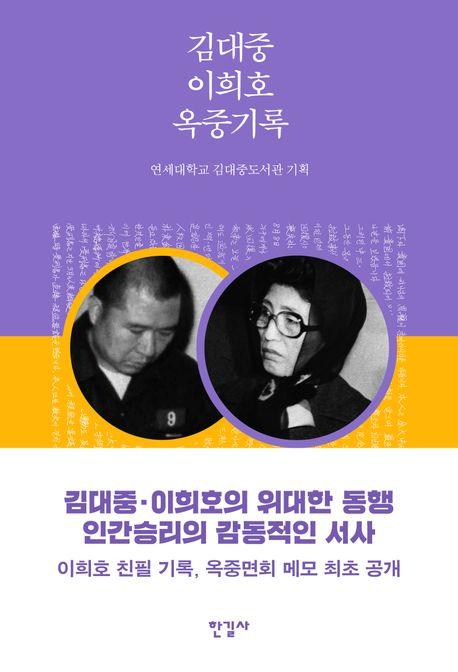
Kim Dae-jung and Lee Hee-ho: Prison Records=Compiled by the Kim Dae-jung Library at Yonsei University; Han-Kil Publishing.
A third book revisiting former President Kim Dae-jung’s political life has been released. Following Kim’s recorded memoir and his exile diary, this new volume collects prison records related to Kim and his political partner, Lee Hee-ho. The book centers on the period from 1976 to 1982, when Kim was detained over the March 1st Declaration for Democratic National Salvation and the fabricated 1980 conspiracy charges. It recreates the urgent atmosphere of the time through Lee’s notes and letters, records of international rescue efforts, and trial documents.
Lee, Kim’s longtime political companion, wrote to the international community to advocate for his human rights and release. Twenty items included in the book — prison-visit notes she personally prepared and letters she sent to domestic and foreign figures — are published here for the first time.
While Kim was incarcerated, Lee acted as his “window” to the outside world. During his imprisonment, when authorities permitted only a single ten-minute visit per month, she compressed international news and geopolitical developments into briefings that she passed along. She summarized inflation trends, global oil prices, loan issues, diplomatic developments, and a broad spectrum of political and economic information. Those updates helped Kim maintain a sense of the times and a practical grasp of current affairs even while behind bars.
She also worked tirelessly to raise international awareness of Kim’s situation, repeatedly appealing to figures such as U.S. Sen. Edward M. Kennedy, Japanese Prime Minister Takeo Miki, and various international human rights organizations.
At a press briefing on the 14th, Park Myung-rim, director of the Kim Dae-jung Library, said, “Whenever we reviewed records from Kim’s prison years, Lee Hee-ho’s name came up. We couldn’t help but title the book ‘Kim Dae-jung · Lee Hee-ho: Prison Records.’” He added that her regular communications with the U.S. embassy, together with her sharp, high-level information-gathering, judgment, focus, and analytical skills, were astonishing. Park credited Lee’s fluency in English, deep knowledge of foreign affairs, and Christian networks with enabling her work.
Kim Ki-man, head of external relations at the Kim Dae-jung Political School, recalled, “When Lee visited Kim at Gwangju Prison in 1980, she told him, ‘If you kneel to Chun Doo-hwan, I will divorce you.’ Kim later said that those words became his guiding view on life and death.”
1981 economic situation: 1) GNP grew 7.1%; per capita national income $1,636 (in 1979 dollars). 2) Inflation: wholesale 11.8%, retail 12.6%. 3) Money supply growth: 25.2%. 4) Exports $21.0 billion, imports $26.3 billion, trade deficit $5.3 billion. 5) Reported total external debt to date: $33.0 billion. Crude oil import costs $7.0 billion (11%), external debt principal and interest payments $3.5 billion (6.3%), grain imports $2.1 billion (3.3%). Prepared by Lee Hee-ho for a prison visit on Jan. 20, 1982 (p. 293)

Accumulation and Release=Shin Su-jung, Woongjin Knowledge House.
The author, a former vice president at KT, argues that the decisive factor in work and life is the cycle of “accumulation and release.” His central point is that one should not remain solely in the quiet work of building skills and knowledge; those capabilities must also be made visible so others can discover them. He urges readers to abandon the passive expectation that opportunity will simply appear and to adopt strategies that actively generate opportunities.
He particularly advises readers to “start light.” By taking modest risks and opening yourself to the world, you expose your weaknesses and create the chance to address them. Small actions followed by iterative adjustments produce a repeating cycle of accumulation and release. That cycle elevates your potential in both work and life. Drawing on a range of books and case studies, the author lays out the mindset and strategies needed to navigate a changing era.
Set an intention and make a plan. Don’t punish yourself when plans go off course. Maintain curiosity and optimism; cultivate grit and flexibility; take modest risks and open yourself to the world. Keep learning, experiment with different possibilities, meet people, and give first—those habits increase the likelihood that unexpected opportunities and contacts will appear. When an opportunity arrives, revise your plan. In an era of rapid change, a compass that points the direction matters more than a highly detailed map. (p. 30)















Most Commented