
Translation result.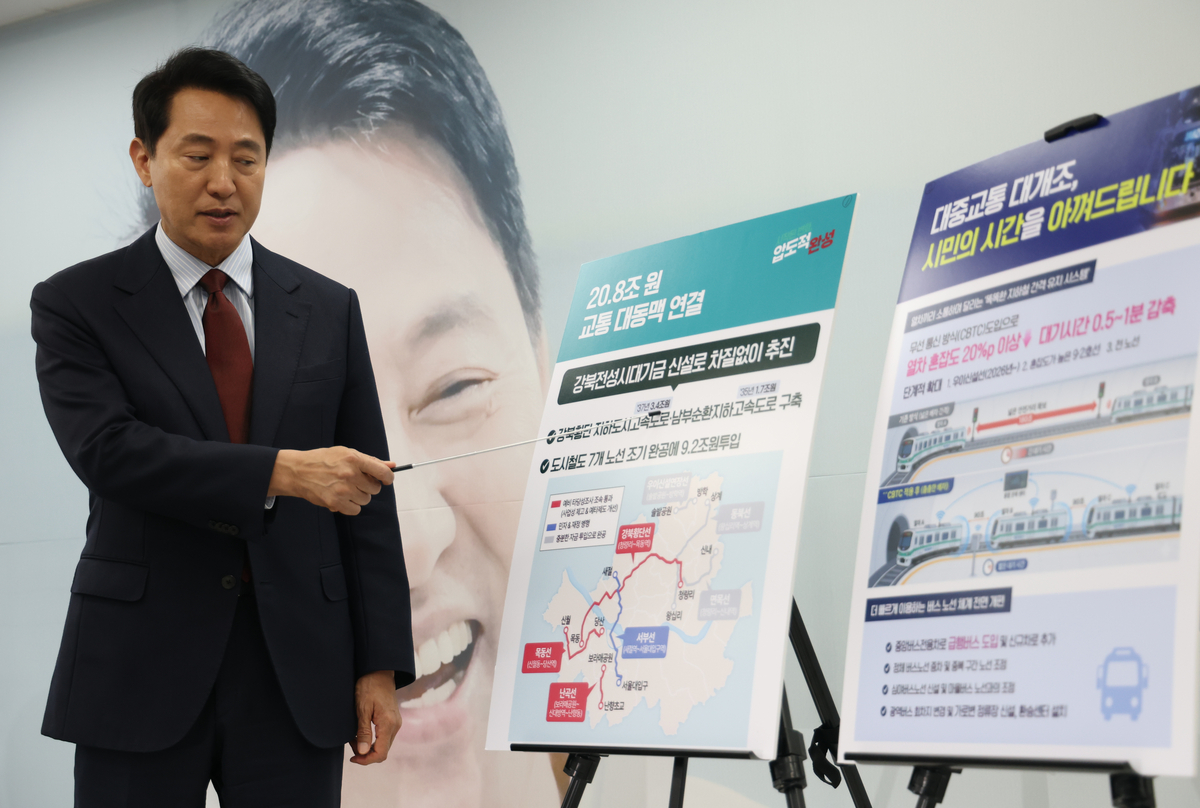 The People Power Party’s Seoul mayoral candidate, Oh Se-hoon, unveiled his \”Seoul Transportation Transformation\” plan on May 10, promising a major expansion of transit infrastructure to shorten commute times and reduce transportation costs.
At a press conference at his campaign office in Gwancheol-dong, Jongno District, Oh said, \”Building on the changes we achieved during the eighth popularly elected municipal administration, we will add major upgrades to complete Seoul as the world’s leading transit city,\” and outlined the plan’s details.
He said he will invest 20.8 trillion KRW (about $15.6 billion) in a \”connecting transport arterials\” project to sequentially expand transit infrastructure across the northeast, northwest and southwest by 2037. The plan covers constructing an underground city highway that crosses northern Seoul and the Southern Ring, and fast-tracking the completion of seven urban rail lines: the Gangbuk Crossing Line, Myeonmok Line, Western Line, Mokdong Line, Nangok Line, Ui-Sinseol Extension Line and Dongbuk Line.
On funding, he said, \”If large development projects occur in Gangnam, we can allocate roughly 50% of the public contribution to a ‘Gangbuk Prosperity Fund’ for northern Seoul,\” and added that the plan is feasible within the Seoul city budget.
To address severe crowding on the Ui-Sinseol Line and subway lines 9 and 2 — long stigmatized as \”hell trains\” — he pledged to install communications-based train control (CBTC) to reduce headways to 90 seconds and to introduce express buses on central bus-only lanes.
He also proposed upgrading the current Climate Companion Card into a \”Seoul Climate Companion Pass\” and introducing a monthly flat-rate pass for the GTX-A line priced at 62,000 KRW (about $46.50).
Oh criticized Democratic Party candidate Jeong Won-o’s proposal to build a new East Line from Ui-dong in Gangbuk to Jamsil-dong in Songpa as unlikely to be feasible. He said Jeong turned a route still under internal review into a campaign pledge and that the benefit-cost (B/C) analysis does not look favorable. \”Announcing a pledge with low feasibility can disappoint local residents,\” Oh said. \”I will focus on routes that increase the likelihood of project success.\”
On the controversy over reports that Jeong used aides to present his pledges, Oh said, \”I at least try to make announcements myself. That is my duty to citizens.\” He added that it is inappropriate for a candidate to rely on aides to present proposals.












Most Commented