
Official Announcement of Re-election Bid
A Necessary Moment for a Self-Sustaining City
Lee Dong-hwan, the People Power Party’s preliminary candidate for Goyang mayor, held a press conference at the Goyang City Council on the morning of the 7th and officially announced his bid for a second term.
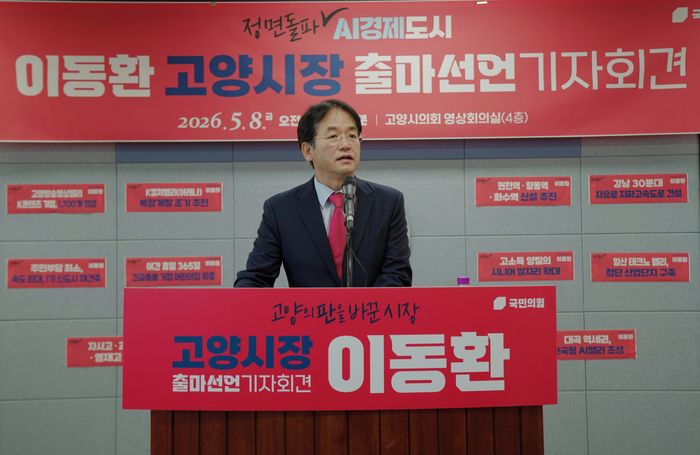
In his campaign statement, Lee said, “I return to this post with solemn resolve,” and pledged to “complete Goyang’s future based on the achievements of the past four years.”
He noted that one of his first actions at the start of his term was prioritizing the push for an economic free zone, treating it as his first official approval. He described the past four years as “a period of struggle — fighting entrenched practices and refusing unreasonable demands for the sake of citizens’ futures.”
Lee cited key accomplishments including the selection of the region’s first candidate site for a 2.93 million-pyeong economic free zone (about 2,400 acres / 3.7 sq mi), the creation of a 370,000-pyeong venture business promotion zone (roughly 300 acres / 0.47 sq mi), securing investment demand worth about 6.5 trillion KRW (≈ $4.88 billion), and drawing roughly 200 investment interests from domestic and international companies and institutions.
He also emphasized gains in culture and branding. He said he transformed the Goyang Sports Complex into a “K-pop pilgrimage site” that attracts global artists such as BTS and established an annual revenue model exceeding 10 billion KRW (≈ $7.5 million).
Warning that “if we stop now, Goyang will slip back into stagnation,” Lee unveiled five core visions to complete the city’s transformation into South Korea’s leading economic and cultural hub.
First: complete a real economic city that creates more than 300,000 jobs. He pledged to finalize the economic free zone designation quickly and activate a “site-development fast track.” He plans to develop the Daegok station area into a “Korean-style AI Valley” and to build the Ilsan Techno Valley into a high-tech hub tied to a goal of fostering 1,000 venture firms.
Next, he promised to deliver a transportation revolution that makes commutes 30 minutes. He said he will secure inclusion of key lines such as the Shinbundang Line and the Goyang-Eunpyeong Line in the 5th National Railway Network Plan, and construct an underground expressway beneath Jayu-ro to enable a 30-minute connection to Gangnam. He also proposed a ring road linking major local points to address congestion at its root.
He then advanced restoring Goyang’s reputation as a premier residential area. He pledged resident-tailored reconstruction that minimizes costs while accelerating timelines, and to return surface space to citizens as forests and parks by moving rail lines underground. He also proposed an AI-based, 24/7 smart safety system to secure critical disaster response time.
He discussed elevating Goyang to a global landmark. Lee plans to build a state-of-the-art domed stadium in Deokyang District with a 50,000-seat capacity to anchor sports and K-pop events, and to position the city as a world-class business center through completion of KINTEX Exhibition Hall 3. He said tourism assets stretching from Bukhansan to the Han River will be developed into revenue-generating resources.
Finally, he included education and care policies that make both children and parents happy. Lee said he will operate a year-round, comprehensive care system and build a top-tier local education environment by attracting science high schools, autonomous private high schools, and gifted programs.
He emphasized expanding partnerships with prestigious overseas universities to create an educational special zone where students can access world-class learning without going abroad.
Lee addressed criticism directly. Regarding the so-called “mayor’s office absence” controversy, he said, “A mayor who only sits at a desk cannot attract global corporate investment.” He defended his overseas visits over the past four years as vigorous outreach to secure future revenue for Goyang, pointing to interest from about 200 companies as evidence.
On the new city hall issue, Lee argued that “rather than spending 400 billion KRW of citizens’ taxes on a new building, it is practical and reasonable to use the donated Baekseok-dong office building.” He said the budget saved would be redirected to welfare, livelihoods, and economic revitalization (≈ $300 million).
© (Dailyan Co.) Unauthorized reproduction and redistribution prohibited
- Ahn Cheol-soo: Why can’t President Lee simply say, “I will face trial after my term”?
- “You can’t make electric cars without China”… Korea’s auto industry crisis exposed in Beijing
- [Exclusive] U.S. base houses Hanwha munitions plant and rare-earths… a de‑Chinaing hub emerges
- Campaigns push back, but the Democratic Party confirms the “neighborly brother” campaign song despite the Jung Cheong-rae controversy
- [6·3 Picks] Jeong Won-oh: “Left Yongsan neglected during four terms” … Oh Se-hoon: “Forced ‘chicken-coop apartments’”










Most Commented