
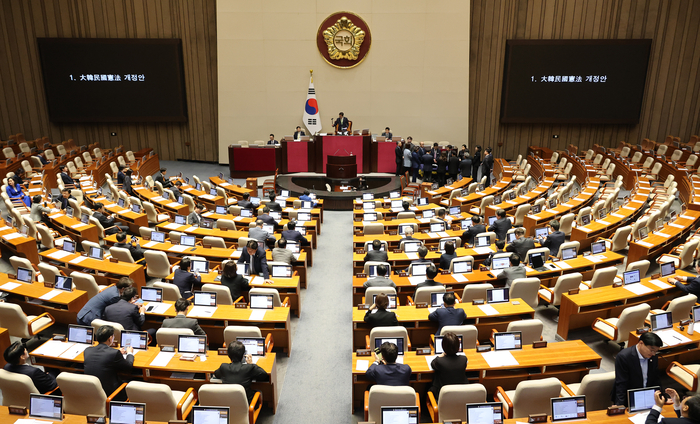
[Sports Seoul | Sangbae Lee, Senior Reporter] On the afternoon of May 7, the National Assembly took up 117 items during the first plenary session of the 435th extraordinary session. Lawmakers approved a slate of bills focused on fostering the AI industry, promoting balanced regional development, securing public safety, expanding labor protections, and strengthening teachers’ authority.
The Special Act on Promoting the AI Data Center Industry was approved, establishing a legal framework for government support of AI data center construction and related special measures. The law directs the state to support rapid construction and the creation of stable operating conditions and to back technology development and industry growth. It also authorizes administrative and financial support for installing power, water, and communications infrastructure, building roads, purchasing equipment, and training specialized personnel.
Notably, the bill allows authorities to consolidate complex approval procedures—such as power‑system impact assessments and building committee reviews—into a single, unified process, and it introduces a provision that treats permits as automatically approved if they are not processed within a specified period. The law also allows renewable energy to be supplied directly to data centers without routing it through the power market.
The Special Act on Support for Designated Large Cities also passed the plenary session. The law provides administrative and financial support for cities with populations over one million, enabling them to pursue development strategies tailored to local conditions. The current designated cities are Suwon, Yongin, Goyang, Hwaseong, and Changwon.
The government is required to prepare a basic support plan for these cities every five years, and the bill grants mayors of these cities authority over 26 administrative functions, including building permits, tourism site designation, and management of shared waters. The changes are expected to expand local autonomy and improve administrative efficiency.
The Basic Life and Safety Act was also enacted. The law codifies citizens’ right to live safely in daily life and at work and delineates the state’s and local governments’ responsibilities for ensuring safety. It requires the government to develop a comprehensive life‑safety plan every five years and establishes a National Life Safety Committee under the presidency and a National Safety Accident Investigation Committee under the Prime Minister.
In labor policy, an amendment to the Labor Standards Act was approved, allowing workers to split paid annual leave into hourly increments. Employers must honor employees’ requests to use leave by the hour, and violations may result in fines of up to 5,000,000 KRW (approximately $3,750). The amendment also permits employees who work four hours a day to end their shift without taking a break if they choose.
To respond to high fuel prices, amendments to the Passenger Transport Business Act and the Freight Transport Business Act were adopted. Under the revisions, when a Resource Security Crisis Alert is issued, the government may subsidize part or all of a carrier’s fuel purchase costs. The law also establishes a basis for providing financial support to intercity and express bus routes designated as long‑distance essential routes due to their public service function.
An amendment to the Nationality Act adjusted simplified naturalization requirements for spouses of recognized independence contributors’ direct lineal relatives. The revision relaxes the domestic residence requirement, allowing eligibility for naturalization after 10 years of marriage and three months of residence in Korea, and it expands circumstances under which dual citizenship is permitted.
Measures to prevent school violence and protect teachers’ authority were also approved. The revision to the School Violence Prevention Act designates the fourth Monday in May each year as School Violence Prevention Day, establishes an annual prevention week with education and public awareness activities, and requires solicitation of special‑education experts’ input when reviewing school‑violence cases involving students with disabilities.
The amendment to the Special Act on Improving Teachers’ Status and Protecting Educational Activities extends legal protection to remote instruction and defines repeated or substantially disruptive complaints that interfere with education as infringements on educational activities. It also provides budgetary authority to support the establishment and operation of Education Activity Protection Centers at the national and local levels.
In sports, an amendment to the National Sports Promotion Act officially renamed the “Disabled Olympics” to the internationally recognized Paralympic Games. The bill additionally includes measures to build support systems for collegiate athletics and to enhance sports marketing.
In military affairs, lawmakers passed an amendment to the Basic Act on the Status and Service of Soldiers. The law requires service members to carry out their duties in compliance with the Constitution and relevant statutes and mandates that the defense minister provide education on the Constitution and military laws. It also creates a legal basis for professional counseling support for service members dealing with mental health issues such as post‑traumatic stress disorder (PTSD).
Meanwhile, a proposed revision to the Constitution failed to proceed because it did not meet the required two‑thirds quorum of the full membership—191 votes. Only 178 members were present, so the vote could not take place. sangbae0302@sportsseoul.com













Most Commented