
Trump’s Controversial Claims: Is South Korea Failing to Support the U.S. in the Iran Conflict?
Daniel Kim Views
Translation result
President Donald Trump again criticized allies — including NATO, Japan and Australia — saying South Korea did not assist the United States in a potential war with Iran. Seoul responded that Trump did not single out Korea and said the remarks are not expected to affect security matters such as nuclear-powered submarines or uranium enrichment and reprocessing.
On April 7, Foreign Ministry spokesperson Park Il said at a regular briefing that the government is monitoring Trump’s repeated comments and will carefully review them through close Korea–U.S. communication before reaching a conclusion.
On April 6 (local time), at a press conference Trump said NATO would not help in a war with Iran and added, “It’s not only NATO. Do you know who else didn’t help us? South Korea, Japan, Australia.” He claimed, “We station 50,000 U.S. troops in Japan and 45,000 in South Korea to protect them.”
He said these countries “take risks right next to Kim Jong Un, who has nuclear weapons,” and added that the United States nonetheless “received no help from these countries.”
This was not the first time Trump made such remarks. On April 1 (local time), during an Easter luncheon at the White House he said allies refused his request to send ships to transit the Strait of Hormuz and complained, “South Korea helps us not at all. We station 45,000 troops right next to nuclear-armed North Korea.” Although U.S. forces in South Korea number about 28,000, Trump has repeatedly inflated that figure.
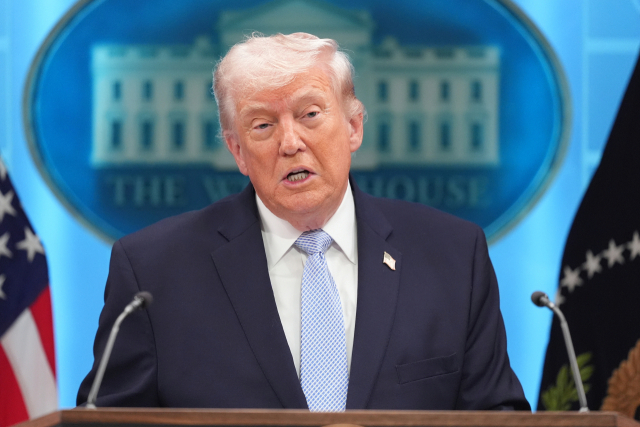
Although Trump has continued to voice complaints about South Korea, the government says he did not single out Korea and believes the remarks will not immediately have a major impact on Korea–U.S. relations.
Officials say Trump had expected support from allies, including South Korea, during a conflict with Iran, and his comments largely reflect disappointment that those expectations went unmet. They add the issue does not directly threaten the Korea–U.S. alliance, and that the U.S. has conveyed the same assessment to Seoul.
In that vein, the government expects Trump’s remarks will not affect security issues such as nuclear-powered submarines. Officials judge the comments are best understood in the context of the Middle East situation.
However, some analysts note that Trump’s earlier suggestion this year about acquiring Greenland strained relations with NATO partners in Europe, and that ties have further deteriorated amid the Iran conflict. Given those strains, they say the Korea–U.S. relationship could also be affected.
Because the United States places a high priority on nuclear nonproliferation and has no clear rationale to grant South Korea exceptional approvals on issues like nuclear-powered submarines, enrichment and reprocessing, some observers warn Washington could act uncooperatively later even if it does not publicly refuse now.
There is also concern that Trump’s well-known unpredictability and tendency to reverse course — traits that some say have become more pronounced during the post‑Iran-attack war — could allow him to backtrack on commitments related to nuclear-powered submarines made at the Korea–U.S. summit with President Lee Jae-myung last October.










Most Commented