
Translation result
First vision debate held in Daegu mayoral primary
Candidates urge voters to back them as best qualified to resolve local issues
Contenders clash over feasibility of policy proposals
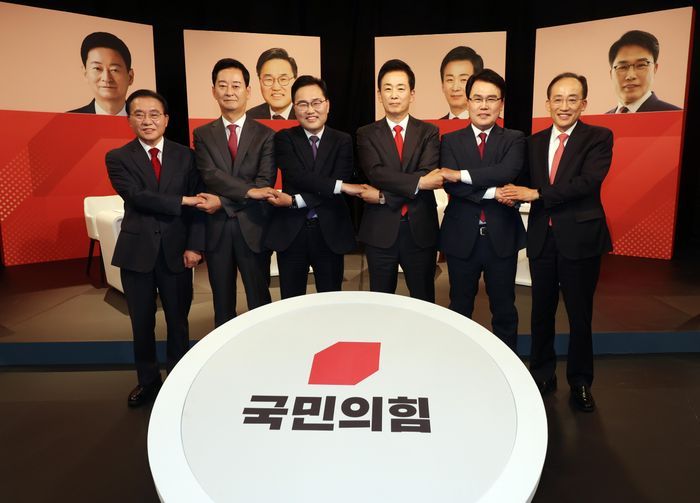
Six People Power Party candidates competing for Daegu mayor in the June 3 local elections each presented policy proposals and strategies to revive the city’s struggling economy and appealed to voters for support. The debate featured sharp exchanges over the feasibility of several proposals.
At the first Daegu mayoral primary vision debate on the 30th, People Power Party hopefuls Yoo Young-ha, Yoon Jae-ok, Lee Jae-man, Choo Kyung-ho, Choi Eun-seok and Hong Seok-jun (in alphabetical order) outlined their plans to address Daegu’s economic slump.
Joo Ho-young, the National Assembly vice speaker, and former Korea Communications Commission chair Lee Jin-sook—both excluded from the primary—asked the party’s nomination committee to reverse its decision but ultimately were not granted a chance to participate in the debate.
The candidates on stage assessed Daegu’s current challenges and each emphasized that they are best suited to resolve the city’s problems, asking voters for their support.
Yoon Jae-ok said economic recovery is essential to overcoming Daegu’s crisis, but warned the mayor will face the significant obstacle of the Lee Jae-myung administration throughout the term. Drawing on his record as the party’s floor leader, he argued that his crisis-management and problem-solving capabilities are what the city needs. He pledged to rapidly advance flagship projects to drive three major transitions: shifting from traditional industries to advanced high-tech sectors, repurposing urban spaces, and reversing youth outmigration.
Choi Eun-seok pointed to his tenure as CEO of CJ CheilJedang, where he led the growth of Olive Young and Bibigo into major brands. He said he would transplant that corporate management DNA into city government to deliver change. Questioning whether a mayor’s reputation alone has ever revived Daegu’s economy, Choi vowed to apply his experience as a global corporate executive to transform city administration. He unveiled the \”803 Daegu Master Plan,\” which targets eight strategic industries as future growth engines.
Hong Seok-jun said that to revive Daegu you must deeply understand the city; long resumes or multiple terms in the National Assembly do not guarantee results. He noted he spent 24 years in Daegu’s municipal government—from neighborhood chief to director of economic affairs—before serving in the National Assembly. Hong pledged to attract major corporations, nurture five emerging industries, and build a youth-focused city by providing free housing for young employees who work for Daegu companies so they do not have to worry about buying a home.
Yoo Young-ha said his record of standing with people in difficult times, rather than only when power was at its height, motivates him to defend conservative strongholds and revive Daegu’s economy. He argued that a forward-looking vision and strong execution are necessary to create industries for the next generation. Yoo proposed attracting two Samsung semiconductor fabs to reshape Daegu’s industrial base and bringing a Samsung Hospital branch to the city to provide high-level medical care.
Lee Jae-man recalled his tenure as Dong-gu mayor, where he oversaw development projects including the Shinsegae department store and Dongdaegu Station. He said that although Daegu has produced finance ministers, floor leaders and presidential contenders, residents’ lives have not improved. \”I will push Daegu out of the shadows and toward the future,\” he said, promising to nurture unicorns across seven new industries to build a \”second Samsung\” in the city and to attract the Sphere, the large-scale entertainment venue from Las Vegas.
Choo Kyung-ho said Daegu, once counted among Korea’s top three cities, has slipped into stagnation. What the city needs now is economic leadership that understands the economy and can solve its problems. Citing his experience as deputy prime minister for the economy and as floor leader, he said he brings economic and administrative expertise as well as political influence. Choo pledged to restructure industry around five future-growth sectors, make Daegu a leading high-tech city, attract domestic and foreign investment, and press for relocating the Industrial Bank of Korea’s headquarters to Daegu. With that expertise, he said, he will restart the city’s economic heartbeat.
During the follow-up moderated debate, candidates clashed over questions about Choo’s legal risks and rumors of preselection involving Choi. There were also sharp criticisms of candidates who do not own homes in Daegu while owning property in Seoul.
The feasibility of pledges such as attracting a Samsung Hospital branch and the Sphere was also scrutinized. Some candidates asked whether former Prime Minister Kim Boo-kyum’s recent entry into the Daegu mayoral race as a Democratic Party candidate would strengthen their opponents.
Meanwhile, the People Power Party plans to hold a second Daegu mayoral primary vision debate on April 13 to select two finalists for the main primary. A final primary debate will be held on April 19, and the party intends to announce its nominee on April 26.
© Dailian Co., Ltd. Unauthorized reproduction and redistribution prohibited












Most Commented