
Translation result.
Calls North the ‘Democratic People’s Republic of Korea’ at an official event
North uses the term Chohan relations after declaring the two Koreas ‘hostile states’
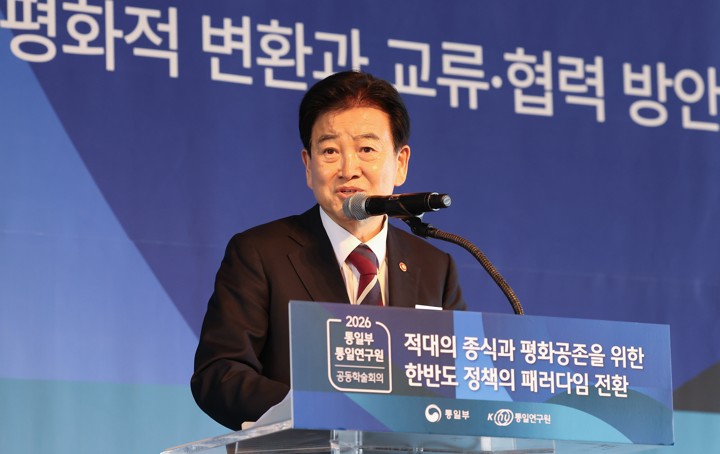
Unification Minister Jeong Dong-yeong delivers the opening address[Provided by Ministry of Unification][Provided by Ministry of Unification]
Unification Minister Jeong Dong-yeong said he hopes South and North will establish a new relationship that benefits both sides and contributes to national development.
Speaking today (25th) at The Plaza Hotel in Jung-gu, Seoul, at a joint academic conference hosted by the Ministry of Unification and the Institute for Unification Studies on “Ending Hostility and Shifting the Paradigm of Korean Peninsula Policy,” Minister Jeong urged both Seoul and Pyongyang—i.e., the Republic of Korea and the Democratic People’s Republic of Korea—to make responsible, forward-looking decisions and bold course corrections rather than dwelling on the past.
The Democratic People’s Republic of Korea is North Korea’s official state name. After declaring inter-Korean relations to be those of two hostile states, the North has adopted the term “Chohan relations” in place of the earlier expression for inter-Korean ties.
This is the first time Minister Jeong has used North Korea’s official state name in a public, outward-facing setting.
Earlier, at an internal New Year ceremony in January, Minister Jeong said the Lee Jae-myung administration respects the DPRK’s system, and he has also referred to the North as the “Democratic People’s Republic of Korea” on social media and other platforms.
Minister Jeong said it is time to redesign Korean Peninsula policy to place peaceful coexistence itself—rather than reunification—as the central objective, stressing that this is not a renunciation of reunification but an effort to institutionalize peace.
He added that if political, economic and legal structures institutionalize peaceful coexistence between the two Koreas, the sides will be able to discuss any issue. He said that when discussions among relevant countries begin, alongside a future inter-Korean basic agreement aimed at building a peninsula peace regime, the Korean Peninsula issue can finally find a path toward resolution.
He also said the South Korean government recognizes and respects the sovereign rights, security interests and right to development claimed by the North, and expressed hope that President Trump’s visit to China in the context of a U.S.-China summit could provide the DPRK with a useful opportunity to discuss those matters.
Earlier, Kim Jong Un told the Supreme People’s Assembly yesterday (24th) that actions by forces attempting to infringe on the nation’s sovereign rights, security interests or right to development will not be tolerated, and he identified South Korea as the most hostile state, vowing to thoroughly reject and ignore it.
Meanwhile, former National Intelligence Service director Suh Hoon, delivering a keynote on the prospects and tasks for a North Korea–U.S. summit, argued that national development is impossible without security and warned that if dialogue and negotiations vanish from the peninsula, security cannot be guaranteed; he emphasized that a North Korea–U.S. summit is necessary for all parties.
#JeongDong-yeong #UnificationMinistry #InterKoreanRelations #Kim Jong Un
Yonhap News TV inquiries and tips: KakaoTalk/LINE jebo23
Park Su-ju (sooju@yna.co.kr)









Most Commented