
What’s Next for South Korea? Inside the Newly Established National Investigation Committee
Daniel Kim Views
Translation result.
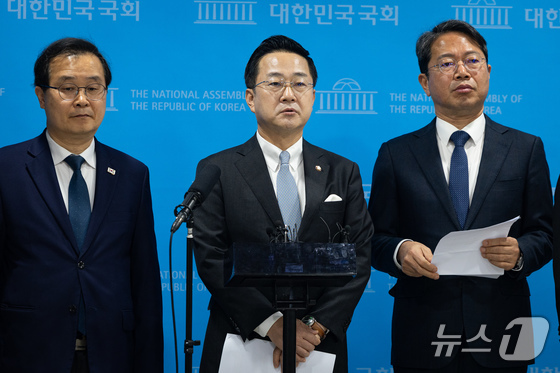
On the 19th, the People Power Party submitted its list of members for the “Special Committee to Investigate Allegations of Prosecutorial Fabrication and False Indictments under the Yoon Suk Yeol administration,” completing the committee’s formation.
According to the petition requesting the parliamentary probe, the committee will consist of 20 members apportioned according to the seat shares of negotiating and non‑negotiating parties.
The chair will be elected by secret ballot after the committee convenes. The committee will include 11 members from the Democratic Party, seven from the People Power Party, and two from non‑negotiating parties.
The Democratic Party named two‑term lawmaker Park Seong‑jun as the committee secretary and appointed the following members (in Korean alphabetical order): Kim Seung‑won, Park Seon‑won, Park Ji‑won, Seo Young‑kyo, Yang Bu‑nam, Yoon Geon‑young, Lee Geon‑tae, Lee Yong‑woo, Lee Joo‑hee, and Jeon Yong‑gi.
Earlier, National Assembly Speaker Woo Won‑sik had told the People Power Party to submit its list by 2 p.m. that day. The Democratic Party said it would change the schedule and place the investigation plan on the plenary agenda if the People Power Party failed to comply.
To block the Democratic Party’s attempted fast‑track approval, the People Power Party filed a roster drawn largely from members of the National Assembly’s Legislation and Judiciary Committee: Kwak Kyu‑taek, Kim Jae‑seop, Na Kyung‑won, Song Seok‑joon, Shin Dong‑wook, Yoon Sang‑hyun, and Cho Bae‑sook. The committee secretary is undecided, and some members may still be replaced.
At a party meeting, the People Power Party said a majority of its lawmakers favored participating in the special committee, which is why it submitted the list.
Yoo Sang‑beom, the party’s senior deputy floor leader for operations, told reporters at the National Assembly that opponents argued participation would violate the law barring investigations into cases pending in court and that it would be an unconstitutional legislative encroachment on judicial authority. They also feared that joining could lend legitimacy to the probe. The party said it will continue a filibuster (unlimited debate) against the investigation plan as scheduled.
Still, Yoo said most lawmakers supported participation. He argued that a parliamentary probe—unlike legislation—permits extensive questioning of witnesses and other participants, and he warned that if the People Power Party stayed out, the ruling party could use the committee to sway public opinion and portray the seven cases as prosecutions brought through fabricated investigations.
Yoo added that by participating, the People Power Party would have the opportunity to question prosecutors and witnesses directly and demonstrate that the investigations were not fabricated. He said the party would reluctantly take part and contest the proceedings aggressively, since the Democratic majority is likely to approve the investigation plan.
According to Yoo, the Democratic Party plans to hold the committee’s first full meeting on the 20th to elect a chair and adopt the investigation plan.
He said the Democratic Party intends to approve the plan by majority vote and then file a request to change the schedule so the plenary can vote on the investigation plan once the filibuster over the Serious Crimes Investigation Agency bill ends.
Non‑negotiating parties will send Cha Gyu‑geun of the Innovation for Korea Party and Son Sol of the Progressive Party.
The parliamentary probe will cover seven cases: the Daejang‑dong scandal, the Wirye case, the case involving former Democratic Research Institute deputy director Kim Yong, the Ssangbangwool North Korea remittance case, the statistics manipulation case, the West Sea shooting of government officials, and allegations of defamatory false reporting against Yoon Suk Yeol.









Most Commented