
Sokcho’s Bold Move: How Public Institution Relocation Can Revitalize the City’s Economy
Daniel Kim Views
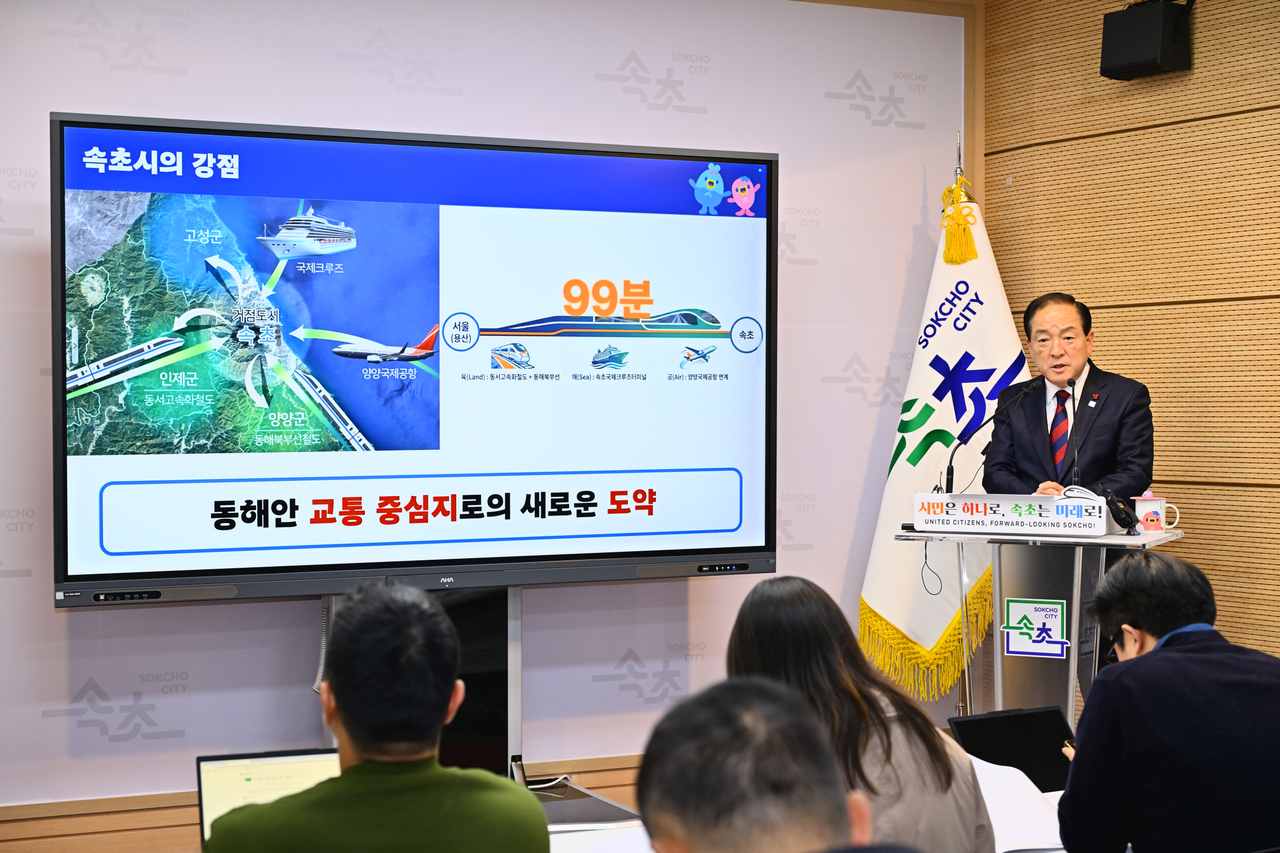
[Herald Economy (Sokcho) = Park Jung-kyu] As the Lee Jae-myung administration advances the second wave of public institution relocations, Sokcho City is actively positioning itself to attract these organizations.
On February 9, during a media briefing led by Mayor Lee Byeong-seon, he stated, “The most fundamental solution to address local population decline is to create high-quality jobs that enable people to settle down.” He added, “We will aggressively pursue the attraction of public institutions to diversify our tourism-centric economy and establish a sustainable foundation for future growth.”
The city emphasized its suitability for public institution relocation, highlighting its emergence as a transportation hub for land, sea, and air, connected to Yangyang International Airport and the Northern East Coast Line following the completion of the East-West High-Speed Railway. Sokcho also touted its status as South Korea’s premier tourist destination, offering an ideal balance of “work and leisure” amidst its pristine natural surroundings.
The city has identified 14 public institutions as relocation targets across six sectors: tourism, marine, environment, security, welfare, and sports. These include Korea Rail Tourism Development Corp., Marine Environment Corporation, Korea Environmental Industry and Technology Institute, North-South Unification Foundation, Korea Senior Employment Agency, and the Korean Sport & Olympic Committee.
The proposed relocation site is within the Sokcho station area development project, which the Ministry of Land, Infrastructure and Transport designated as a key investment district in 2022. Approximately 510 billion KRW (around 382.5 million USD) will be invested to develop it into a mini new city for Sokcho.
The city envisions creating a multifunctional space centered around a MICE (Meetings, Incentives, Conferences, and Exhibitions) complex near the historic area, integrating business, residential, cultural, educational, and medical facilities. This compact urban hub, situated close to the old downtown, is expected to offer significant advantages for relocating public institutions.
Furthermore, the city plans to implement a comprehensive residential infrastructure package in conjunction with attracting public institutions, aiming to develop a new urban center that caters to both residents and employees of the relocated organizations.
To this end, city officials visited the offices of national assembly members, the Gangwon Special Self-Governing Province, and the Gangwon Research Institute in January to present their case for attracting public institutions. The city is also conducting targeted studies to refine its attraction strategies for each institution, with Mayor Lee Byeong-seon personally leading outreach efforts to potential relocating agencies.
Mayor Lee Byeong-seon emphasized, “The relocation of public institutions is not just a short-term achievement, but a pivotal decision that will shape Sokcho’s trajectory for the next century.” He called for public support and engagement in this initiative, drawing parallels to the citywide mobilization for the East-West High-Speed Railway project in 2015.
The mayor concluded, “Through close collaboration with the federal government, National Assembly, and Gangwon Special Self-Governing Province, we are committed to successfully attracting public institutions. This initiative will serve as a catalyst for private sector investment, ultimately reshaping our industrial ecosystem and creating a tangible foundation for Sokcho’s future that our citizens can truly appreciate.”












Most Commented