
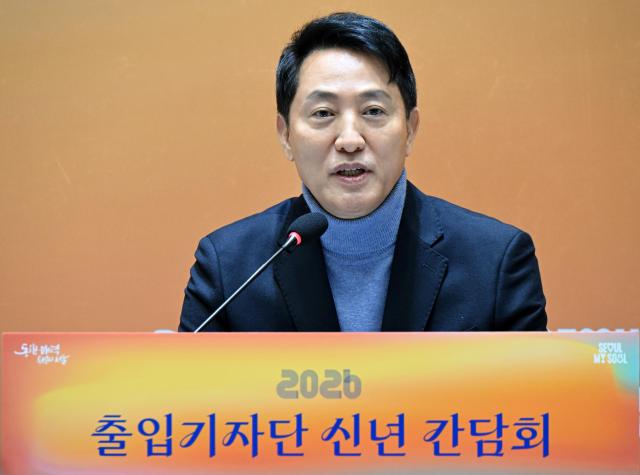
On February 10, during a New Year’s press conference at City Hall, Seoul Mayor Oh Se-hoon emphatically stated, “I am not considering leaving the party at all.” [Photo: Seoul City]
Oh addressed rumors about his potential departure from the People Power Party amid tensions with party leadership. He asserted, “I have made my commitment to protecting Seoul crystal clear and have absolutely no intention of taking a different path.”
Responding to questions about his stance on leaving the party, Oh remarked, “While there have been various interpretations recently, my role and responsibilities remain unambiguous.”
He acknowledged the speculation among pundits and political analysts, saying, “I’m aware of the discussions stemming from my divergent views from party leadership. My focus is on elevating Seoul to a global top-five city while ensuring balanced development in northern Seoul. My actions clearly demonstrate my unwavering commitment to Seoul.”
This statement comes amid escalating tensions with People Power Party leader Jang Dong-hyuk and disciplinary procedures against the party’s Seoul chairperson, Baek Hyun-jin, which had fueled speculation about Oh’s political future and candidacy prospects.
Regarding the timing of his candidacy announcement, Oh stated, “As an incumbent mayor, I don’t believe choosing a specific date for the announcement carries much significance. It’s still premature, and there’s no need to rush, especially since the party hasn’t even announced the primary schedule.”
Oh emphasized that the spirit of the new mayoral term should focus on “maintaining the pride of Seoul citizens.” He added, “This spirit emerges from setting a visionary agenda rather than merely reacting to citizens’ demands.”
Reflecting on his tenure, Oh stated, “I’ve worked to cultivate Seoul citizens’ pride in their global city. We’ve reached a point where we can confidently assert Seoul’s position as Asia’s premier city.” He stressed that preserving and enhancing Seoul’s status should be the cornerstone of this election.
Oh criticized the current political landscape, noting, “Since the implementation of the ‘Oh Se-hoon Three Laws’ in 2004, the fundamental structure has remained unchanged.” He emphasized the need to address systemic issues in the nomination process that lead to various improprieties. Oh added, “There’s deep public concern about unlimited fundraising through events like book launches. It’s time to explore legislative solutions to impose reasonable restrictions.”
The mayor also offered pointed criticism of Jung Won-oh, the Democratic Party’s leading Seoul mayoral candidate. Oh remarked, “Jung’s approach to issues like public transportation and the Sam-pyo Ready-Mix Concrete site clearly reveals his limitations and his allegiance to Democratic Party ideology.”
Specifically addressing the Sam-pyo site, Oh noted, “This issue could have been resolved during the terms of former Mayor Park Won-soon and District Chief Jung Won-oh. During my first term in 2009, I introduced advance negotiation and public contribution systems, with Sam-pyo as the pilot project. Had negotiations proceeded as planned, we could have secured about 2 trillion KRW (1.5 billion USD) in public contributions, significantly accelerating Seongsu-dong’s development. Instead, the redevelopment was delayed by a decade.”
Oh lambasted the government’s regulations on multiple homeowners as “unsustainable.” He explained, “While government measures typically show short-term effects for two to three months, they fundamentally contradict market principles. We must differentiate between multiple property owners and professional rental businesses.”
He continued, “Real estate is undeniably a commodity that requires adequate supply. Policies that suppress and constrict supply are ultimately unsustainable.” Oh cautioned that such short-sighted approaches inevitably lead to unintended consequences and market distortions.
Furthermore, Oh strongly opposed the Ministry of Land, Infrastructure and Transport’s recent intervention in the “Garden of Gratitude” project at Gwanghwamun Plaza, denouncing it as an abuse of power.
Oh asserted, “Halting a legally compliant project over minor technicalities is a clear overreach of authority. If the central government persists in this excessive use of power, Seoul City will have no choice but to assert its rights. I sincerely hope it doesn’t come to that.”
On February 9, the Ministry of Land issued a stop-work notice to Seoul City, claiming the Garden of Gratitude project violated national planning and road laws. Prime Minister Kim Min-seok echoed these concerns in a National Assembly session, alleging procedural lapses by Seoul City.
Oh rebutted, “The Ministry’s attempt to classify underground facilities with media installations and symbolic structures as public roadways is a strained interpretation. Despite my objections, they omitted this crucial point from their announcement. It’s evident that ministry officials are desperately searching for legal technicalities to obstruct the project.”
Regarding project authority, Oh maintained, “The procedural oversight for this initiative rests with the Seoul mayor. Even if there were procedural shortcomings, the reasonable approach would be to request corrections, not halt the entire project. This seems like a predetermined outcome searching for justification.”
In closing, Oh urged the People Power Party leadership to prioritize public sentiment. He stated, “Yoon Suk Yeol’s stance on martial law embodies conflicting values that cannot realistically coexist in an election campaign. Attempting to reconcile these incompatible positions is making the election unnecessarily challenging.”
He concluded, “I hope they understand my call to engage with broader public sentiment and pursue moderate expansion. The party leadership must reflect deeply on this and demonstrate consistency in their words and actions. They should approach this with the sobering awareness that losses in metropolitan elections could cascade into nationwide local election defeats.”










Most Commented