
Is Lee Gae-ho the Right Choice for Gwangju’s First Special Mayor? A Deep Dive into His Vision
Daniel Kim Views
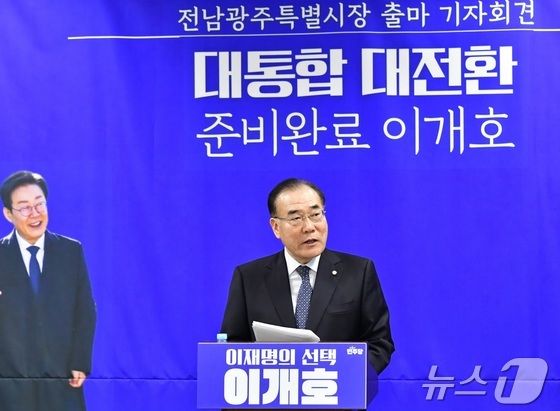
Lee Gae-ho, a Democratic Party lawmaker (67, representing Damyang-Hampyeong-Yeonggwang-Jangseong in South Jeolla Province), has announced his candidacy for the position of Mayor of Gwangju-Jeonnam Special City.
On the 10th, Lee held a press conference at the Gwangju City Council. He stated, “Drawing on my 45 years of experience in administration and politics, I am running for Mayor of Gwangju-Jeonnam Special City to implement compassionate politics and create a society where everyone can prosper together.”
Lee emphasized, “Gwangju’s growth potential is diminishing, while Jeonnam faces a crisis of an aging population. The concentration of power in the Seoul metropolitan area has become a black hole, draining even local capital.” He added, “If we continue on separate paths, both regions will falter. We must respond with innovative changes to establish the southern capital of South Korea.”
He asserted, “The Gwangju-Jeonnam Special City is uncharted territory. Navigating this special city through challenging terrain and turbulent times demands a leader with extensive administrative experience and astute political acumen.”
Lee notably mentioned, “I contributed to the landslide victory in the 22nd National Assembly elections with promises directly impacting citizens’ lives, such as establishing ten institutions on par with Seoul National University, including nursing care costs in health insurance coverage, and implementing comprehensive measures to address low birth rates.” He added, “I have experience working closely with President Lee Jae-myung, and we have developed a relationship built on mutual trust.”
Lee declared, “I will achieve a bold transformation for Jeonnam and Gwangju through three key initiatives and four regional development strategies.” He also stated that he would request the government to strategically locate the semiconductor industry, known for its high electricity consumption, in the Jeonnam-Gwangju area.
He outlined the three key initiatives as: 1) declaring energy sovereignty through the principle of ‘local production for local consumption’, 2) introducing a tiered electricity pricing system, and 3) securing 20% of the 150 trillion KRW (112.5 billion USD) national growth fund for Jeonnam. The four regional development strategies include: 1) attracting a national AI research institute to Gwangju and promoting research, verification, and industrialization, 2) reinventing the eastern Jeonnam region as a global economic and cultural hub, 3) establishing a dedicated RE100 industrial complex on the southwestern coast, and 4) implementing a basic income for those in agriculture and fisheries.
A native of Damyang, Jeonnam, Lee graduated from Hyo-dong Elementary School, Dongseong Middle School, Geumho High School, and the Business Administration Department at Chonnam National University. He began his public service career after passing the 24th administrative examination, starting at the former Jeonnam Provincial Office in Donggu, Gwangju.
Lee served as an administrative officer for President Kim Dae-jung’s transition committee, deputy mayor of Mokpo, Yeosu, and Gwangyang, and head of the planning and management office in Jeonnam before concluding his public service as the 35th Deputy Governor. He entered the 19th National Assembly through a by-election and has since served four terms as a congressman and as the Minister of Agriculture, Food and Rural Affairs.









Most Commented