
Job Security vs. Flexibility: President Lee Jae-myung’s Bold Solutions for South Korea’s Labor Crisis
Daniel Kim Views
President Lee Jae-myung emphasized that while job stability is important, alternatives for employment flexibility must be created to improve the overall quality of jobs. He stressed the need for a grand compromise through social dialogue to expand the social safety net for non-regular workers.
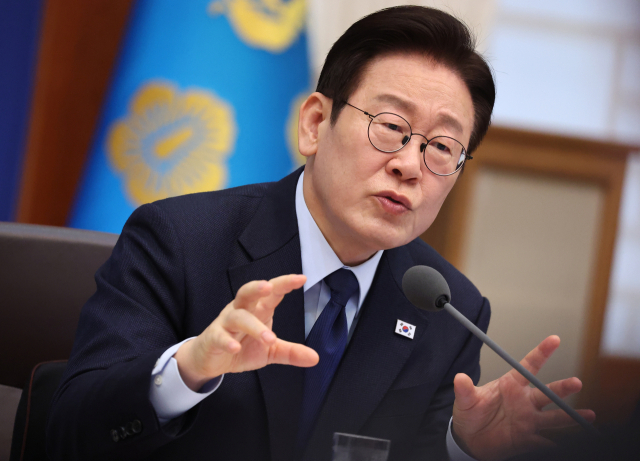
During a Cabinet meeting at the Blue House on the 10th, President Lee mentioned the labor shortage in the domestic shipbuilding industry, stating, “While some insist on maintaining (regular jobs), the reality is that jobs are decreasing, and new hires are all subcontracted or employed as non-regular workers.”
He continued, “Currently, there are about 4,300 to 4,400 foreign workers in the (shipbuilding industry) earning monthly wages of 2.2 million KRW (about 1,650 USD).” He pointed out, “If foreign workers are hired for 2.2 million KRW (about 1,650 USD) a month, what happens to domestic workers and jobs?”
Lee questioned, “From our perspective, it seems like we’re paying minimum wage, but does this help develop the shipbuilding industry? The ecosystem should be maintained by workers growing into skilled technicians and mid-level engineers, but these people work for a year and then leave (for their home countries). Then we bring in more workers for 2.2 million KRW (about 1,650 USD), and they leave again. I think there’s a problem here. Is this really desirable?”
The President emphasized that the government should advocate for improving workers’ conditions. He said, “I’ve heard that some (shipbuilding) companies are paying subcontractor employees the same level of wages as their direct hires as part of coexistence measures. The Ministry of Employment and Labor should also speak up about this issue.” He added, “When companies and industries develop, small and medium-sized enterprises should simultaneously benefit and have opportunities to create a vibrant ecosystem.”
He continued, “The current vertical structure, rather than a horizontal one, is not competitive. It might be efficient for a short time, but in the long run, it lacks spontaneity and creativity, making it impossible to win in global competition.” He added, “This applies not only to the shipbuilding sector but to other fields as well. We need to reach a grand compromise through social dialogue at some point. Although it’s difficult right now, we should set our direction that way.”
President Lee also emphasized that the most serious problem in our society is polarization, and the reality of non-regular workers needs to be improved.
He stated, “For non-regular workers, being fired is death. It’s too cold out there. They’ll freeze to death.” He pointed out, “The so-called social safety net is too weak, there’s no possibility of re-employment, and the gap between regular and non-regular workers is so large that it feels like standing on the edge of a cliff.”
He continued, “The problem is that from a company’s perspective, once they hire a regular employee, they can’t respond to economic downturns, so they never hire again. There’s an understandable aspect from the company’s point of view. So this vicious cycle continues.”“We need to increase non-regular workers’ compensation so they’re not anxious when they leave their jobs, and there should be a strong safety net so that even if they’re fired, they have faith that they can survive,” he emphasized.
He also mentioned that the structure of labor unions seems to have an impact, saying, “There was a saying ‘Workers of the world, unite!’ but that’s an ideal. It seems that (regular worker unions) are in a situation where they can’t consider subcontractors and non-regular workers.”
He added,“There are separate unions for companies and non-regular workers, but we need to move towards industry-wide unions, and wage negotiations should be conducted broadly at the industry level for society to normalize.”
At the Cabinet meeting, Deputy Prime Minister for Economy Koo Yun-cheol announced plans to end the suspension of additional capital gains tax on multi-home owners as scheduled on May 9th, while also extending the period for balance payment and registration to 4-6 months for housing transactions in land transaction permit zones.
Deputy Prime Minister Koo explained, “We are considering a plan to require balance payment and registration within 4 months for contracts made in land transaction permit zones from May 9th. Previously, we reported a plan to give 3 months for Gangnam’s three districts and Yongsan, but there were public opinions requesting 4 months from the permit date for land transaction permit zones.”
The government also decided to temporarily exempt buyers from the actual residence requirement for a certain period when purchasing houses with existing tenants in land transaction permit zones. Deputy Prime Minister Koo explained, “In cases where there are tenants, buyers don’t have to actually reside during the contract period and can move in after the contract ends. We will allow this within a maximum of 2 years, considering the rental period.”
President Lee mentioned that it’s problematic that the capital gains tax exemption for multi-home owners continues to be maintained for housing rental business operators. He said, “There are opinions questioning whether it’s necessary to give permanent benefits just because they were once registered rental businesses, even though they’re multi-home owners,” adding that he had proposed reducing benefits on social media the day before.
When President Lee said, “If there’s no additional tax even after 100 or 1,000 years beyond the mandatory rental period, it’s problematic that people who bought 300-500 houses can sell them after 20 years without additional capital gains tax,” Deputy Prime Minister Koo responded that they would set a sale deadline so that the capital gains tax exemption benefit would only apply if the property is sold within a certain period after the end of the rental period.
Meanwhile, President Lee drew attention by emphasizing the role of the media, stating that facts are important in a democracy. He said, “When false information is provided, it’s difficult to make proper judgments, and ultimately, it distorts the exercise of sovereignty by the people. The media’s essential function is to report the truth, which greatly contributes to the development of democracy. That’s why it’s considered the fourth branch after the legislative, executive, and judicial branches. They should receive recognition and protection, enjoy the benefits, and also bear the responsibilities.”
He also indirectly mentioned recent incidents where individuals like Harold Rogers, interim representative of Coupang Korea, were reported for alleged perjury during National Assembly hearings. Lee said, “Recently, I’ve noticed too many instances of people blatantly lying, damaging the authority of the National Assembly, or disrespecting it by not attending without reason.” He added, “Whether it’s advantageous to the ruling party or the opposition is not important. Perjury cases should be quickly determined whether they’re true or false, just or unjust. This is a matter of the National Assembly’s power and authority as a core institution of the state and constitutional order,” calling for swift handling of National Assembly perjury cases.










Most Commented