
How Jeong Jun-ho’s ‘3+1 Strategy’ Aims to Transform Gwangju and Jeonnam into South Korea’s New Tech Hub
Daniel Kim Views
He unveiled his '3+1 strategy' aimed at revolutionizing industry, urban spaces, and administration as part of his vision for a 'Honam Special City' based on the integration of Gwangju and South Jeolla Province.
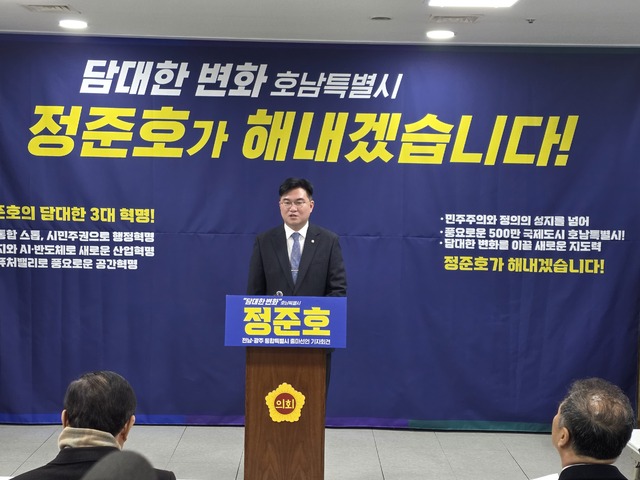
In his declaration, Jeong asserted, “The integration of Gwangju and South Jeolla is not just an option; it’s a survival strategy. We must now pivot to a leading strategy that can challenge the Seoul metropolitan area.” He emphasized that “through a major transformation centered on AI, the Honam region can leap forward to become South Korea’s new epicenter.”
Jeong cited examples of how digital transformation has boosted national competitiveness, stating that “Honam will compete with the capital region through a mega-regional strategy that combines AI, energy, and cutting-edge industries.”
To realize this vision, he proposed the core ‘3+1 strategy’. The first pillar, the ‘Industrial Revolution’ strategy, aims to establish an energy system that combines renewable energy with small modular reactors (SMRs) and develop industrial complexes that meet RE100 standards to attract major corporations and high-tech industries. Notably, he plans to transform the Gwangju Airport site into a production and research hub for robotics, advanced mobility, and physical AI.
For the ‘Administrative Revolution’, he committed to promoting transparent governance through clear deadlines for administrative processes and public policy disclosure, while establishing a consultative body involving labor, management, government, and civil society to foster a stable investment climate.
Additionally, he proposed a ‘+1 strategy’ for ‘Future-oriented Welfare’, which includes plans for affordable high-quality rental housing, guaranteeing basic rights to energy and communication, and implementing autonomous public transportation to reduce living costs and create a family-friendly urban environment.
To secure funding, he outlined a financial structure based on 25 trillion KRW (18.75 billion USD) in government support, linking it to citizen-driven initiatives such as a future fund, a citizen’s bank, and a talent development fund.
Jeong expressed his determination, stating, “We will create a Honam that attracts people back rather than one that loses them to bold changes,” aiming to achieve a population of 5 million within the next decade.
Gwangju = Reporter Jo Jae-ho samdady@viva100.com













Most Commented