
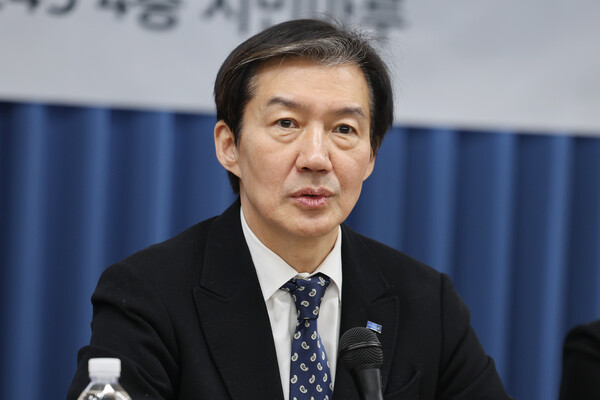
The Democratic Party’s proposal for a pre-local election merger collapsed within a week, triggering public criticism from the Justice Innovation Party. This escalating tension between parties has exposed cracks in the ruling coalition’s messaging control.
On March 10th, political insiders and media reports revealed that the Democratic Party of Korea convened a general meeting at the National Assembly. Members reportedly agreed that pursuing a merger before local elections was impractical. Chief Spokesperson Park Soo-hyun stated after the meeting that while members recognized the “need for unification,” they deemed it unfeasible under current circumstances, despite its potential merits. The party planned to finalize its decision at a Supreme Council meeting later that day.
Tensions had been brewing since the previous day. On March 9th, during a National Assembly Supreme Council meeting, Cho Kuk praised the government’s KOSPI 5000 achievement as a hallmark of people-centric governance. However, he cautioned that failure to extend these benefits to manufacturing, small businesses, and local economies could be seen as a political shortcoming. Cho cited the February 2026 Business Sentiment Index forecast of 93.9, indicating a downturn in economic outlook across domestic demand, exports, and investments.
That same day, Cho reportedly used Facebook to urge the Democratic Party to prioritize party unity over factional interests. Reports also emerged that President Lee Jae-myung had referenced his past warnings about internal conflicts posing the greatest risk to the party.
The pro-Lee faction within the Democratic Party swiftly retaliated. Supreme Council member Kang Deuk-gu asserted on Facebook that the Justice Innovation Party is not part of the Democratic Party’s internal affairs. He argued that invoking the President’s past statements was counterproductive and likely to intensify conflicts. Fellow council member Lee Un-joo criticized Cho for setting a March 13th deadline for merger talks, viewing it as undue pressure.
In essence, while the Democratic Party acknowledges the need for unity, it fears that prolonged merger debates could undermine its local election strategy and national policy messaging. The Justice Innovation Party is leveraging demands for equitable distribution of political gains and calls for reduced intra-party power struggles. Meanwhile, the Democratic Party’s pro-Lee faction is framing these actions as unwarranted interference in their party’s internal matters, adopting a defensive stance.













Most Commented