
Why 83.96% of New Special Laws Are Causing Controversy in South Korea’s Local Governance
Daniel Kim Views
83.96% of Special Law Provisions Deemed Political Pandering: Calls to Halt Implementation
Constitutional Concerns Raised; Mandatory Resident Voting Proposed
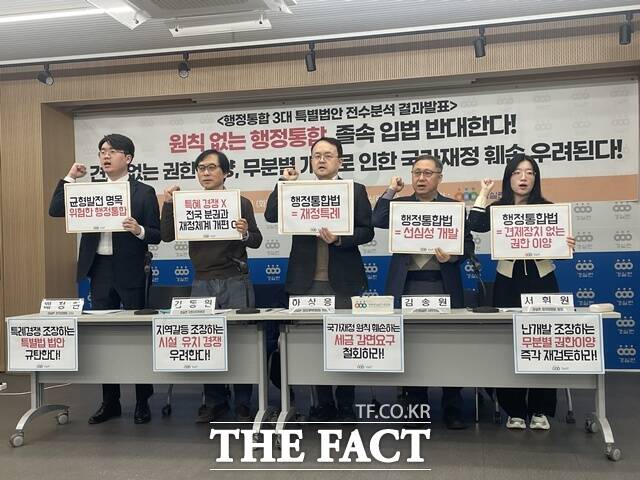
[The Fact | Reporter Dabin Lee] The Citizens’ Coalition for Economic Justice (CCEJ) has demanded a halt to the government’s push for three special bills on administrative integration in Chungnam-Daejeon, Jeonnam-Gwangju, and Daegu-Gyeongbuk regions, labeling them as hasty legislation motivated by political agendas in the run-up to the June 3 local elections.
On the 10th, the CCEJ held a press conference at their auditorium in Jongno-gu, Seoul. They revealed that after a comprehensive analysis of 1,035 provisions in the three special bills for administrative integration, 83.96% were found to focus on politically motivated local demands, financial privileges, and power transfers. The CCEJ argued that these bills, which threaten the foundation of the administrative system and lead to fiscal waste, must be stopped immediately.
The CCEJ pointed out that rather than enhancing local autonomy and accountability, the bills primarily consist of provisions granting special privileges to facilitate development. They questioned the effectiveness of administrative integration alone in improving regional prosperity when local authority remains unchanged.
Furthermore, the CCEJ warned that the current three special bills are likely unconstitutional. They argued that provisions allowing local government heads to arbitrarily waive feasibility studies or offer inheritance tax exemptions in regions pursuing administrative integration violate principles of fiscal democracy and separation of powers.
The organization emphasized that to ensure procedural legitimacy, administrative integration must be subject to mandatory resident voting. They stressed the importance of basing such integration on thorough deliberation by local residents, rather than on hasty legislation driven by political interests.














Most Commented