

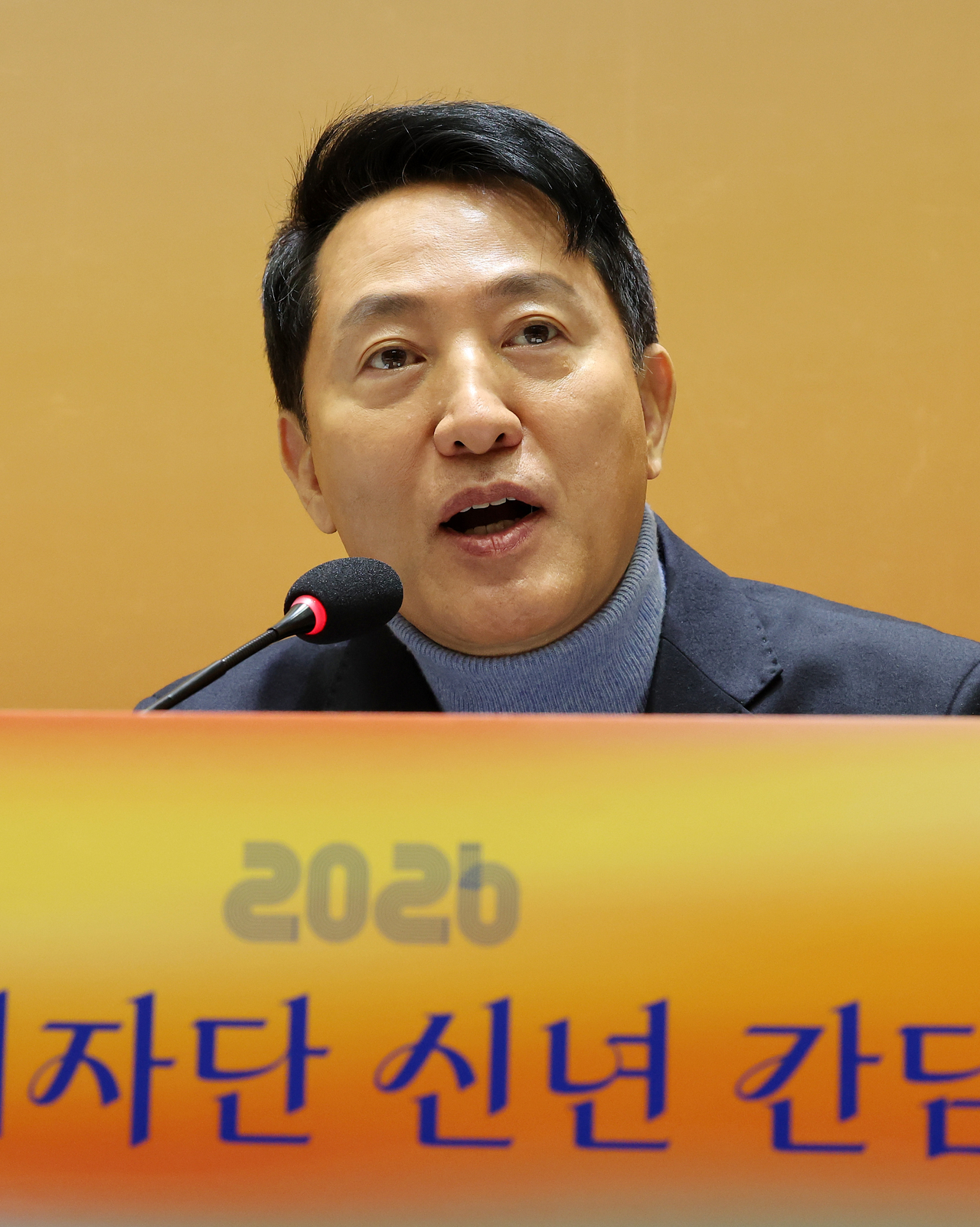
In a recent poll conducted approximately four months before the June 3 local elections, Seongdong District Mayor Jeong Won-oh surpassed current Seoul Mayor Oh Se-hoon by a significant 14.2 percentage points.
The survey, commissioned by Straight News and carried out by polling firm Jo Won C&I from February 7 to 8, included 806 Seoul residents aged 18 and older. In a hypothetical one-on-one matchup, Jeong, a member of the Democratic Party, secured 47.5% of the votes, while Oh, representing the People Power Party, received 33.3%, giving Jeong a substantial 14.2-point lead.
This widens the gap compared to the previous survey conducted on January 24-25, where Jeong had 50.5% and Oh had 40.3%, a difference of 10.2 percentage points.
In the latest poll, a multi-candidate scenario showed Jeong leading with 28.4%, followed by Oh at 20.2%. Other contenders included Na Kyung-won from the People Power Party at 13.9%, Park Joo-min from the Democratic Party at 9.3%, former People Power Party leader Han Dong-hoon at 6.7%, Democratic Party member Seo Young-kyo at 5.1%, and Democratic Party member Jeon Hyun-hee at 3.0%.

Regionally, Jeong led in most areas. However, in the traditionally conservative fourth district (comprising Seocho, Gangnam, Songpa, and Gangdong), the race was neck-and-neck with Jeong at 25.4% and Oh at 25.3%.
Party support figures showed the Democratic Party leading with 48.1%, compared to the People Power Party’s 31.6%, giving the Democrats a 16.5-point advantage. Smaller parties like the Justice Innovation Party, Progressive Party, and Reform Party received 2.0%, 0.9%, and 2.8% respectively.
When asked about their perspective on the upcoming June local elections, 49.5% of respondents believed in empowering the ruling party to support national governance, while 39.2% favored empowering the opposition to check the government. This indicates a 10.3-point lead for the governance support argument.
This survey employed an Automated Response System (ARS) polling method, using 100% mobile phone virtual numbers with random sampling proportional to gender, age group, and region. The sample size was 806 (out of 14,183 total call attempts, with a 5.7% response rate). The margin of error is ±3.5 percentage points at a 95% confidence level. For more comprehensive information, please consult the website of the Central Election Polling Review Committee.














Most Commented