
Translation result
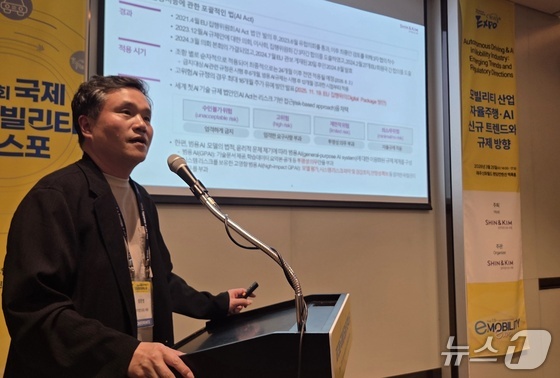
Since the AI Framework Act took effect in January, experts have warned that Level 4 and higher autonomous vehicles will need to provide “prior notice” and adopt other safety measures. They say regulators must put in place a system to manage related laws and guidelines systematically and keep them up to date.
Jang Jun-young, head of the AI Center at law firm Sejong and an attorney, told the seminar “New Trends and Regulatory Directions for Autonomous Driving and AI in the Mobility Industry” at the 13th International e-Mobility Expo in Jeju that the AI Framework Act does not yet broadly apply to autonomous driving. He cautioned, however, that if generative AI or advanced AI is used in service delivery, disclosure obligations and other regulations could come into play.
The act classifies AI into categories such as high-impact AI, generative AI, and large-scale AI, with most regulatory attention focused on high-impact systems. AI providers must assess in advance whether their services qualify as high-impact and, if so, take steps—such as issuing prior notice—to ensure safety and reliability.
According to Jang, the Ministry of Science and ICT’s guidelines indicate that autonomous vehicles at Level 4 and above are likely to be considered “high-impact (high-risk) AI.” That distinction reflects the shift at Level 4, when the system, rather than the driver, takes primary control of the driving task.
He added that even some Level 3 systems could fall into the high-risk category if they are designed to minimize human intervention, so companies should carry out prior reviews to determine risk classification.
Personal data is another major concern. Because AI relies on advanced data processing, incidents such as copyright infringement or personal data leaks can cause severe damage to companies. Autonomous driving and mobility services inherently require sensitive inputs such as video and location data.
Jang noted a positive development on the use of video data. Where companies once relied on regulatory sandboxes to use original footage as an exception, amendments to the Autonomous Vehicles Act and the Personal Information Protection Act are now creating a structured special-exemption framework for using original footage to improve AI performance.
He proposed building an “AI governance system” as the practical solution. “Managing AI risk is ultimately a compliance issue,” Jang said, stressing the need for a framework that systematically manages relevant laws and guidelines and updates them continuously.
He emphasized the value of analyzing data flows step by step to identify risks ahead of time. Firms should map what data is collected, processed, and used across a service and proactively block potential privacy and copyright violations.
“Regulators will examine whether companies took all feasible measures when an incident occurs,” he said. Visualizing data flows with a “data flow chart” and ensuring safety at each stage while controlling risks, he added, will be a critical factor in a company’s future success.
At the same time, government and public agencies outlined safety-by-design measures. Lee Jeong-gi, deputy director of the Automotive Safety Research Institute at the Korea Transportation Safety Authority (KATRI), urged the creation of a Korean-style safety certification system to respond to diversified international standards.
The conference also reviewed the current state and trajectory of domestic autonomous-driving technology. Kim Geon-woo, head of the Future Platform Economic Research Center at Kakao Mobility, predicted the industry will shift from vertical integration toward role specialization. Where companies today may provide both autonomous-driving technology and services, he expects those functions to separate, leading to greater industry segmentation.
He noted that Apple operates both software and hardware businesses, whereas the Android ecosystem does not.













Most Commented