
Translation result.
[Herald Economy reporter Jeong Kyung-soo] As government and industry push ahead with a roughly 200-vehicle autonomous driving pilot centered on Gwangju, South Korea’s self-driving sector has entered a decisive commercial testing phase, analysts say. With the program moving from small pilots to large-scale service trials, many view this moment as a narrow “golden window” to keep pace with global competitors.
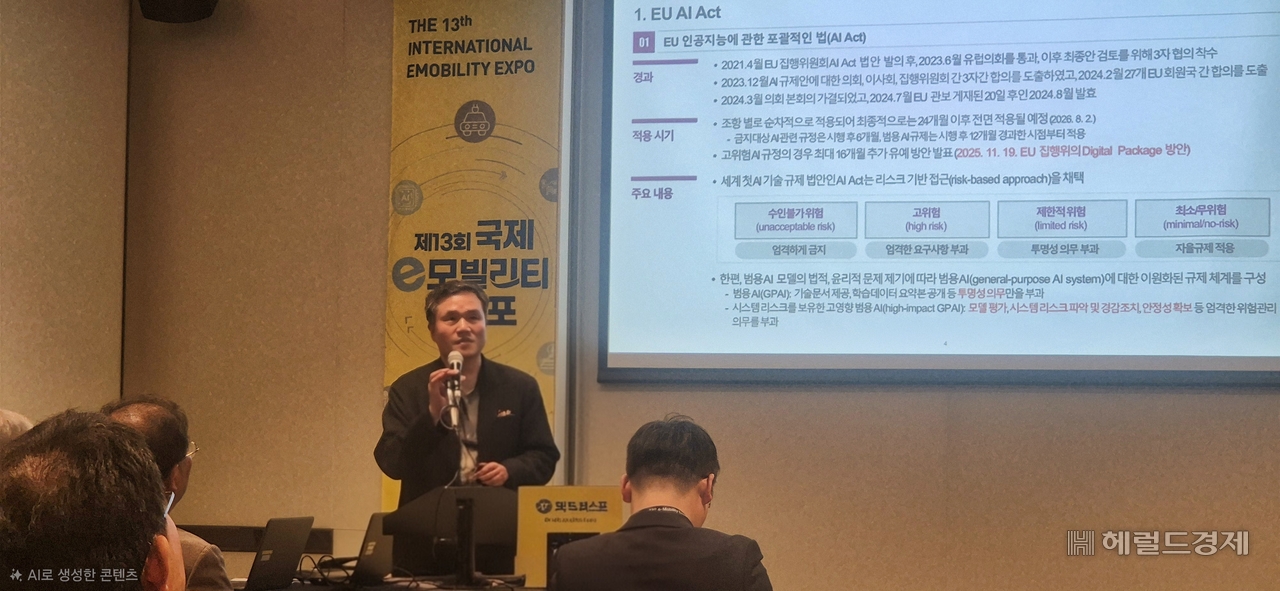
At a March 25 seminar in Seogwipo’s Shinhwa World hosted by law firm Sejong — titled “Mobility Industry: New Trends and Regulatory Directions in Autonomous Driving and Artificial Intelligence (AI)” — the planned expansion of large-scale autonomous projects around the Gwangju pilot city was a central topic.
Byung-yong Yoo, vice president of Autonomous AtoZ (AtoZ), said the government plans to deploy about 200 autonomous taxis in Gwangju this year. “They won’t be fully driverless on day one,” he said, “but we expect the fleet to move steadily toward increased autonomy over the next two to three years.”
Yoo noted that Korea’s testing to date has mostly involved limited pilots with fewer than 10 vehicles. “Now we need to prepare for tests of 200-plus vehicles and start planning for commercialization,” he said. “If autonomous driving stalls now, the technology could stagnate — this is effectively the last golden window.”
Compared with global leaders such as Waymo in the U.S., Tesla and Baidu in China, Korean firms have trailed in capital and scale. Speakers at the seminar pointed out that overseas players are executing investments measured in trillions of KRW (hundreds of millions to billions of USD), while domestic companies are working with budgets in the hundreds of billions of KRW (tens to hundreds of millions of USD) and must therefore pursue more pragmatic commercialization strategies.
That reality is pushing Korean companies to prioritize route-based and public-transit services over an all-out robo-taxi rollout. “With limited budgets, route-based services are the most feasible starting point in Korea,” Yoo said. “They move large numbers of people at once and make it easier to persuade local governments to expand operations.”
The Gwangju pilot city is significant not only as a service trial but as a testing ground for a large-scale data loop: collecting real-road driving data, feeding it back to improve systems, and iterating. Because autonomous systems gain strength by learning from countless edge cases and unexpected scenarios, operating a large fleet becomes a core competitive asset.
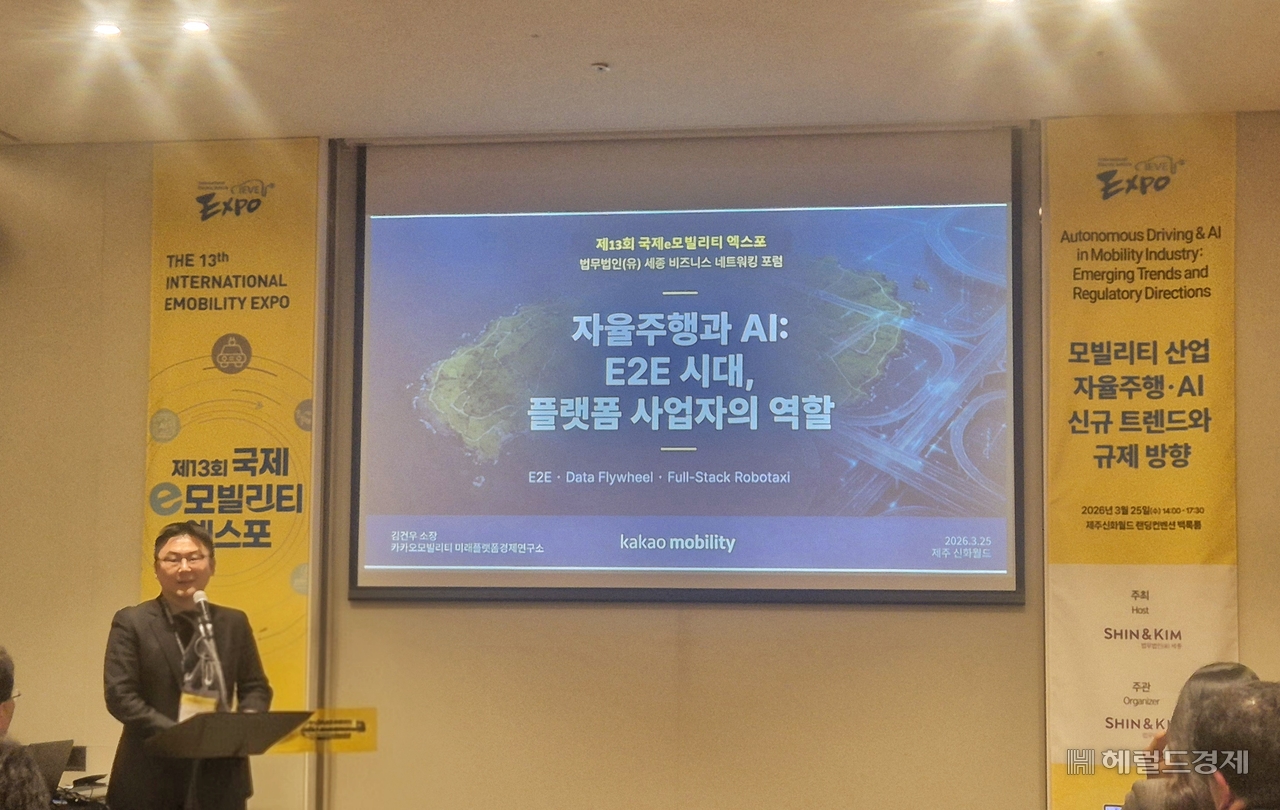
Geon-woo Kim, head of Kakao Mobility’s Future Platform Economy Lab, said competition in autonomous driving is increasingly data-driven. “To scale across a city, companies need robust data pipelines and strong operational capabilities,” he said. “This race isn’t just about vehicle technology anymore — platforms, operations, control centers and data acquisition define the winners.”
Industry observers also highlighted a technological shift from rule-based systems to AI-driven end-to-end models. Kakao Mobility described autonomous driving as converging with physical AI and entering practical service stages, making integrated systems for data collection, labeling, model training and operations essential.
Yet technical progress alone won’t guarantee commercialization. Jeong-gi Lee, deputy director of the Vehicle Safety Research Institute at the Korea Transportation Safety Authority, identified safety certification and alignment with international standards as decisive factors. “Even if the U.S. and China opened markets earlier, selling vehicles and services ultimately depends on how safety and certification frameworks are designed,” he said, noting that Korea is preparing a Level 4 autonomous vehicle certification system.
Lee added that the Gwangju pilot should be treated not as a local project but as a venue to align development roadmaps with real-world certification processes. “Demonstrations, certification and regulatory reform must advance together for the industry to scale,” he said.
Regulatory change is also accelerating. Seminar speakers flagged this year’s AI Framework Act as a new variable for autonomous driving. Jun-young Jang, head of Sejong Law Firm’s AI Center, said autonomous driving — given its direct impact on traffic and safety — will require companies to assess whether their systems qualify as high-impact AI under the new law. “Firms must prepare not only technology but also transparency, safety and risk-management systems,” he said.
Jang cautioned, however, that the industry already complies with a range of vehicle management and autonomous vehicle laws, raising concerns about overlapping regulations under the AI Framework Act. “In the field, there is a strong call for more refined guidelines and expanded deemed-rule provisions,” he added.
The industry sees whether Gwangju’s large-scale demonstration converts into real commercialization as a turning point for Korea’s autonomous-driving sector. Stakeholders argue that expanding tests from constrained settings to citywide services is essential to secure technological competitiveness.
Yoo emphasized that while many business models exist, Korea’s realistic near-term path is expansion through route-based and public-transit services. “We’re expanding service areas step by step in cooperation with local governments,” he said, adding that the effort can later extend to taxis and logistics.










Most Commented