
A recent survey conducted by Chabot Mobility polled 450 potential new car buyers.
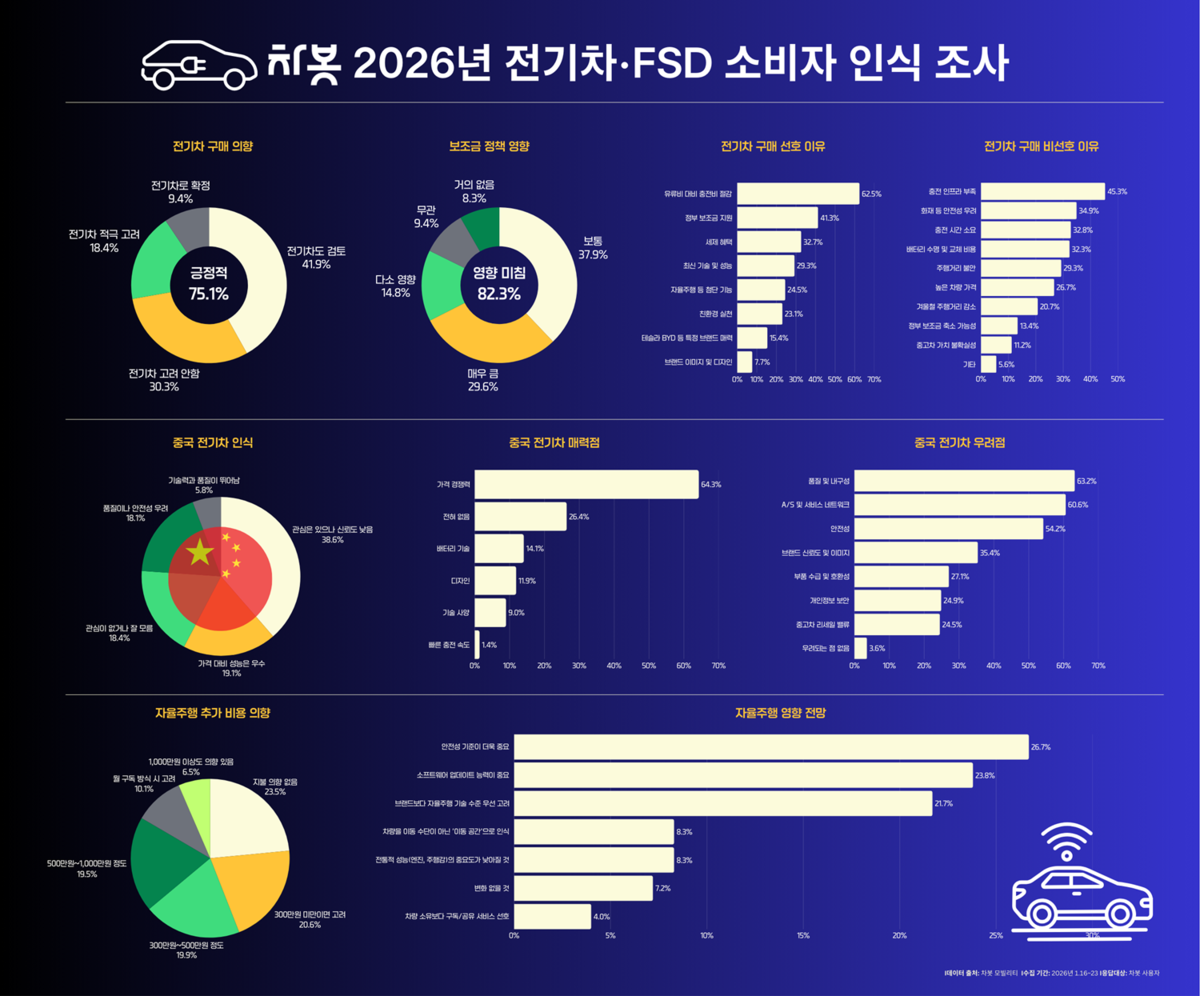
Chabot Mobility reported on February 10 that 75.1% of respondents expressed positive intentions towards buying an EV.
Breaking down the responses, 41.9% said they are “considering an EV,” 18.4% are “actively considering” one, and 9.4% have “decided on an EV.” On the flip side, 30.3% stated they are “not considering an EV.”
Age-wise, 100% of respondents in their 20s showed interest in EVs, with 85.4% of those in their 30s responding positively. In contrast, older demographics (50+) showed less enthusiasm, indicating a faster EV adoption rate among younger generations.
Economic factors emerged as the primary drivers for EV consideration. The top reason, cited by 62.5% of respondents, was “savings on charging costs compared to fuel expenses,” followed by government subsidies (41.3%) and tax benefits (32.7%).
However, infrastructure and safety concerns remain significant hurdles. The lack of charging infrastructure topped the list at 45.3%, followed by safety concerns such as fire risks (34.9%), charging time (32.8%), battery lifespan and replacement costs (32.3%), range anxiety (29.3%), and vehicle cost (26.7%). The government’s EV subsidy policy was widely viewed as a crucial factor in vehicle selection. A combined 80% of participants acknowledged that the policy has some level of influence on their purchasing decisions.
Perceptions of Chinese EV brands showed a mix of interest and caution. The most common response (38.6%) indicated “interest but low trust.” However, 19.1% believed these brands offer “excellent performance for the price,” suggesting some competitive edge in terms of value.
Yet, 18.4% reported being “not interested or not well-informed,” while 18.1% expressed concerns about quality and safety.
Regarding willingness to pay for advanced autonomous driving features like Tesla’s FSD, 23.5% of respondents indicated “no willingness to pay.” However, 20.6% would consider paying for costs below 30 million KRW (about 22,500 USD), 19.9% for costs between 30 million and 50 million KRW (about 22,500 USD to 37,500 USD), and 19.5% for costs between 50 million and 100 million KRW (about 37,500 USD to 75,000 USD). This suggests that 76.5% of respondents are open to some level of additional cost for these features.
A Chabot Mobility spokesperson stated, “EVs are now seen as practical alternatives to traditional vehicles, offering benefits beyond environmental friendliness, such as lower maintenance costs and total cost of ownership. While Chinese EV brands are gaining attention due to competitive pricing, establishing trust in quality, after-sales service, and safety will be crucial for their success in the market.”
Reported by Woo-jin Jang (jwj17@dt.co.kr)











Most Commented