
 |
| Chabot Mobility provides. |
Electric vehicles (EVs) are gaining traction as a mainstream option in the U.S. auto market, with trust and safety emerging as key factors driving purchase decisions.
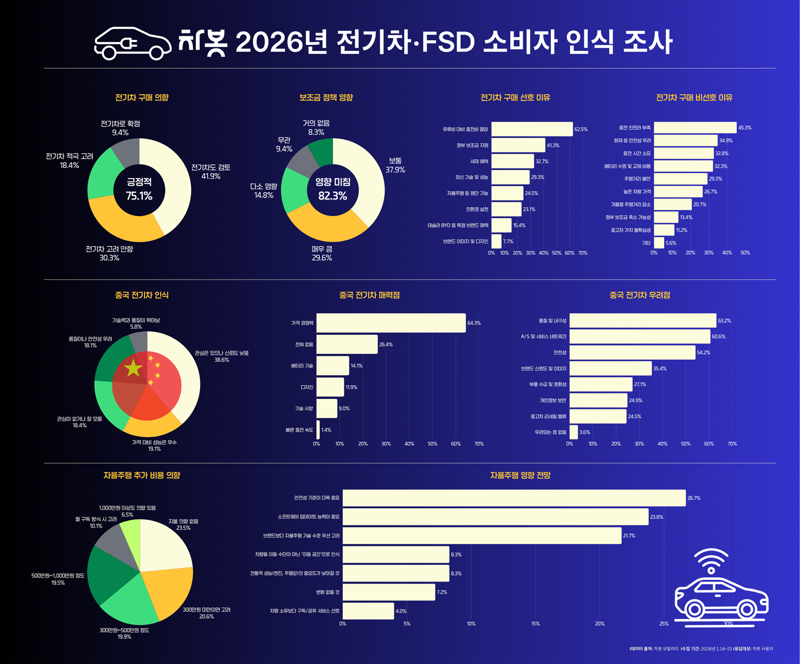
A recent survey by Chabot Mobility, involving 450 potential new car buyers, revealed that 75.1% of respondents view EVs favorably.
The survey found that 41.9% of respondents are considering EVs as an option, 18.4% are actively considering them, and 9.4% have decided to purchase an EV. Younger generations show higher acceptance rates, with 100% of those in their 20s and 85.4% of those in their 30s open to EVs, while older age groups demonstrate less interest.
The primary motivations for considering an EV include lower charging costs compared to fuel expenses (62.5%), government incentives (41.3%), and tax benefits (32.7%).
However, potential buyers express concerns about insufficient charging infrastructure (45.3%), safety issues such as fire risks (34.9%), lengthy charging times (32.8%), and battery lifespan and replacement costs (32.3%). The 2026 EV subsidy policy is seen as a significant factor by about 67% of respondents.
Regarding Chinese EV brands, 38.6% of respondents are interested but remain skeptical. While price competitiveness (64.3%) is the main attraction, concerns center on quality and durability (63.2%), inadequate after-sales service networks (60.6%), and safety concerns, including battery fire risks (54.2%).
As autonomous driving technology advances, safety criteria are expected to become increasingly important in vehicle selection (26.7%). Other factors gaining prominence include software update capabilities (23.8%), autonomous driving technology levels (21.7%), and prioritizing technology over brand (18.0%).
Only 7.2% believe vehicle selection criteria will remain unchanged, indicating that autonomous driving advancements will likely influence purchasing decisions. For advanced autonomous features like Full Self-Driving (FSD), 76.5% are willing to pay extra, with most preferring a price range of 300-500 million KRW (225,000-375,000 USD).
A Chabot Mobility spokesperson noted, “EVs are now seen as practical alternatives, not just for their environmental benefits, but also for potential savings in maintenance and total ownership costs. While Chinese EV brands are attracting attention with competitive pricing, building trust in quality, after-sales service, and safety will be crucial for their success in the U.S. market.”
eastcold@fnnews.com, Reporter Kim Dong-chan












Most Commented