
Translation result
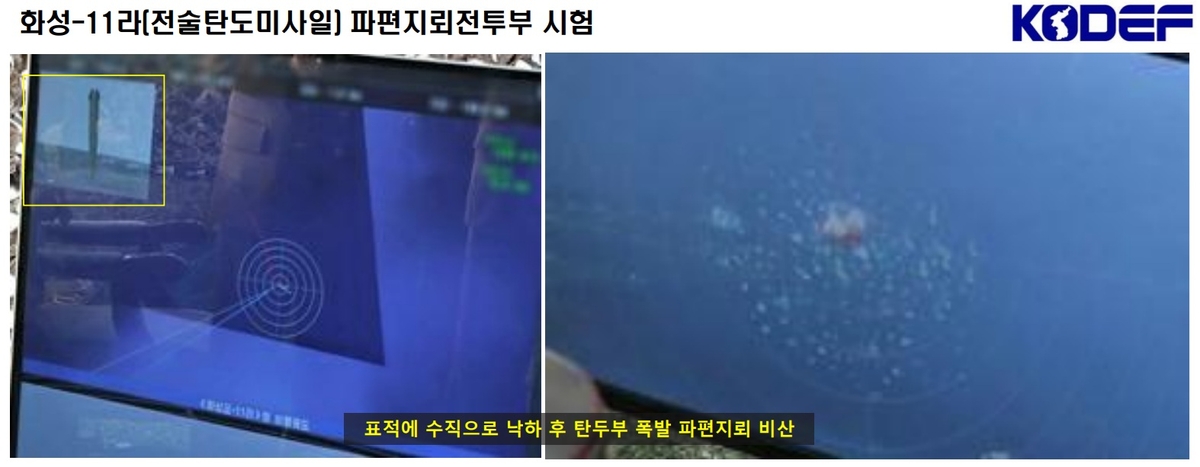 North Korea released footage on the 20th showing a test launch that used cluster munitions. Although Pyongyang conducted cluster-munition trials on the 6th–8th, this is the first time it has publicly released such footage.
The day before, North Korea test-fired multiple rounds of what it labeled the Hwasongpo-11ra from Sinpo in South Hamgyong Province. The released photos show launches from the end of a breakwater and cluster munitions striking Alseom.
International observers had broadly described the system as a new tactical ballistic missile, but North Korea used the name “Hwasongpo-11ra.” Analysts say the missile pairs precision-strike capability with warheads loaded with submunitions (cluster bombs) and airborne mine-dispensing payloads, increasing its lethality.
The Hwasongpo-11ra is the domestic designation for the KN-23, often likened to Russia’s Iskander, and appears to be a scaled-down variant of the KN-23 family. When Pyongyang unveiled the Hwasan-31 tactical nuclear assembly in March 2023, schematics identified the Hwasongpo-11ra label.
Until now, North Korean state media often used generic labels like “new tactical ballistic missile” or “tactical guided missile.” This release marks the first official use of the Hwasongpo-11ra name.
Shin Jong-woo, secretary-general of the Korea Defense and Security Forum (KODEF), said the Hwasongpo-11ra appears shorter and slimmer than the recently tested Hwasongpo-11ga and resembles South Korea’s Korean Tactical Surface-to-Surface Missile (KTSSM) in form and role.
KCNA claimed five Hwasongpo-11ra missiles struck an island 136㎞ away, inflicting very high-density damage across 12.5–13㏊. The agency said the salvo leveled an area equivalent to about 18 soccer fields.
That would be roughly double the area Pyongyang claimed to have devastated during the 6th–8th tests, when it reported destroying 6.5–7㏊.
 North Korea historically fielded short-range ballistic systems such as the KN-02 Toksa, but those platforms have become obsolete. Since about 2021, Pyongyang has focused on short-range systems development, building on progress with variants like the Hwasongpo-11ga.
“A 136 km range covers Seoul and reaches U.S. forces’ garrisons in Pyeongtaek, Osan Air Base, Songtan–Anjung and the Cheonan–Asan area,” said Hong Min, a senior researcher at the Korea Institute for National Unification. “By filling the gap between rocket artillery and short-range ballistic missiles, this system would enable strikes against some of the most sensitive targets in the Seoul–Pyeongtaek area of the ROK–U.S. alliance. That makes it a serious threat.”
He added that the Hwasongpo-11ra appears to have been designed from the outset for salvo fires and high-precision suppression, and that its operational fielding suggests a reorganization of corps-level firepower.
Kim Jong Un, who observed the test, emphasized development of “scatter warheads for diverse missions” and an increase in high-density suppressive strike capability against specific target areas.
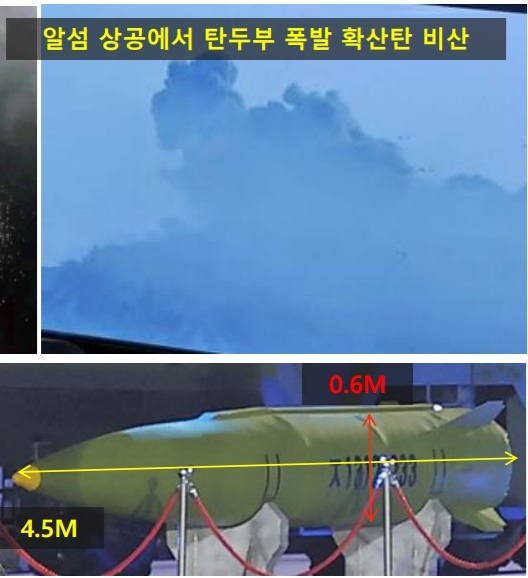
Cluster munitions contain tens to hundreds of submunitions within a single warhead. They airburst and scatter bomblets over a wide area, making them difficult to intercept and indiscriminately lethal—sometimes described as “devil’s weapons.”
After observing Iranian cluster munitions challenge Israel’s advanced air defenses, Pyongyang appears to be accelerating experiments that pair cluster munitions with tactical ballistic missiles.
Notably, the airborne mine-dispensing payload mentioned by state media appears to disperse mines that do not detonate on impact but remain as area denial devices. Analysts say dispersed mines could effectively block opposing-force movement across an affected zone.
The so-called “missile warhead specialist research group” appears to be a department under the Missile General Bureau responsible for warhead research and development. Observers believe the unit is being used to experiment with equipping warheads with a variety of lethal payloads, including cluster munitions and mine-dispensing warheads.

- “No wonder my stomach hurt” — the betrayal of a once-trusted “zero-calorie” drink
- “The Strait of Hormuz was supposed to reopen… but Iran warns it will attack approaching ships”
- “Fired 30,000 workers and the stock shot up?” — employees suffer while shareholders cheer
- North fires multiple ballistic missiles after 11 days — seventh launch this year
- Defense reform under the Lee Jae-myung administration — military to introduce a “major-branch” structure
- “Give your bank account and you’ll get cash” — beware virtual-account scams, regulator warns
- No wonder it took so long — Incheon Airport’s “speed” rating falls
- “Sending my son to medical school is so hard” — medical school admission cutoffs at a three-year high
- How long will the maritime standoff that fattens futures speculators last?
- Didimdol housing loans plunge 40% — speculative demand cooled, real buyers left scrambling









Most Commented