
2025 Media Revenue Rankings: Why JoongAng Ilbo Surged to the Top Amidst Declining Ad Markets
Daniel Kim Views
MediaToday is launching a media-focused newsletter called Mio Letter. On Wednesdays we will publish a roundup of the week’s media coverage; on Fridays we will release a themed report, “Mio Pick of the Week,” distributed first to newsletter subscribers. You can subscribe at https://media.stibee.com. Editor’s note.
Last year, many news organizations released earnings reports. This newsletter summarizes those results, reconstructed from the MediaToday articles listed below.
[Related: Chosun Ilbo ranked No. 1 in operating profit, but JoongAng Ilbo and Korea Economic Daily overtook it in revenue]
[Related: Regional papers sink into the red…diversifying into everything from billboards to rental businesses]
Ad market collapses
The outlook is grim. In 2024 online ad spending totaled 10,101,100,000,000 KRW (≈ $7.58 billion USD), or 59% of the market. Broadcasting ad spending was 3,219,100,000,000 KRW (≈ $2.41 billion USD), 18.8%. Newspaper and magazine ads totaled 1,987,500,000,000 KRW (≈ $1.49 billion USD), 11.6%. Advertisers are clearly shifting to online channels.
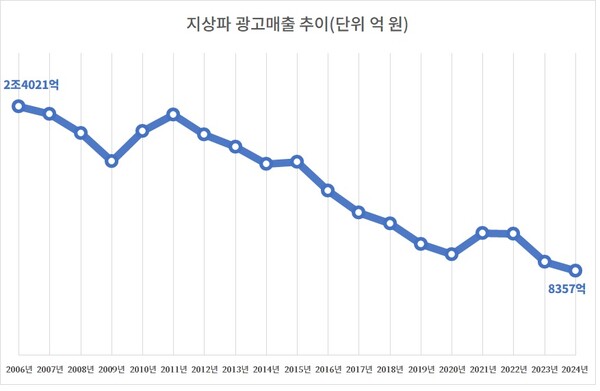
Terrestrial broadcasters have been hit especially hard. Combining data from industry surveys shows terrestrial ad revenue fell from 2,402,100,000,000 KRW (≈ $1.80 billion USD) in 2005 to 835,700,000,000 KRW (≈ $626.78 million USD) in 2024. That’s not a simple halving—it’s roughly a two-thirds decline. In 2005, advertising accounted for 78.1% of terrestrial broadcasters’ revenue; by 2014 it had dropped to 47.4%, and by 2023 to 24.9%.
It’s no surprise advertisers are reallocating budgets to digital. A survey of 84 advertisers planning OTT buys in 2026 found 21.4% would shift part of their broadcast media budgets to OTT, 20.2% would move some online-media budgets, and 8.3% would cut newspaper and magazine budgets. Many advertisers are trimming other media to fund OTT placements.
Worsening economic pressure has also tightened corporate wallets. Companies have been cutting ad spending year after year. There was a time when placing ads felt like insurance for firms; once a company stops, winning that budget back is often often close to impossible.
Why JoongAng Ilbo ranks No. 1 in newspaper revenue
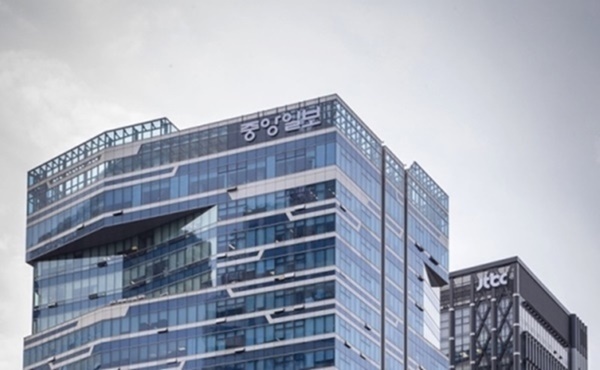
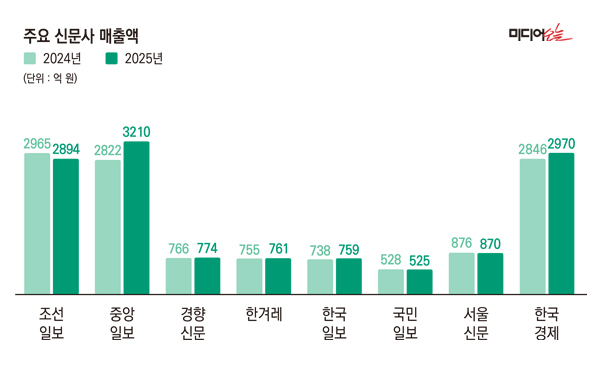
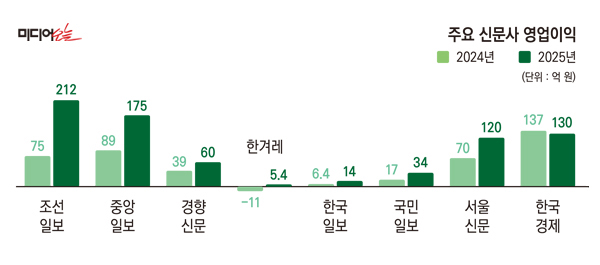
Some publishers still posted gains. In 2025 JoongAng Ilbo led newspaper revenue with 321,000,000,000 KRW (≈ $240.75 million USD), followed by Korea Economic Daily with 297,000,000,000 KRW (≈ $222.75 million USD). JoongAng Ilbo has increased revenue for three straight years. Longtime leader Chosun Ilbo fell to third.
The main drivers were outdoor and elevator advertising. Last August, JoongAng Ilbo bought TownBoard for 53,200,000,000 KRW (≈ $39.90 million USD) and launched an elevator-TV ad business. Buildings and apartment elevators now carry “The JoongAng” signage; elevator screens show ads alongside JoongAng Ilbo headlines.
A JoongAng Ilbo spokesperson told MediaToday on the 6th, “We have pursued diversification of revenue platforms and expansion of our sales network for years. Building on stable competitiveness in our core businesses, outdoor advertising, events, and content ventures have entered active monetization and driven revenue growth. The TownBoard acquisition has contributed through synergies with existing operations, and digital paid subscriptions are becoming a meaningful revenue source. JoongAng Ilbo is using these steps to build a sustainable business model beyond mere top-line growth.”
Korea Economic Daily shows clear business results
Korea Economic Daily ranked second in newspaper revenue (297,000,000,000 KRW, ≈ $222.75 million USD) and reported operating profit of 13,000,000,000 KRW (≈ $9.75 million USD). The publisher attributes this to multiple successful business lines.
A Korea Economic Daily representative said, “Successful cultural projects—such as visits by the Vienna Philharmonic and the Royal Concertgebouw, and exhibitions like ‘Wooster’—boosted revenue. Despite raising the monthly subscription from 20,000 KRW (≈ $15.00 USD) to 25,000 KRW (≈ $18.75 USD) in October 2024, circulation grew year over year. Assets tracking the KEDI index, developed by Korea Economic Daily, surpassed 10,000,000,000,000 KRW (≈ $7.50 billion USD) in net asset value this January, strengthening our position as an index provider and increasing index-related revenue. The advertising rights at Incheon International Airport, awarded in September 2023, also contributed through active sales.”
SBS passed the 1 trillion-won mark but lost more than ₩90 billion each year afterward
Among the three terrestrial broadcasters, only SBS reported operating profit (13,200,000,000 KRW, ≈ $9.90 million USD). Yet after peaking at 1,012,600,000,000 KRW (≈ $759.45 million USD) in 2022, its revenue fell to 866,600,000,000 KRW (≈ $649.95 million USD) in 2023, 768,400,000,000 KRW (≈ $576.30 million USD) in 2024, and 676,700,000,000 KRW (≈ $507.53 million USD) in 2025—drops of more than about 90,000,000,000 KRW (≈ $67.50 million USD) each year.
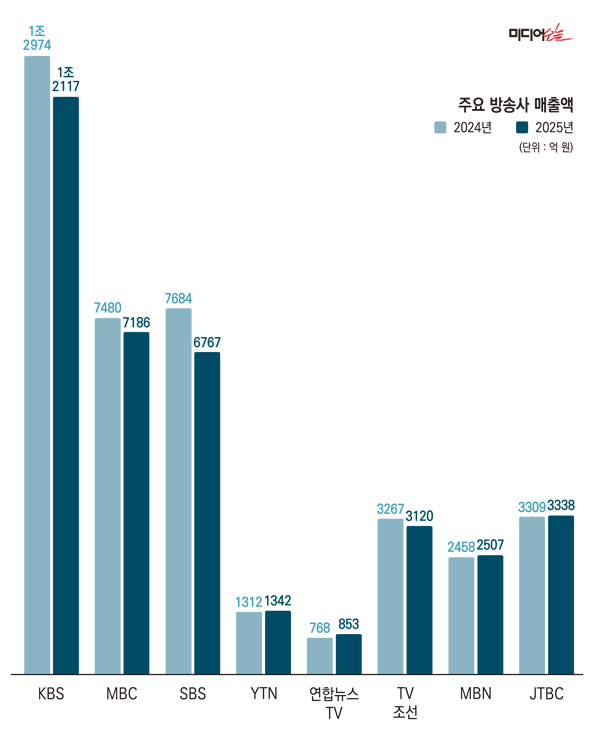
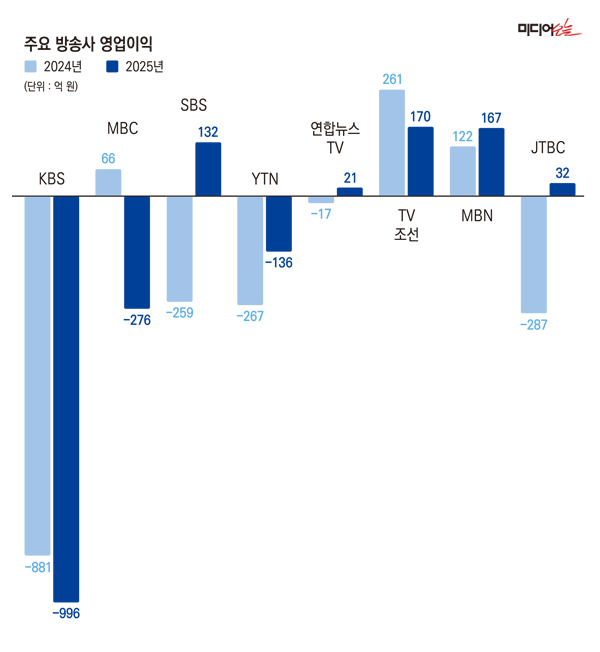
COVID-era viewing spikes, the introduction of mid-roll ads, and hits such as “The Penthouse,” “Taxi Driver,” and “One the Woman” briefly helped results but did not sustain momentum. The major shareholder Taeyoung Construction’s workout filing at the end of 2023 also appears to have affected SBS and its affiliates. Although SBS posted a loss in 2024 and returned to profit last year, that swing came largely from cutting production costs by more than 90,000,000,000 KRW (≈ $67.50 million USD).
An SBS source said, “We cut costs, and the Netflix partnership we signed two years ago probably appeared in last year’s financials. Advertising revenue fell 10–20% compared with the first quarter last year. I don’t expect broadcasting to get easier this year.”
MBC posts a roughly ₩27.6 billion operating loss after weak drama performance
MBC has held annual revenue in the mid-700 billion-won range for three years, but unlike 2023 (operating profit 7,700,000,000 KRW) and 2024 (6,600,000,000 KRW), it recorded an operating loss of –27,600,000,000 KRW (≈ –$20.70 million USD) last year. Broadcast ad income fell from 265,000,000,000 KRW (≈ $198.75 million USD) to 243,500,000,000 KRW (≈ $182.63 million USD), a decrease of 21,500,000,000 KRW (≈ $16.13 million USD). Several dramas underperformed, leaving them unprofitable. Net income rose from 21,500,000,000 KRW (≈ $16.13 million USD) to 177,700,000,000 KRW (≈ $133.28 million USD), but that increase reflected a one-time gain from selling the Busan MBC building.
An MBC spokesperson said, “Our dramas underperformed last year. Series like ‘Labor Attorney No Mu-jin’ and ‘Let’s Go to the Moon’ failed to hit, producing roughly a 20,000,000,000 KRW deficit (≈ $15.00 million USD). The era when terrestrial broadcasters routinely posted operating profits is over. We recorded losses around 13,000,000,000 KRW (≈ $9.75 million USD) in January–February this year; KBS is also seeing significant deficits. Conditions could improve over time, but the first half of this year could still show large losses.”
Only Mokpo MBC among regional MBCs posted operating profit
Regional broadcasters have pushed hard to diversify revenue because the advertising slump hits them especially hard.
Last year, only one of 16 regional MBCs reported operating profit: Mokpo MBC earned 330,000,000 KRW (≈ $247,500 USD). All other regional stations recorded operating losses. Mokpo MBC moved its headquarters in 2023 to a site in front of Mokpo Station and began earning rental income, launched a digital out-of-home (DOOH) advertising business, and expanded an eight-year investment in solar power generation. Jeonju MBC has also specialized in solar projects suited to the flat Honam plains. Stations such as Busan MBC and Daegu MBC raised operating funds by selling buildings: Daegu MBC sold its headquarters in 2019 for 400,000,000,000 KRW (≈ $300.00 million USD), and Busan MBC sold its building in 2021 for 360,000,000,000 KRW (≈ $270.00 million USD).
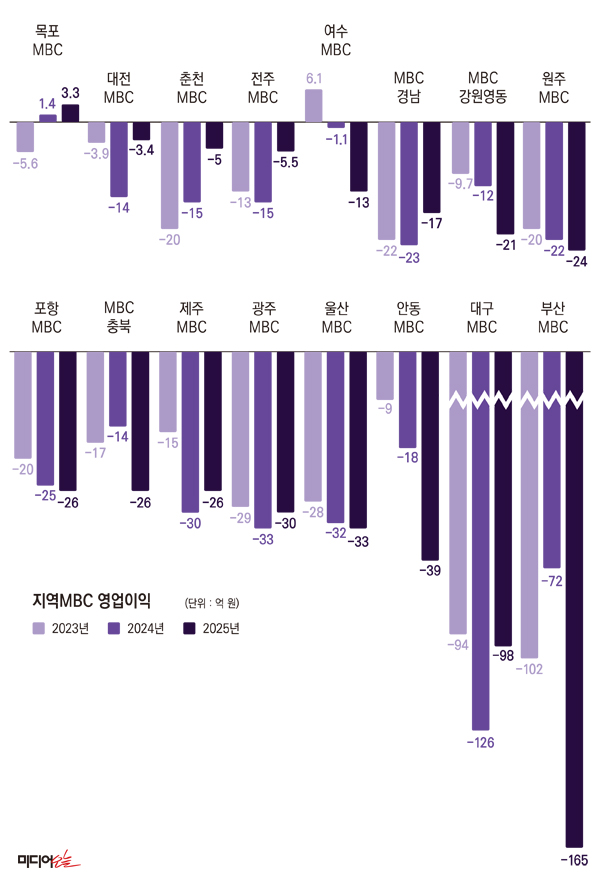
Mokpo MBC CEO Kim Soon-gyu explained the profit drivers: “Our media wall delivers revenue other stations don’t have. Moving in front of Mokpo Station in 2023 created rental income and allowed us to add DOOH. We also expanded solar investments steadily, and our local sales team worked hard. No single factor explains our operating profit.” As broadcast ad revenue collapsed, Mokpo diversified revenue streams and reduced the share of broadcast ads in total sales; CEO Kim noted, “KOBACO accounts for about 23% of Mokpo MBC’s total revenue.”
MBC Gyeongnam turned aggressive content investment into profit. Several high-quality documentaries won critical recognition and wider audiences; “Adult Kimjang” (2023) and “Gimbap Paradise” (2024) became the first regional programs from the station to be distributed on Netflix, opening new channels. MBC Gyeongnam’s YouTube channels—‘MKitaka’ with 1.06 million subscribers and ‘MNu’ with 470,000—helped reduce its deficit, and the station returned to net profit of 40,000,000 KRW (≈ $30,000 USD) last year.
Only three of ten regional private broadcasters turned a profit
Last year, only three of ten regional private broadcasters reported profits; by contrast, in 2021 two were in the black. KNN (Busan/Gyeongnam), TBC (Daegu), and JTV (Jeonju) posted operating profits of 2,700,000,000 KRW (≈ $2.03 million USD), 1,500,000,000 KRW (≈ $1.13 million USD), and 1,300,000,000 KRW (≈ $975,000 USD), respectively. But KNN’s profit fell from 5,600,000,000 KRW (2023) (≈ $4.20 million USD) to 4,100,000,000 KRW (2024) (≈ $3.08 million USD) to 2,700,000,000 KRW (2025) (≈ $2.03 million USD), and TBC’s dropped from 4,100,000,000 KRW (2023) to 1,500,000,000 KRW (2024–2025). Profits are shrinking.
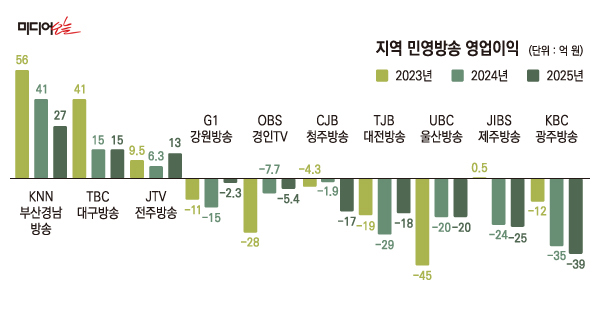
KNN and JTV also generated revenue through aggressive YouTube distribution. Kim Chun-young, head of communications at JTV, said, “YouTube has become one of our business areas. YouTube revenue rose sharply last year; without it, we likely wouldn’t have avoided a loss.”
Regional private broadcasters face a stark reality. Kim Chun-young noted, “Ad revenue fell from about 18,000,000,000 KRW in the early 2000s to roughly 3,200,000,000 KRW recently. With ad revenue declining about 20% each year, regional stations can’t avoid losses. Even when we post a profit, the amount is small. We explored many businesses to cover deficits, even planning and running municipal festivals directly.”
TBC added, “Only a minority of regional stations post operating profit, and those that do rely on non-broadcast revenue—concerts, contract wins, and other activities—not advertising. It’s hard to cover payroll with ad income alone. Ad revenue has decreased around 10% annually; what was roughly 27,000,000,000 KRW in 2012 fell to about 7,300,000,000 KRW last year.”
Busan Ilbo halves its operating loss; Gyeonggi Ilbo increases operating profit
Of eight major regional newspapers that disclosed 2025 results, only Gyeonggi Ilbo and Jeonbuk Ilbo reported operating profits above 500,000,000 KRW (≈ $375,000 USD). Busan Ilbo posted a –4,600,000,000 KRW loss (≈ –$3.45 million USD) last year, roughly half its 2023 loss of –9,900,000,000 KRW (≈ –$7.43 million USD). Busan Ilbo also increased revenue to 38,600,000,000 KRW (≈ $28.95 million USD), up about 7,000,000,000 KRW from two years earlier (32,000,000,000 KRW, ≈ $24.00 million USD).
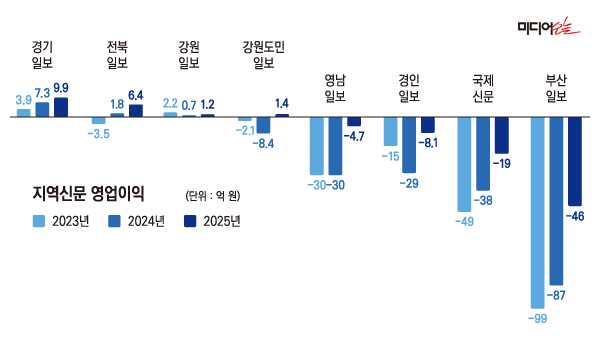
Their strategy involved everyone—from staff to management—working to offset falling ad revenue. Management diversified into cultural projects, a data-center build, rental businesses, outdoor advertising, and investments in a digital-asset exchange. Busan Ilbo CEO Sohn Young-shin said, “We cut costs, including through natural reductions in headcount. Everyone adopted emergency management to boost ad and sponsorship revenue. New culture projects last year included the Yangsan Egg-ya Festa, a golf tournament, and a digital finance and blockchain academy. We continue our marine and fisheries CEO academy as well.”
Gyeonggi Ilbo stands out for steady growth: revenue rose from 28,000,000,000 KRW (≈ $21.00 million USD) in 2023 to 31,600,000,000 KRW (≈ $23.70 million USD) in 2024 and 35,100,000,000 KRW (≈ $26.33 million USD) in 2025, while operating profit climbed from 390,000,000 KRW (≈ $292,500 USD) to 730,000,000 KRW (≈ $547,500 USD) to 990,000,000 KRW (≈ $742,500 USD). Gyeonggi Ilbo’s management office said they aggressively pursue competitive-bid projects, run sports and cultural events, and are exploring museum and expo businesses. In 2023 they were the only Gyeonggi–Incheon outlet accepted as a Naver Contents Partner, which appears to have increased distribution fees and brand recognition.”
*This report compiles data from the Financial Supervisory Service’s electronic disclosure system and original reporting. For revenues and operating profits (including losses) above 1,000,000,000 KRW (≈ $750,000 USD), figures are rounded to the nearest 100,000,000 KRW (≈ $75,000 USD); amounts below 1,000,000,000 KRW are shown to the nearest 10,000,000 KRW (≈ $7,500 USD).














Most Commented