
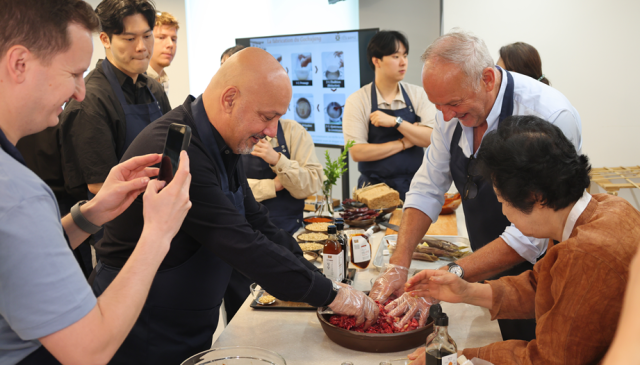
Frédéric Anton—one of France’s most celebrated Michelin three-star chefs and a Meilleur Ouvrier de France (MOF)—sampled traditional Korean condiments and was clearly impressed. With fine-dining chefs across Europe praising jang, the stage is set for K-sauces to make a bigger splash globally.
On June 1, the Ministry of Agriculture, Food and Rural Affairs reported that three Michelin three-star chefs—Anton, Christian Le Squer, and Martin Offenzer—joined a Korean food culture experience on May 30 at the Food Masters Experience and Promotion Center in Jongno, Seoul.
The session was led by Korea’s certified food master Gi Sun-do. Using methods passed down for 360 years, Gi ran hands-on workshops and served jang-based dishes that won over the chefs.
The visitors were full of praise for the jang-driven dishes. Chef Frédéric Anton called Korean food \”a healthy, vegetable-forward cuisine enhanced by fermentation.\”
Korea’s jang culture has recently gained international recognition for its history and distinctiveness. In 2024, UNESCO inscribed Korea’s jang-making culture on the Representative List of the Intangible Cultural Heritage of Humanity. Traditional jang—doenjang, ganjang, and gochujang—and the methods used to make them reflect fermentation techniques and culinary wisdom accumulated over thousands of years.
Korean sauces are already proving their appeal in global markets. Gochujang and Korean-style barbecue sauces have surged in popularity, especially in the U.S. Last year, sauce exports totaled USD 92.2 million to the United States, USD 60.4 million to China, and USD 4.02 million to the Commonwealth of Independent States (CIS).
The ministry expects sauces to drive K-food growth this year and is pushing to expand exports. Since 2016, the ministry and the Korea Food Masters Association have operated the Food Masters Experience and Promotion Center to promote the value of traditional foods and food culture.
Recently, the center has focused on hands-on programs that let visitors make traditional foods themselves. Last year, it hosted 53 sessions led by food masters and 204 programs taught by traditional food specialists, all aimed at showcasing the strengths of Korean food culture.
Jung Kyung-seok, Director of Food Industry Policy at the ministry, said, \”When our jang-making culture was inscribed on UNESCO’s list in 2024, it once again highlighted the excellence of our traditional jang to the world. We will continue to actively support the ongoing development of traditional foods and food culture.\”










Most Commented