
Translation result.
Since NASA’s crewed Moon flight — the first in 54 years — Artemis II comes with a meticulously planned astronaut menu. Because the Orion spacecraft cannot refrigerate or receive resupplies, all food is loaded before launch and must work within strict mass, space and power constraints.
According to NASA’s crew menu document released on April 2, the mission includes a total of 189 menu items.
The menu team did more than box up standard in-flight meals: they selected foods to meet calorie, fluid and nutrient needs while reflecting crew preferences. Those choices were balanced against Orion’s limits on weight, volume and electrical power.
The beverage list offers more than 10 options. Along with coffee and green tea, the menu includes mango and peach smoothies, chocolate and vanilla breakfast drinks, lemonade, apple soda, and cocoa. Crew members are limited to two drinks per person per day; NASA says the mission includes 43 cups of coffee in total.
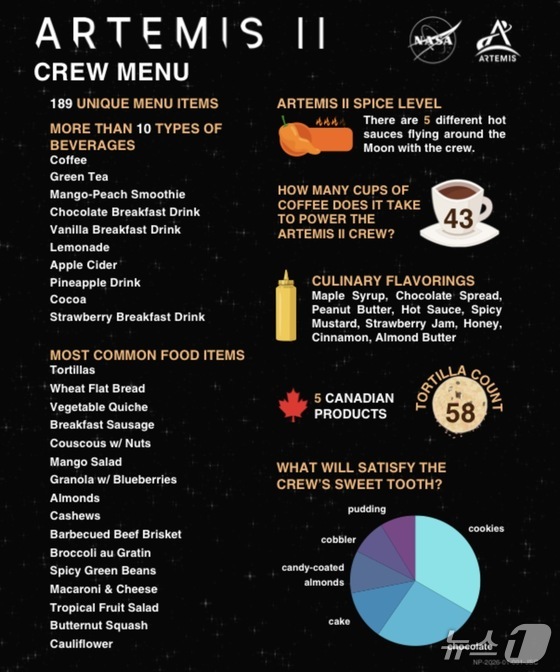
Five hot sauces among 189 menu items — what a resupply-free “space diet” requires
Planners also included a range of culinary flavorings: maple syrup, chocolate spread, peanut butter, strawberry jam, honey, cinnamon, spicy mustard and five kinds of hot sauce. Some ingredients come from Canada, reflecting international cooperation in provisioning the menu.
Meals resemble familiar Earth food. The list includes tortillas and wheat breads, vegetable quiche, breakfast sausages, couscous with nuts, mango salad, granola, almonds and cashews.
The team packed 58 tortillas in total. The menu also features barbecue beef brisket, broccoli gratin, spicy green beans, macaroni and cheese and tropical fruit salad.
Dessert options are included, too: cookies and chocolate, candy-coated almonds, cobblers, puddings and cakes — sweet choices meant to boost morale even in a tightly constrained environment.
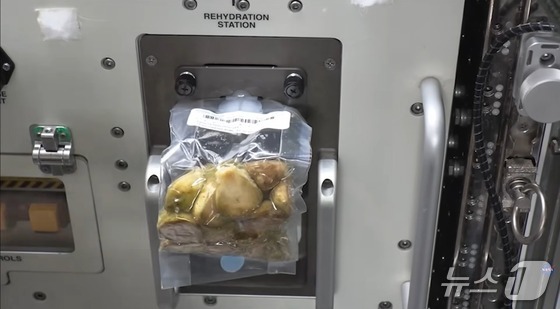
Rehydration and heating — how astronauts eat in space
The menu relies on shelf-stable items rather than fresh food because Orion has no refrigeration and cannot receive resupplies. Foods are engineered to minimize crumbs and other hazards in microgravity.
Items fall into ready-to-eat, rehydratable (freeze-dried), heat-preserved and irradiated categories. Preparation is kept simple so meal prep doesn’t interfere with spacecraft systems or crew activities.
Meal methods change by flight phase. During launch and reentry — when water systems may be offline — crew receive foods that can be eaten without preparation. Once flight stabilizes, astronauts rehydrate freeze-dried meals with water or warm food in a small onboard heater.
Crew members sampled and rated the menu before flight, so the final selection reflects personal tastes and nutritional needs. NASA grouped each astronaut’s food into containers holding two to three days’ worth of meals to give them choice and flexibility during the mission.
Artemis II’s menu differs from food flown on Apollo, the Space Shuttle and the International Space Station because it must be fully self-sustaining with no resupply. While the ISS receives regular cargo and fresh food, Artemis II will operate on a fixed, preapproved menu.
NASA says the core challenge is delivering nutrition, safety and taste within extremely limited space and resources.
Artemis II will carry four astronauts on a roughly 10-day crewed test flight around the Moon before returning to Earth. For the first time on a crewed flight, NASA will test Orion’s life-support systems in flight and evaluate deep-space operations like communications dropouts and reconnection when the spacecraft passes behind the Moon. The agency plans to use this mission as a stepping stone for sustained lunar exploration and to build capabilities for future Mars missions.












Most Commented