
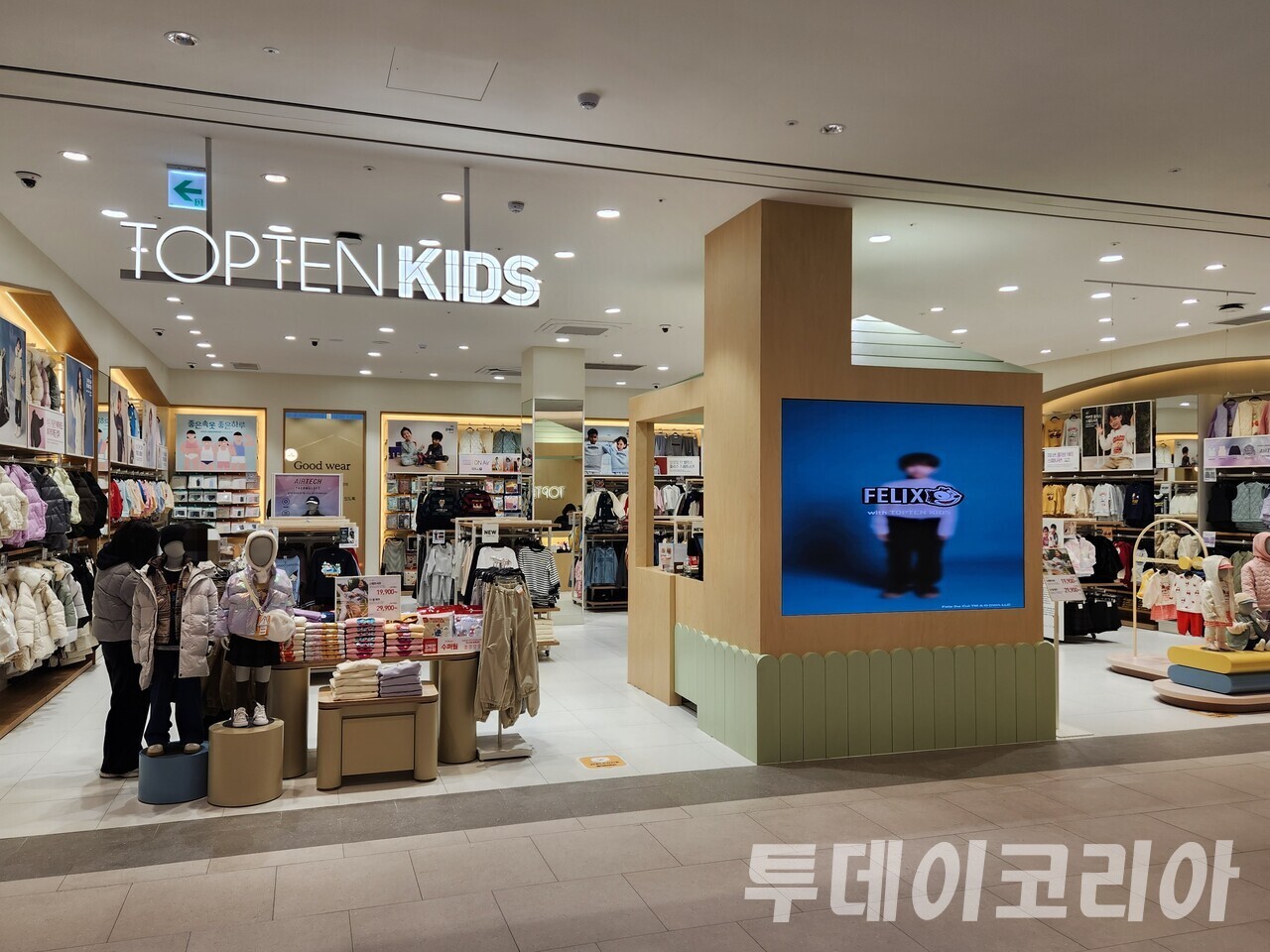
TodayKorea — Reporter Jihoon Kim | With the rise of “golden consumption”—where parents with a single child spend more on that child—South Korea’s children’s apparel market is experiencing a noticeable boom. A slight rebound in birth numbers has industry watchers optimistic that the growth will continue.
Summarizing TodayKorea’s reporting on the 1st, market researcher Euromonitor estimates the domestic kids’ apparel market at roughly 2.63 trillion KRW (approximately $1.97 billion)—about a 43% jump since 2020.
Industry insiders say the expansion is driven partly by kids treating brands and design as status markers, and partly by reduced resistance to premium-priced items.
Euromonitor expects that the market could grow to about 2.907 trillion KRW (approximately $2.18 billion) by 2030 as demand strengthens.
In response, major local fashion companies are doubling down on kids’ offerings, launching kid-focused promotions and new collections to capture the trend.
For instance, Shinsung Tongsang’s kids’ label TopTen Kids opened a customer-experience store last year called TopTen Kids OneGrove, built around a “playground with books” theme and featuring a baby-only zone for infants and toddlers.
The brand also rolled out TEN-sational experience zones at Starfield Hanam and Suwon, and it has a wide retail footprint spanning department stores, big-box retailers, outlets and online channels.
TopTen Kids has diversified its lineup into three age-focused lines—Baby (1–4), Toddler (4–7) and Junior (8–13)—with designs tailored to active kids.
Notably, the company implemented a five-step, multilayer quality-check system last year that covers design planning, artwork review, corporate approvals, sampling and mass production. After an initial pass by the graphic design team, legal and compliance perform cross-checks to create a dual verification process.
The result has been stronger quality controls: issues ranging from typos to discriminatory or offensive language are now classified by risk level and managed in stages.
That approach appears to be paying off.
Industry sources say TopTen Kids ran a baby-line pop-up at Starfield Village Unjeong from Feb. 23 through March 5 and pulled in about 120 million KRW in sales (roughly $90,000).
Analysts credit the strong performance to the brand’s strategy of proactively targeting shopping districts that draw family traffic.
A TopTen Kids spokesperson told the press, “We’re building brand strength through product quality and immersive customer experiences. Having grown through parenting communities, we’ll keep focusing on hands-on events to build parents’ trust.”
An industry official told this paper, “TopTen Kids has reinforced product quality based on a philosophy of giving children and parents well-made clothes, and it has boosted competitiveness by adding experiential stores. Coupled with the golden-kids trend, the brand has successfully tapped into parents’ desire to dress their kids in the best.”









Most Commented