
Translation result

Can’t Wash Your Curtains Often? An Unexpected Trick to Remove Odors
Curtains trap more household odors than most people realize—soaking up cooking smells, dust and dampness. But laundering them frequently is often impractical. Thick blackout curtains, in particular, are cumbersome to wash, making odor control more essential. In that situation, many people turn to baking soda as a simple deodorizing trick.

Curtains are fabrics that easily absorb odors
Curtains are often made from fibers such as cotton or polyester.
Those materials readily capture odor particles and dust suspended in the air.
Homes near the kitchen or those with poor ventilation are especially prone to lingering smells.
\”Sometimes I notice a musty smell coming from my curtains,\”
The longer you go between washes, the more likely those odors are to settle in.
Baking soda often works as an odor absorber
People commonly use baking soda as a deodorizer in household cleaning.
It can help neutralize odor-causing molecules, which is why it’s used in refrigerators and shoe cabinets.
The same principle makes it useful for managing curtain odors.
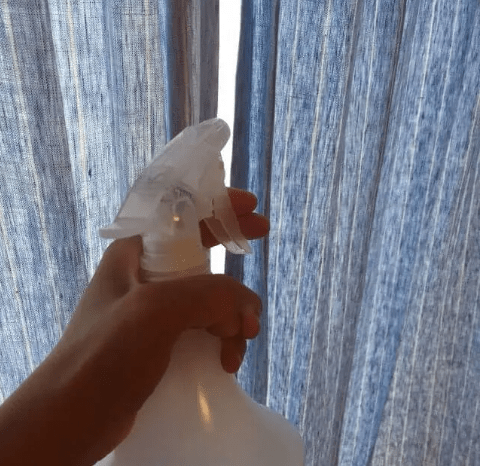
Dilute it in water and spray so it spreads evenly across the fabric
Put baking soda and water in a spray bottle, shake gently, and mist the curtains so a thin layer coats the surface.
Letting it sit gives the baking soda time to interact with odor particles.
That can help reduce smells that have become embedded over time.
Should I spray more to get better results?
Don’t overdo it—heavy spraying can leave marks. A light, even mist is usually enough.
There’s a reason to leave it for about 30 minutes
This pause allows the baking soda to work on the odor molecules. Waiting a short while typically produces better results than wiping it off immediately.
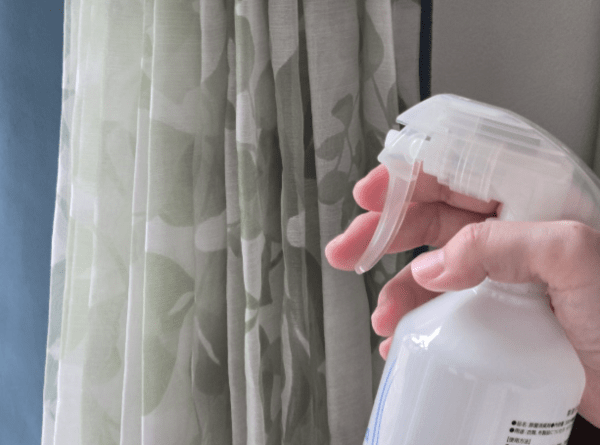
It’s especially helpful to ventilate at the same time.
A final airing step matters
Using a fan or a hair dryer on a low setting helps any remaining moisture evaporate quickly.
If you skip this step, a damp, musty smell can linger.
So be sure to include a drying step in the routine.
So removing moisture is the key, right?
Exactly. Controlling moisture is crucial to odor management.

Sunlight and ventilation together work even better
If possible, open windows and let fresh air move through the room.
Sunlight and airflow are effective at reducing odors trapped in fabric.
Choose a clear, sunny day over a rainy one when you can.
Test dark-colored curtains first to be safe
Some fabrics can show faint marks.
So test the solution on an inconspicuous area before treating the whole curtain.

Ultimately, the key is tackling both odor and moisture
Simply spraying an air freshener usually won’t solve curtain odors for long.
You need to address odor particles and reduce residual moisture in the fabric to make a noticeable difference.
So regular care for curtains matters, too.
Right. Because curtains aren’t washed often, interim maintenance is especially important.














Most Commented