
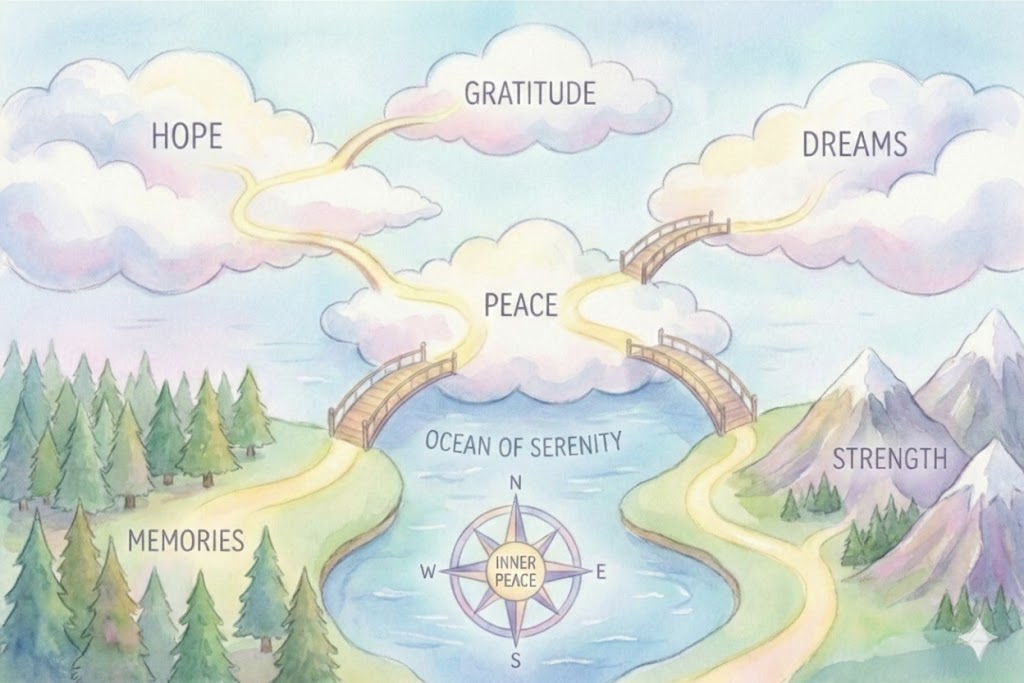
Inner Map — After Fifteen Questions, How We Record Our Lives
Not long ago I asked people to name their “life photo.”
The answers arrived like small, persistent echoes.
One person recalled standing beneath the cherry blossoms on Kyung Hee University’s campus at 20.
They said the day felt unusually clear, and the lightness of their step and an unguarded laugh looked so lovely they planned to dig up the photo.
Another friend pointed to a childhood vacation snapshot with relatives. They couldn’t explain why it lingered — the family never gathered like that again, and they weren’t especially close — yet that day stayed warm in memory.
Someone else remembered an early morning in Switzerland on their honeymoon, looking out a hotel window at the Jungfrau. Everything was strange and unnervingly sharp: alone, quiet, unfamiliar, intensely alive.
Another person spoke of a photo taken right after birth, calling it the starting point of a long story — their life photo.
Hearing their stories made me more curious.
What exactly is a life photo? Is it the defining moment of a life?
Maybe the day was ordinary, perhaps a little dull; the moment may have felt meaningless then.
Some scenes pass without our noticing.
Yet over time, certain images cling to us.
They rise unbidden and, among countless other moments, quietly glow.
So I ask: does life belong to the person who remembers it, or to the person who records it?
Probably both. Memory is selective; recording is deliberate.
What matters may not be making grand moments but refusing to let small feelings slip away.
A seemingly insignificant day, a mood that’s hard to name, thoughts you never told anyone.
Try holding those moments for a beat and jotting them down, even briefly.
Someday, those notes might become your life photo — your life moment.
How are you drawing your inner map?
These days, when photos feel more immediate than words, I ask:
Is your life photo an actual photograph, or an as-yet-unshot scene?
Is the moment you want to return to now a happy one, or one that defied explanation?
What scene from today stayed with you, even if no one else noticed?
And what do you choose to remember — and what are you letting go of?
Today I posed these questions to the reporter who uploads our Inner Map series.
1. What was your first impression when you read the Inner Map project and its prologue? And what do you think this series means within a publication that covers AI?
: With information coming at us nonstop, society grows easily fatigued. AI coverage pours out daily, and keeping up can feel less like choice than obligation. In that climate, content that not only lets readers pause but also slows thought and prompts reflection becomes more valuable. I see Inner Map serving that purpose within an AI-focused outlet.
2. AI Times readers know technology and industry well. Have you noticed how readers reacted or changed after reading Inner Map?
: Inner Map consistently attracts steady readership. In an era when serialized pieces often lose momentum, that consistency matters. It indicates demand even within a specialist publication for material that offers a breather. In a world where readers click only what interests them, Inner Map’s regular, engaged audience suggests it has become a go-to column rather than a one-off.
3. Any installment that stayed with you? From episodes 1 to 15, which word or line lingered longest?
: At 480p everything blurs: April’s green, May’s green, June’s green — all just “green.” But in 4K, April’s light green lets light through; May’s green deepens; June’s green grows dark and heavy. The same tree, the same leaf, yet the color is wholly different. Turn up the resolution, pull the zoom, and look slowly. When you see the world in higher resolution, the illusion of “ordinary” falls away. Every passing moment around us has never existed in low quality.
This passage from episode 10 impressed me most. It felt like a line that could sit in a novel or essay — an expression that connects with everyday feeling.
4. The series runs an Experiment Map alongside Inner Map. Have you tried following the prompts or keeping an experiment-style journal yourself?
: Translating submissions naturally brings me back to the questions. I find myself turning the prompts over again, and I hope to carry the experience further by drawing my own map in my own way.
5. What does your current emotional landscape look like — a calm plain, a bustling city, or a garden just beginning to bloom?
: Lately my mind alternates between calm plains and steep climbs. I’m not settled; I’m finding balance. Maybe it’s a phase many early-career professionals pass through. Since I’m still shaping my approach, experiencing different paths and terrains feels like it broadens my life.
6. Where is your mental hideaway, the place you catch your breath away from deadlines?
: I find relief in conversations that aren’t about work. AI comes up everywhere now, but sometimes you need time to think about life’s direction; books are my refuge. It’s less a fixed place than moments that shift the grain of my thinking — those moments become my hideaway.
7. What is AI to you, and lately, what does “self” mean to you?
: I see AI as an unfinished thing. Many fear it, but I see more potential in people. Perhaps the most remarkable figures today aren’t the systems but ordinary workers keeping pace with rapid change. When my confidence dips, I remind myself that the self holds more potential than I assume. After all, people built AI. I want to keep my own creativity and inventiveness alive.
We still try to understand who we are,
hesitate between certainty and doubt,
and live holding onto emotions that never fully explain themselves.
Perhaps whether we live, record, or revisit life,
we rarely reach certainty,
and we keep asking whether it was love or happiness.
Between those moments, our inner lives shift, return to certain points, and occasionally surprise us by revealing ourselves anew.
Maybe that process is one of life’s small pleasures.
So today I wanted to ask about life photos. I wanted to meet a fellow recorder and continue the question together.
Over the past 15 weeks, what kind of inner map have you drawn? Share a little if you like.
And when you look back someday, what scene will this moment become?
Including the fact that you can’t know yet.
Ayn (content planner; author of Inspiration Lessons for the Bookstore Traveler, among other works)














Most Commented