
Translation result

No matter how wealthy someone may be, people sometimes quietly avoid sitting near them. By contrast, there are people with modest means who make you think, “I’d really like to have a meal with that person.” Class isn’t measured by possessions; it shows in how you use what you have, how you speak and how you’ve lived.


How wealth can mask a lack of class
On the YouTube channel Knowledge Inside, which has 3.74 million subscribers, Yeongman Yoo, a professor at Hanyang University, zeroed in on behavior at decisive moments. After a group meal, for example, some people suddenly go looking for the restroom or pull out their phones the moment the bill arrives. Their attention drifts at the very instant the social test occurs. It’s not that they can’t pay — it’s a habit.
Yoo argues this is more than mere stinginess. Opening your wallet can be an expression of regard. Those who step up to pay in key moments, who reach out first, are often the ones who keep people close over the long run.
Another common trait is an inability to read the room. Some speakers treat a short guest spot like the main event and fill 45 minutes; others use a three-minute slot to deliver a 30-minute monologue. They see only themselves. They fail to appreciate how valuable other people’s time is or what role they are meant to play.
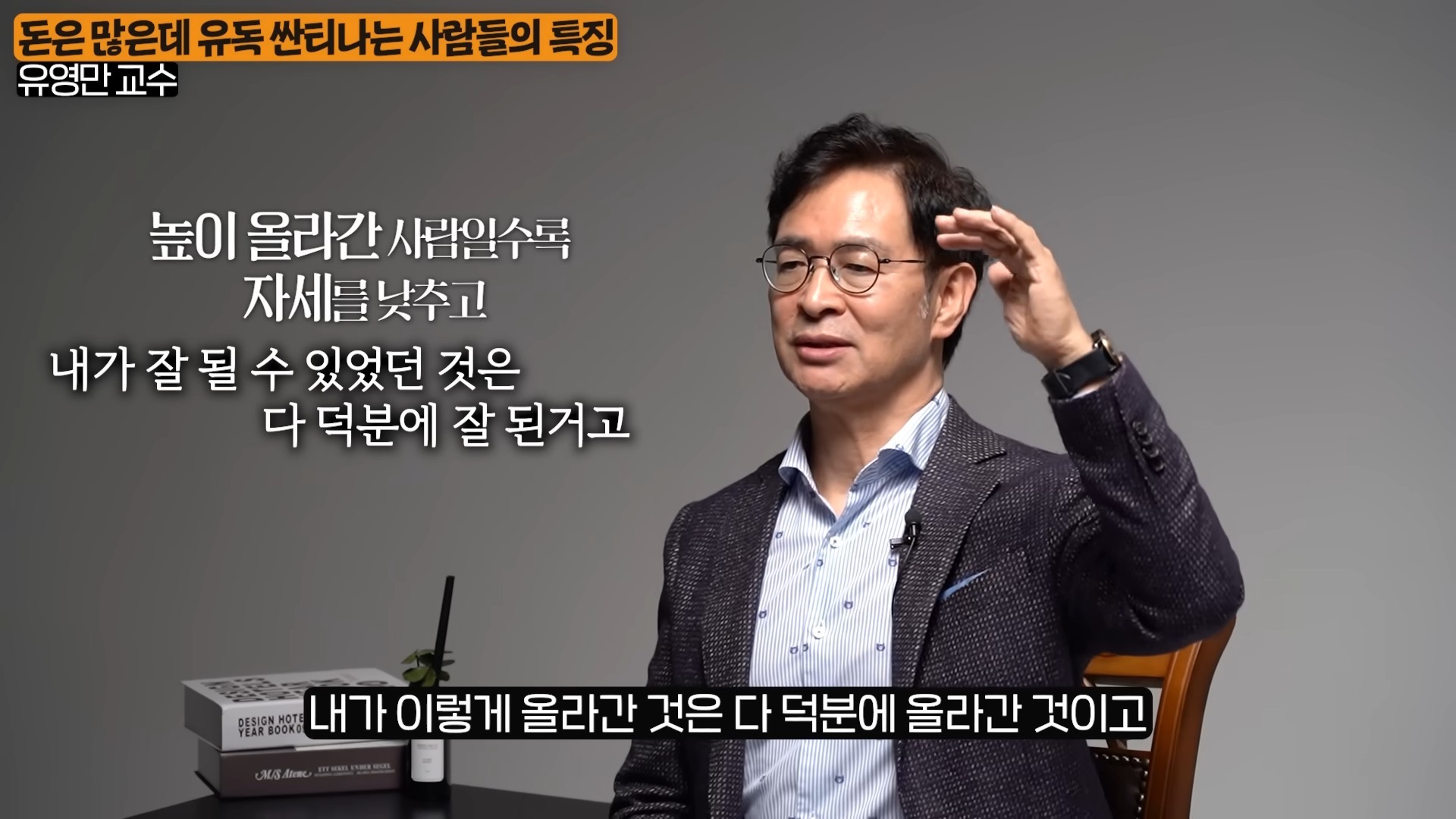
Knowledge or money rarely change this behavior. If anything, the more some people acquire, the more they feel compelled to display it. Yoo emphasizes that truly elevated people tend to lower their posture and acknowledge that their success was made possible by others — and that humility is the real marker of dignity.
What distinguishes those who radiate dignity despite having little
So what sets the opposite group apart? Yoo’s first answer is the weight of their words.
They don’t rely on obscure, academic vocabulary. Instead, ordinary phrases carry the weight of lived experience. Those words don’t merely brush the ear; they land and resonate. A single remark can make you realize that this person speaks from a different place.
Another sign is a face that reflects a well-lived life. Some people’s expressions reveal their history without heavy makeup. It’s hard to explain exactly, but when you meet them you naturally want to start a conversation. That presence comes not from ornament but from the density of experience — a quiet, lived dignity.

Three secrets to living with dignity – 1. Strip away the fluff
The first step toward living with dignity is stripping away the fluff. Yoo uses himself as an example: remove “Hanyang University” and “professor” from “Hanyang University Professor Yeongman Yoo” — what’s left is just his name.
Titles, affiliations and adjective-laden numbers are what he calls bubbles. They appear to describe you, but often they stand in for you. True strength is competing in the world with only your name once the fluff is gone.
The issue becomes clearer in your 50s and 60s. When you leave a job, when titles disappear and organizational shelter vanishes, what remains defines your real dignity. Some people still get calls after their business card stops mattering; others attract attention only while holding a lofty title and lose contact at retirement. The difference is the person themself.
To live with grace on name alone, Yoo recommends practicing finding small wonders in everyday life. Dignified people spot meaning in the small things and can put that meaning into words. As that habit grows, so do the tone of their language and the steadiness of their gaze — and that becomes dignity.

Three secrets to living with dignity – 2. Words can reveal your character
In the same circumstances, some people use words that wound. Those people tend to follow a pattern: when things go wrong they look outward for the cause. Yoo illustrates this with a window-and-mirror analogy. Some people look out the window and blame the environment or others. Those who look in the mirror first ask, “What did I do wrong?” And when things go well, they look out the window and credit others for their success.
People who look in the mirror during failure and out the window in success speak without venom. Their words encourage reflection rather than resentment.
How you say something matters. Snapping, accusatory language only puts people on the defensive. A posture of empathy and understanding, rather than blame, opens conversation.
Three secrets to living with dignity – 3. Don’t let envy rule you
Yoo points to Salieri from the film Amadeus as an example of a life consumed by envy — a man who spent his days asking why he couldn’t match Mozart’s genius. If your questions always point outward and you seek causes externally, you set yourself up for frustration.
People who blame outside forces follow a familiar script: “It failed because the organization was bad,” “the environment didn’t support me,” “someone interfered.” As long as the questions point outward, real change is unlikely. Blaming external causes leads to conflict with others, and that conflict often leaves only psychological defeat instead of solutions.
By contrast, those who grow turn their questions inward. Faced with spilled water, they ask, “What can I do now to make the most of this situation?” That is a reflective, learning-oriented question. Habitually asking it means you fight the problem, not the person. People who fight the problem tend to find the path to resolution in time.
A shift in perspective produces very different attitudes in the same situation. Those who turn their questions inward keep the door of possibility open. That appears to be the shared secret of people who live with dignity despite having little.

Five traits that can transform the second half of life
Finally, Yoo outlines five traits that can turn the second half of life around.
First, they carry blank stationery, not an answer sheet. Some people look for a single right answer; others write their own solutions as situations demand. The latter tend to live with dignity.
Second, they live by centripetal, not centrifugal, force. Instead of following what “others” say is good, they center life on what they themselves love. There’s a different kind of style between those whose subject is “they” and those whose subject is “I.”
Third, they pursue a future of intention, not a passive future. They don’t wait for the future to arrive; they build it.
Fourth, they welcome unfamiliar stimuli. Encounters with the unfamiliar can generate new understanding.
Fifth, they live with a sense of fulfillment, not constant strain. Some people chase speed and results and feel hollow even after achieving their goals. Others find accomplishment in small daily wins and discover happiness in the details — they live with quiet satisfaction.
In the end, dignity is not determined by an innate aura or the size of your possessions. It grows by stripping away the fluff, by adopting measured language and comportment. Those differences in dignity can steer the second half of life in a new direction.















Most Commented