
How AI is Revolutionizing the Beauty Industry: Speeding Up Product Development in 2026
Daniel Kim Views
Translation result.
Cosmax brings AI into color formulation
Radically cuts stages that used to need repeated trials
Kolmar Korea builds prescriptions from user-specific data
Trims formulation design time to one-third
LG Household & Health Care shortens ingredient discovery from 1 year 10 months to 1 day
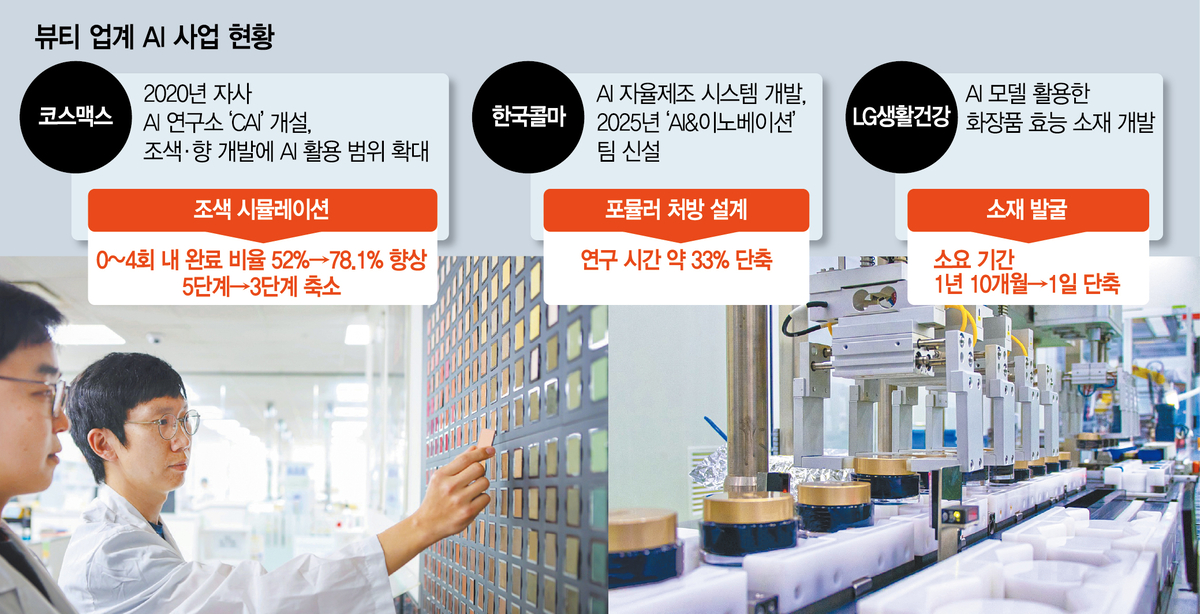
The beauty industry is slashing development times by rolling out artificial intelligence across every step—from ingredient discovery and formulation design to production. The competition is no longer just about quality; it’s a full-on speed race.
On the 8th, industry sources reported that domestic ODM leader Cosmax(192820) has applied AI to the crucial color-matching stage of color cosmetics, sharply boosting efficiency. Color matching translates clients’ abstract requests—think “a soft, spreading rosy shade”—and has traditionally required researchers to run multiple trial-and-error experiments. Cosmax introduced a smart color-matching AI that automatically sets initial colorant amounts. As a result, the share of batches completed within 0–4 trials climbed from 52% to 78.1%, while those needing 5–9 repeats fell from 47.2% to 21.9%.
Cosmax has also moved AI into fragrance development. The system detects unexpected off-odors that can appear when raw scents mix, cutting the time needed for root-cause analysis and fixes. Its customized automated manufacturing setup—AI paired with robotic arms—now handles about 3,500 essences and more than 10,000 hair-care formulations. At Pyeongtaek Plant No. 2, applying AI robots to half the production lines boosted productivity by 40%.
Kolmar Korea(161890) reorganized its Convergence Technology Lab late last year to create an AI & Innovation team aimed at expanding AI capabilities. Its new AI-based personalized formulation system analyzes vast user data—climate, skin condition, UV exposure and other variables—to identify optimal ingredient combinations. Since adopting the system, formulation design time has been cut to one-third of what it used to be when researchers spent months on repetitive trials.
A Kolmar Korea official said, “We’re expanding and refining our AI systems. They’re used most actively in sun care, and we can extend services by linking them with smartphones and wearables. The system can adjust sunscreen protection based on real-time UV exposure and skin data, and it can send reapplication alerts when UV intensity changes.”
LG Household & Health Care(051900) is boosting research competitiveness by bringing AI into ingredient discovery. LG H&H and LG AI Research used an AI model specialized in new-substance discovery—ExaOne Discovery—to develop functional cosmetic ingredients last year. The AI analyzes large volumes of molecular-structure data to predict each substance’s properties. That shortened the average candidate-discovery period for functional ingredients from 1 year 10 months to just 1 day. The company plans to introduce the high-performance ingredient developed this way into its flagship brand The History of Whoo as early as this year.
An industry source said, “AI adoption has moved beyond simple process automation. It’s redesigning the entire lifecycle from planning to launch. Because development speed translates directly into market leadership, competition over AI capabilities will only get fiercer.”














Most Commented