
|
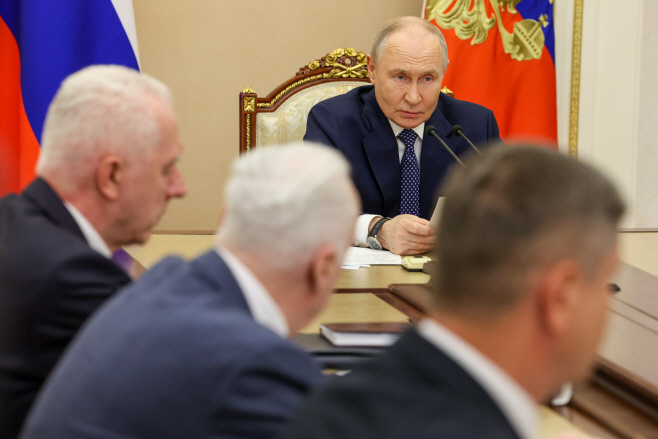
Senior officials at Russia’s Finance Ministry and Central Bank warned President Vladimir Putin that the costs of the war in Ukraine have become unsustainable and urged cuts to defense spending, Bloomberg reported on June 1 (local time).
Russia posted a cumulative fiscal deficit of 5.88 trillion rubles (124.068 trillion KRW; about $93.05 billion) for January–April 2026 — roughly 50% higher than the government’s annual plan — even as the Defense Ministry is seeking up to an additional 3 trillion rubles (63.3 trillion KRW; about $47.48 billion). The Financial Times warned that battlefield setbacks and fiscal strain could deepen rifts within Russia’s elite and increase the risks to Putin’s hold on power.
◇ Russia’s four‑month deficit reaches 5.88 trillion rubles — about 50% above plan
Bloomberg’s compilation of Finance Ministry data shows Russia’s fiscal shortfall widened sharply this year. The cumulative deficit was 1.63 trillion rubles in January, 3.45 trillion in February, 4.58 trillion in March and 5.88 trillion in April. Bloomberg said that equals roughly 2.5% of GDP and runs about 50% above the government’s annual plan.
Monthly deficits were 1.63 trillion rubles in January, 1.82 trillion in February, 1.123 trillion in March and 1.3 trillion in April. In just four months Russia surpassed the 2025 annual cumulative deficit of 5.63 trillion rubles.
By July 2025 the cumulative deficit had stood at 4.62 trillion rubles (with a monthly deficit of 1.24 trillion), underscoring how quickly the shortfall has accelerated over the past year. Bloomberg added that the sovereign wealth fund, the National Welfare Fund, saw withdrawals of roughly 500 billion rubles (10.55 trillion KRW; about $7.91 billion) in the first two months of 2026, leaving its balance about 60% below pre‑invasion levels.
|
◇ Finance Ministry and Central Bank press for defense cuts; Defense Ministry seeks 3 trillion rubles more
Officials at the Finance Ministry and the Central Bank warned that the projected level of defense spending risks widening the fiscal deficit and urged the Kremlin to trim defense budgets, Bloomberg reported. The Defense Ministry and some Kremlin‑linked factions pushed back, arguing cuts would hurt companies dependent on military contracts and damage the broader economy.
Two government‑knowledgeable sources told Bloomberg the Defense Ministry has requested up to 3 trillion rubles in additional funding this year.
Bloomberg reported that Putin has instructed the Finance Ministry to search for savings in other budget areas before cutting defense spending. When the 2026 budget was drafted, officials had already warned of a potential shortfall of 1.2–1.5 trillion rubles (25.3–31.64 trillion KRW; about $18.98–23.73 billion) in the defense sector for the second half of the year, but they had assumed lower defense spending in H2 following a June 2025 summit in Alaska between President Donald Trump and Putin that raised hopes of a possible end to the war.
Finance Minister Anton Siluanov told business daily Kommersant on May 27 that “we need to exercise restraint in public spending” and warned that “reserves are not infinite. Fiscal vulnerability is unacceptable amid sweeping global changes.”
|
◇ Oil price spike tied to US‑Israel‑Iran hostilities fails to steady Russian finances; growth forecast cut to 0.4%
Although oil prices jumped amid hostilities involving the US and Israel against Iran, the windfall did not prevent fiscal deterioration, Bloomberg reported. Government officials told Bloomberg oil would need to remain above $100 a barrel (151,760 KRW) for at least a year for the economy to see meaningful improvement, and that temporary windfall revenues cannot solve structural problems in growth, inflation and the banking sector.
Bloomberg also noted that a strong ruble has reduced export revenues and worsened pressures on public finances. In May, the Economy Ministry cut its 2026 GDP growth forecast from 1.3% to 0.4%, and the economy contracted in the first quarter for the first time in three years.
Government spending rose about 16% year‑on‑year in January–April; state procurement jumped 41%; and authorities are considering a windfall tax on some commodity producers and banks, Bloomberg said.
|

◇ Financial Times: Failure in Ukraine could lead to Putin’s removal
The Financial Times highlighted that authorities dropped tank and heavy‑equipment displays from the May 9 Victory Day parade because of drone threats — a symbolic indication, the paper said, that the “special military operation” has failed to force Ukraine’s capitulation and that even Moscow has become vulnerable.
Drawing historical parallels — from the 1905 Russo‑Japanese defeat and the unrest that followed, to the 1917 revolution; from Nikita Khrushchev’s fall after the Cuban Missile Crisis, to the Soviet collapse after the prolonged Afghan war — the FT argued that defeat in Ukraine could ultimately lead to the removal of the 73‑year‑old Vladimir Putin. The paper judged, however, that a popular uprising or electoral change is unlikely; the most realistic path to a change of power is elite fragmentation. It added that the current ruling circle consists largely of loyalists and beneficiaries of the conflict, many of whom are subject to Western sanctions, raising high barriers to an actual transfer of power.
Alexander Gabuev of the Russia and Eurasia Program at the Carnegie Endowment for International Peace told the FT that the current ruling elite “are carefully selected loyalists and beneficiaries of the present standoff.”















Most Commented