
Translation result.
Masters a complex shot in just three weeks
Set to appear at next month’s CONCACAF World Cup venues
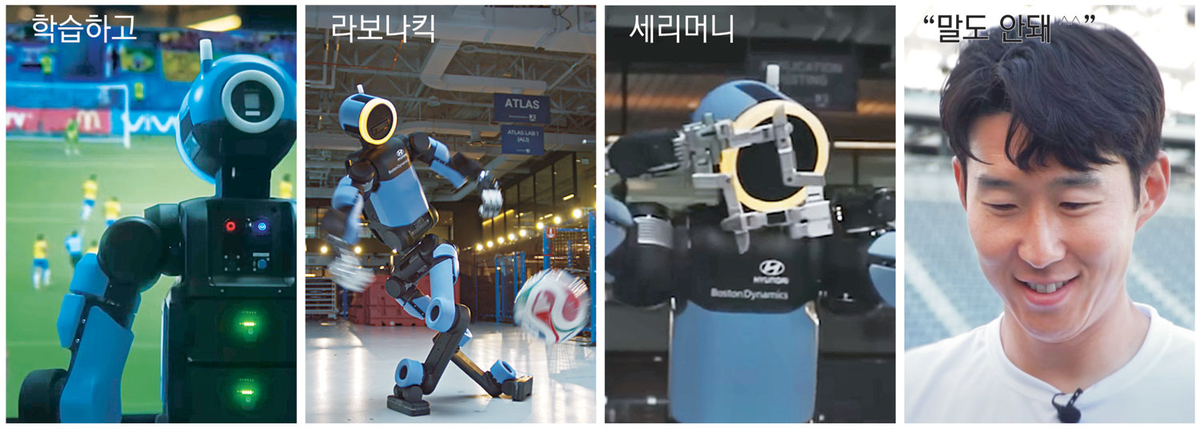 On May 29, Hyundai Motor Group released a video showing Atlas, the bipedal humanoid from its robotics affiliate Boston Dynamics, performing advanced soccer moves. Engineers say Atlas has moved beyond basic full-body control and simple object handling to reproduce precise human motions—some so difficult that many players would struggle to pull them off—bringing its industrial deployment closer than ever.
Atlas is scheduled to showcase its physical-AI capabilities across venues at the 2026 CONCACAF World Cup, which opens on June 11 (local time), serving as a K-humanoid ambassador at event sites.
Hyundai, a FIFA partner for the CONCACAF World Cup, released a “School of Football” campaign on its official YouTube channel that features Atlas executing high-level soccer techniques. Across five clips, Atlas completes passes and shots with composure and even performs a rabona—striking the ball with a crossed leg. It strings together feints to wrong-foot defenders, finishes with a “ghost rabona,” the campaign’s most demanding move, and then mimics Korean national team captain Son Heung-min (LA FC)’s signature “click” celebration.
The launch film and three training videos published through the previous day have already racked up roughly 33 million views in five days. Hyundai says no computer-generated imagery (CGI) was used. After watching, Son Heung-min reacted, “No way — this is real,” adding, “It’s better than many players.”
Hyundai modeled Atlas on motion data from real players and used reinforcement learning with intensive repetition to train the robot. The company says Atlas mastered the ghost rabona in just three weeks. While Boston Dynamics previously posted a video showing a refrigerator-moving routine ten days earlier, Hyundai says the ghost rabona was more complex yet required less training time—underscoring its AI-driven reinforcement-learning and hardware-control capabilities.
Organizers plan to deploy Atlas units—including the second-generation “All-New Atlas”—and Boston Dynamics’ four-legged robot Spot throughout stadiums to assist with security patrols. Jisung Won, head of Hyundai’s Brand Marketing Division, said, “We presented the future of robotics to the world through soccer,” and added that the company will keep building diverse brand experiences using mobility and robotics.
Hyundai Motor Group plans to mass-produce more than 30,000 Atlas units annually by 2028, with at least 25,000 slated for initial deployment at Hyundai and Kia production sites. Industry estimates put Atlas’s early production cost at about 200 million KRW (150,000 USD) per unit. Analysts expect costs to fall as volume rises, potentially dropping to about one-quarter of the initial price once production hits 30,000 units.
Atlas will undergo systematic training at the Robot Meta-Plant Application Center (RMAC) inside Hyundai Motor Group’s Meta Plant America (HMGMA) before entering industrial operations. Hyundai plans to deploy Atlas at Kia’s Georgia plant in 2029. Hyundai Mobis, South Korea’s largest auto parts supplier, will provide the actuators that power Atlas’s movements.











Most Commented