
|
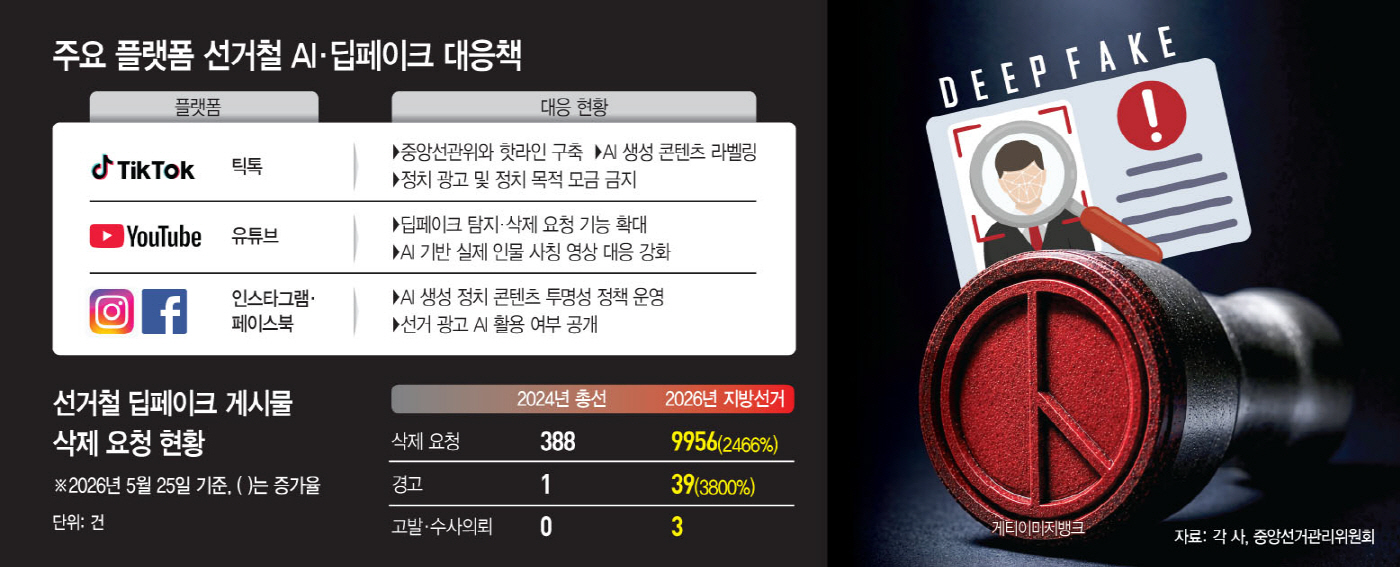
People filed nearly 10,000 takedown requests for election-related deepfake posts ahead of the June 3 local elections. Global social platforms are intensifying efforts to block generative AI–driven misinformation. As deepfake videos of politicians spread rapidly across social and short-form platforms, those companies have positioned themselves as an election safety net.
On May 28, the National Election Commission and other agencies said that as of May 25 they had received 9,956 requests to remove deepfake posts related to the June 3 local elections. That is more than 25 times the 388 takedown requests reported during the 2024 National Assembly election.
Recent advances in generative AI now allow users without technical expertise to produce images and videos that are difficult to distinguish from real content, accelerating the spread of false information. The rapid circulation of such material on short-form, video-first platforms has raised growing concerns that it could undermine electoral fairness.
Platforms are beefing up defenses against AI-driven misinformation for the election season. TikTok, for example, recently set up a hotline with the National Election Commission and published policies to counter election misinformation. The policies require labels on AI-generated or AI-edited content and ban political advertising and fundraising for political purposes.
TikTok also operates a Korean-language Trust & Safety team dedicated to monitoring election-related policy violations. It combines automated detection with external reporting systems and says it proactively blocks many violating posts before users report them. The company reports that it proactively removes roughly 99% of content that breaches its global standards.
YouTube is expanding its AI deepfake detection and removal capabilities. It recently extended protections against unauthorized synthetic combinations of real people’s faces and voices to include ordinary users. Previously focused on politicians, public figures and creators, YouTube widened its policies as generative AI became more widespread.
Meta, which runs Facebook and Instagram, has tightened transparency rules and fact-checking for AI-generated political content. It requires election advertisers to disclose AI use and mandates distinct notices for political ads created or altered with AI. Meta also partners with IFCN-affiliated fact-checking organizations to verify misinformation and reduces the distribution of content likely to spread AI-based falsehoods. During election periods, dedicated teams closely monitor misinformation and attempts at external interference.
Despite these measures, some experts warn that generative AI is advancing faster than platforms’ detection tools. Because false content can spread widely and quickly on social and short-form platforms, relying primarily on after-the-fact takedowns has limitations.
An industry official said, “As generative AI advances rapidly, cases where people cannot tell what’s real have surged. Although platforms are improving AI detection, it is hard to keep pace with the technology’s evolution. Responses must go beyond takedowns to include clearer labeling of AI content sources and stronger cross-platform cooperation.”











Most Commented