
Translation result.
Which country is the safest in the world? A leading U.S. news outlet recently sought to answer that question with a new ranking. Asian countries dominated the top public-safety slots, and South Korea placed seventh.
U.S. News & World Report recently released its Best Countries rankings. For the first time, the publication shifted from a perception-based model to a data-driven methodology that evaluates 100 countries using 100 data indicators. The study measures national capacity across eight categories—governance, culture & tourism, economic development, health, infrastructure, natural environment, opportunity, and civic health—and 24 subcategories. Governance carried the greatest weight in the overall assessment and was emphasized as a key determinant of national success.
The outlet’s rankings editor said, “As geopolitical tensions rise and attention to stability and resilience grows, the 2026 Best Countries ranking provides a clearer picture of national capacity.” He added, “Our new data-driven framework reflects how effectively countries deliver opportunity and quality of life to their citizens.”
Switzerland tops overall ranking; Europe dominates the leaderboard
Switzerland finished first overall. It led in economic development and governance, ranked second for opportunity and culture & tourism, and placed fourth in health. Denmark was second overall, with the top spot in civic health, second in infrastructure, and third in health. Sweden placed third, ranking fourth in governance, third in opportunity, and seventh in natural environment. Of the top 25 countries, 18 were European.
The United States scored highly in economic development (2nd) and culture & tourism (1st), but weaker showings in health (33rd), infrastructure (39th), and civic health (41st) left it 18th overall. South Korea ranked 20th overall.
There were notable results in other categories: Iceland topped health, Cambodia led natural environment, and Singapore ranked first in infrastructure, with Denmark and Luxembourg following. Denmark also placed first in the energy and climate security subcategory.
Asia claims top public-safety ranks; South Korea seventh
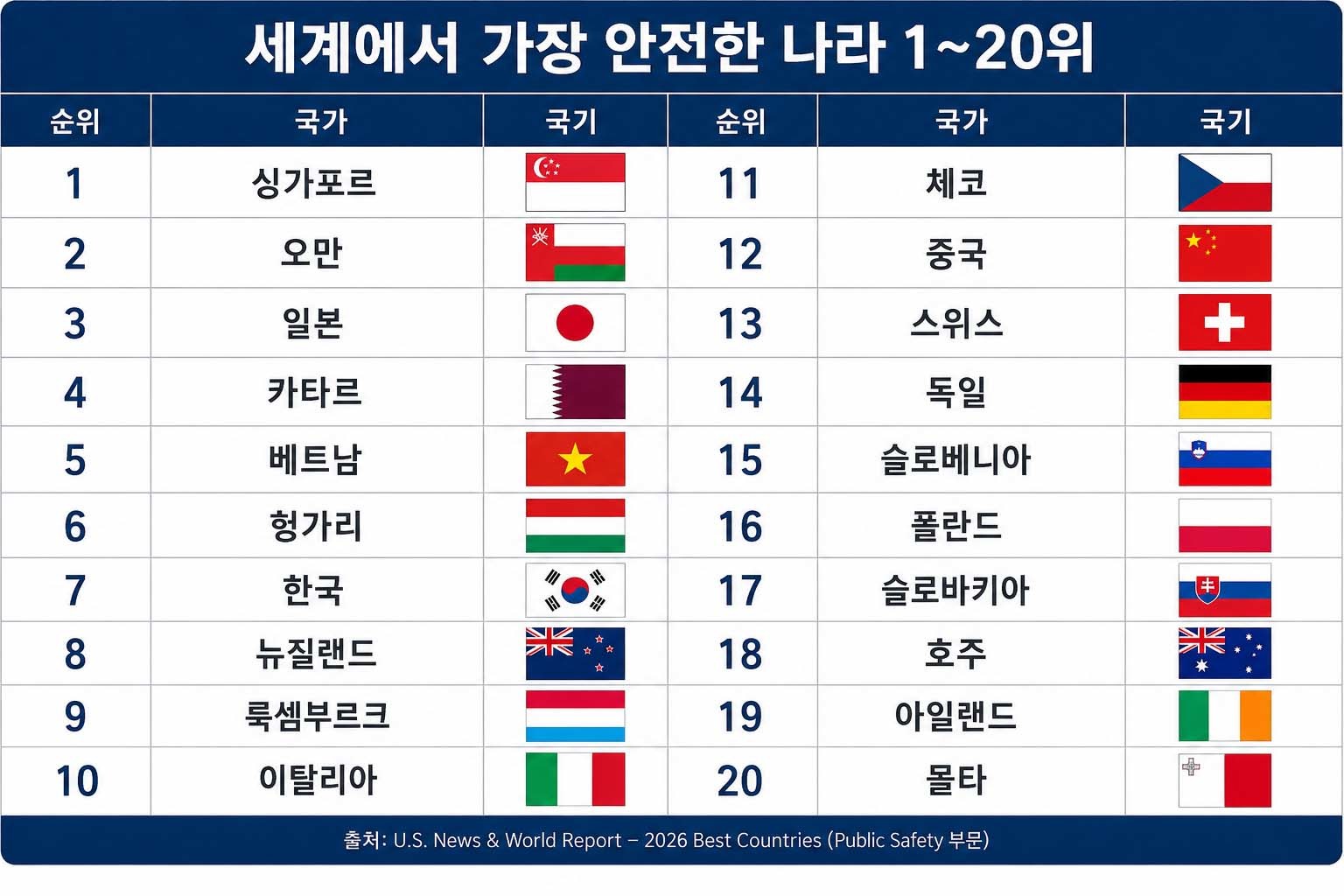
Public safety was a particular arena of Asian strength. Among the top 10, five were Asian: Singapore (1st), Japan (3rd), Qatar (4th), Vietnam (5th), and South Korea (7th). Oman, representing the Middle East, placed second.
Singapore, founded as a 19th‑century British trading colony, is now a prosperous city-state with one of the world’s busiest ports. High per‑capita GDP and low unemployment make it among the wealthiest places globally. Strong law enforcement and strict social norms contribute to its world‑class public safety. Singapore also ranked first in infrastructure but was 96th in natural environment, underscoring a trade-off between development and environmental outcomes. Oman, while second in public safety, ranked 99th for human rights and freedoms.
Japan earned third place largely on the strength of very high public-safety indicators and a low homicide rate. Hungary placed sixth; New Zealand was eighth; Luxembourg ninth; and Italy tenth. Ranks 11–20 went to the Czech Republic, China, Switzerland, Germany, Slovenia, Poland, Slovakia, Australia, Ireland, and Malta, respectively.
South Korea: more than public safety
South Korea’s strengths extend beyond public safety. It ranked sixth in economic development and seventh in health. Notably, it was second globally in digital connectivity—measured by internet speed, cybersecurity, penetration, and access—behind Singapore. That placement reflects its ultra‑fast internet infrastructure and robust, government-driven digital investment. Seoul also scored well as a cultural hub where fashion, technology, and entertainment intersect.
Different from travel-safety rankings
These results, however, should be viewed in context. Rankings can vary significantly depending on which institutions measure safety and the methodologies they use.
The findings diverge sharply from this year’s Berkshire Hathaway Travel Protection (BHTP) report, a widely cited travel-safety measure. BHTP ranked the Netherlands, Australia, and Austria as the top three safest travel destinations for 2026. The Netherlands rose from 14th the previous year to first, credited for low crime, solid infrastructure, and an inclusive safety environment for diverse travelers. BHTP surveys travelers who visited each country over the past five years and weights data on terrorism, weather disasters, health risks, and the safety of vulnerable groups. South Korea did not make BHTP’s top 15 countries, but Seoul was 12th among cities, praised for advanced security systems and low crime risk.












Most Commented