
Translation result.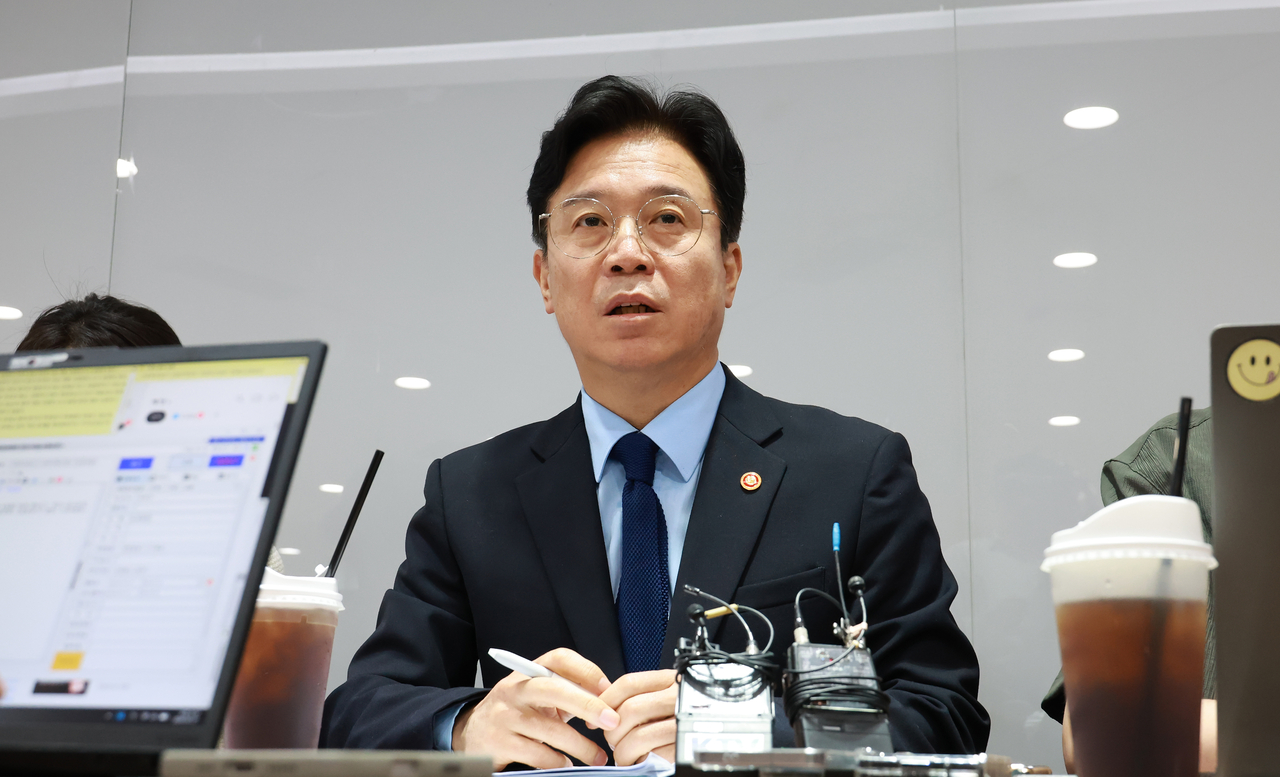 [Herald Economy=Reporter Kim Yong-hoon] “Samsung is a private company, but semiconductors have become a public good.”
Labor Minister Kim Young-hoon told reporters at the Government Complex in Sejong on May 27 that, while Samsung Electronics is a private firm, semiconductors have become as essential as air in the AI era, and the government therefore needs to play an active role.
His comments link the dispute over Samsung’s performance-based pay to broader questions about the semiconductor industry’s public character and the redistribution of excess corporate profits.
“If factories are privately owned but the products they produce take on public characteristics, that is an issue we must consider,” Kim said. “They grew with tax support, access to the power grid, and national infrastructure—doesn’t that make them companies of national significance? It’s only natural for the government to pay attention to labor relations at major worksites.”
Kim framed the current Samsung labor negotiations not as a purely internal corporate dispute but as part of a larger discussion about social redistribution. “Samsung’s success today was possible not only because of its workers but also because of support from the state and local communities,” he said. “If that is the case, redistribution should be debated at the societal level.”
He also expressed concern about excess corporate profits being concentrated among certain groups of permanent employees.
“We need to reconsider whether a system that allows only regular employees to capture excess gains is appropriate,” Kim said, calling for discussions on shared growth between prime contractors and subcontractors and on redistribution within the labor market. To that end, the Ministry of Labor plans to hold an emergency forum on June 1 to launch talks on a “Korean-style social solidarity wage policy.”
“I want to open the door to debate how to socially distribute large corporations’ excess wages,” he said. “The solution ultimately lies in social dialogue.”
He was careful to stress that this does not mean the government intends to directly dictate how companies allocate profits. “The government has no intention of telling companies what to do with their profits,” he said, explaining that the aim is to seek solutions through social dialogue rather than by imposing guidelines.
Commenting on the union vote approving the tentative “2026 Wage and Collective Agreement” with 73.7% in favor, Kim observed, “A bad agreement is better than a good ruling.” He added that while Samsung has world-class technology, it has relatively limited experience with labor relations, so it is significant that the company ultimately resolved the issue through dialogue.














Most Commented