
Translation result.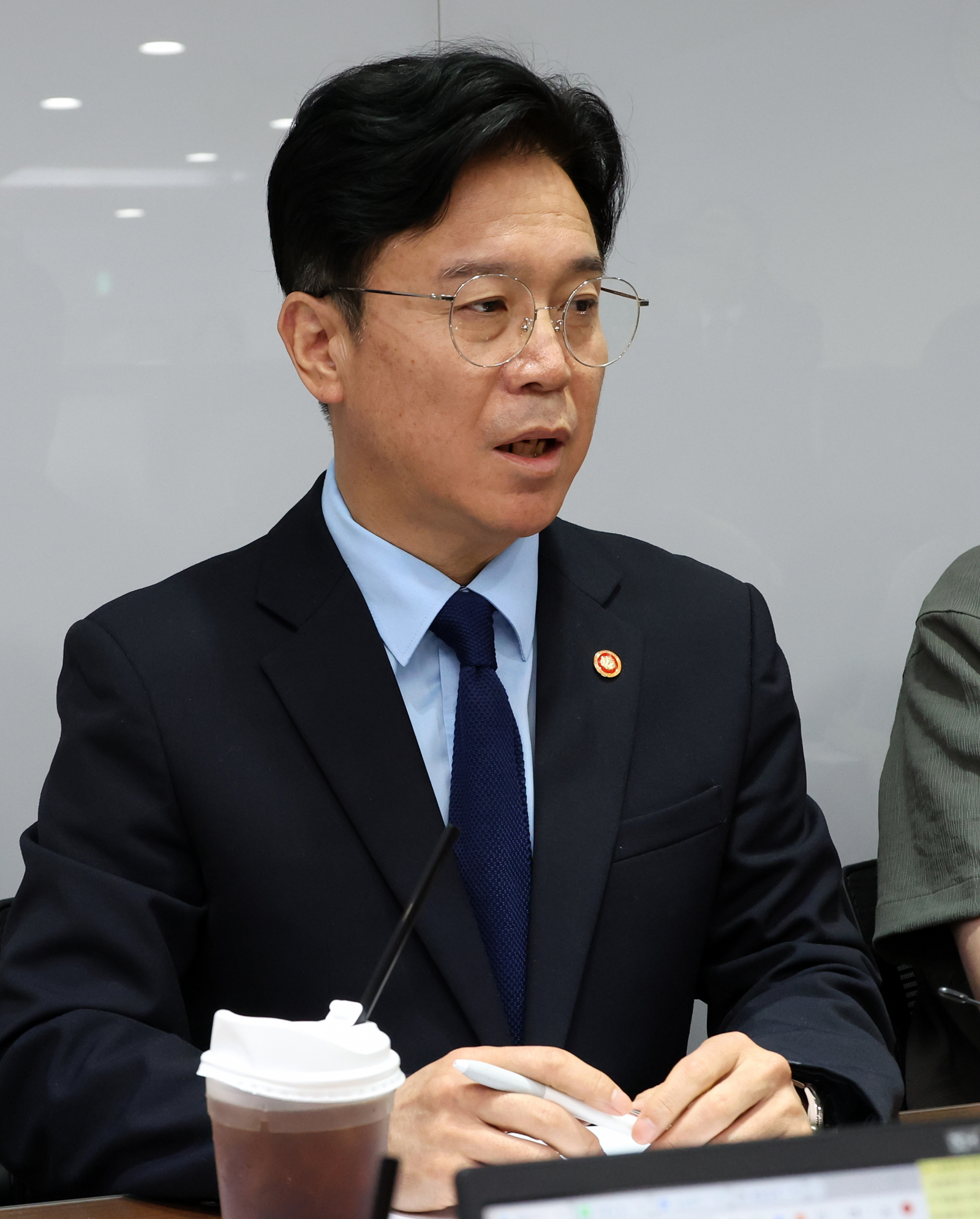
Labor Minister Kim Young-hoon said that in the AI era semiconductors have effectively become a public good, and he announced plans to convene a forum to discuss how excess profits earned by large corporations should be socially redistributed.
The Ministry of Employment and Labor said on May 27 that Kim made the remarks during a morning meeting with labor reporters at the Sejong Government Complex, where he addressed the recent labor negotiations at Samsung Electronics.
Earlier, on May 20, Samsung Electronics and its union reached a tentative agreement after more than six hours of final negotiations at the Gyeonggi Employment and Labor Office in Suwon, with the minister’s facilitation.
The union had demanded disclosure of the formula used to calculate excess-profit performance bonuses (OPI), removal of payout caps, and allocation based on operating profit. After marathon talks, labor and management tentatively agreed to defer profit-sharing for loss-making divisions for one year. They also agreed to create a special management performance bonus funded by 10.5% of business results and to pay it in company stock.
Kim said, “Any flawed agreement is preferable to a good court ruling,” noting that resolving such a difficult issue through dialogue—given the enormous excess profits at stake—deserves praise.
According to Samsung’s joint bargaining committee, union members ratified the tentative agreement with 73.7% voting in favor.
Kim said the vote was a wise decision despite sharp divisions within the company. He urged the union to help stabilize labor-management relations and called on the company to honor commitments on partner-company co-prosperity, community contribution, and workplace safety.
Some critics argue the government intervened too deeply in what should have been a private labor dispute.
Kim acknowledged that criticism but said the issue requires attention to both form and substance.
He argued that while Samsung is a private company, in the AI era semiconductors have become as essential as air. If the capital and labor that produce these goods imbue them with a public character, society must consider whether they should be treated as public.
He stressed that Samsung benefits from public inputs—tax subsidies, broad citizen shareholding (roughly one in ten citizens owns Samsung stock), and public utilities such as power and water—and said the government had a duty to make mediation efforts at major worksites.
At the same time, he acknowledged it will be difficult to approach every company the same way and called for new social innovations to complement technological advances so that heavy-handed interventions are not routinely necessary.
Kim said the agreement should spark a public debate on who should receive the excess profits concentrated in companies during the AI era and how those profits should be distributed.
He announced plans to hold an urgent symposium on June 1 to explore the possibility of a Korean-style social solidarity wage and mechanisms for socially redistributing excess profits from large corporations.
“Samsung’s success today reflects not only the union’s dedication but also the efforts of the state, local communities, and society,” he said. “If people agree on redistributing that success, the solution must come through social dialogue.”
He asked labor, management, and experts across sectors to contribute ideas and pledged that the government would support efforts to activate social dialogue.
However, he drew a firm line against creating new legislation or formal government guidelines on this matter.
“How could the government set guidelines?” Kim asked, arguing the issue should be resolved through labor self-governance and social dialogue.
Responding to doubts about the effectiveness of public debate, he said democratic systems rest on faith in the power of dialogue and called for unwavering determination and imaginative thinking that transcend existing frameworks.
Some have pointed to models such as Sweden’s Rehn–Meidner system, which narrows wage gaps across firms and channels excess profits back to society.
Kim said the Swedish model reflects specific Swedish conditions and would be nearly impossible to apply here because Korea is too fragmented. “We must find our own path,” he said.
He rejected the claim that the Samsung dispute was a consequence of amendments to the labor law often described as the “Yellow Envelope Act.”
Kim noted that the Samsung union’s bonus demands trace back to a 2021 labor agreement at SK Hynix, before the labor law was amended, and that the Samsung union never threatened illegal strikes. He said he could not agree with calls to revise the Yellow Envelope Act.
On major labor bills—extending the retirement age, presumed-employee rules, and the Workplace Basic Act—he said additional public discussion is necessary and pledged to work toward advancing them during the regular parliamentary session.
Kim said the ruling Democratic Party’s task force has developed mature proposals on raising the retirement age. On presumed-employee rules and the Workplace Basic Act, both labor and management oppose them, so he said he cannot push them unilaterally as a government priority and will continue to seek dialogue.
Regarding the Minimum Wage Commission, he welcomed the initiation of discussions to set standards for contract workers and said the move is significant. He framed it as a turning point away from purely quantitative targets—such as the campaign for a 10,000 KRW hourly minimum wage (about $7.50)—toward a more inclusive commission structure.
Kim also reflected on reaching his 300th day in office, citing reductions in workplace fatalities and unpaid wages as his primary achievements.
He said workplace fatal accidents fell 7.5% year-on-year in the first quarter—the lowest level since related statistics began—and unpaid wages declined by 7.7%. “No one should die or be injured at work, and no one should be cheated out of pay. There is still work to do, and I will push harder,” he said.
Other news related to this article
- Guest left a dryer on to dry shoes and went out for five hours; hotel narrowly avoided a fire
- Parents stunned after daycare sent a ‘Couples Day’ gift that read Tonight: Hong Kong songs
- [Opinion/Lee Sang-bok] The pie has grown—so why is society more insecure?
- [Times Desk] Bonus battle: affiliation won, contribution lost
- ‘Memory division’s 600 million KRW (approximately $450,000) bonus’—Samsung deal approved, but disputes remain












Most Commented