
Translation result [Herald Economy = Reporter Ko Seung-hee] A distinctly Korean identity helped break down walls in the mainstream. BTS’s name reverberated again at the center of the U.S. music scene — but this time they weren’t alone. The Korea-U.S. joint girl group KATSEYE and Netflix’s hit animated series K-Pop Demon Hunters each reinforced K-pop’s global standing, taking three and four awards respectively.
BTS took home three trophies at the 52nd American Music Awards on the 25th (local time) at the MGM Grand Garden Arena in Las Vegas: the night’s top honor, Artist of the Year, plus Song of the Year and Best K-Pop Male Artist.
Among the three major U.S. music prizes — the Grammys, the Billboard Music Awards and the AMAs — the AMAs stand out for their voting method.
Unlike the Grammys, where industry voters weigh artistic judgment, or the Billboard Awards, which lean on chart metrics, the AMAs rely entirely on global fan votes. That makes the ceremony a clear barometer of fandom strength worldwide.
After roughly three years and nine months away for military service, BTS demonstrated that the ARMY’s cohesion remains formidable.
The group swept all three categories in which it was nominated — Artist of the Year, Song of the Summer, and Best Male K-Pop Artist.
The wins mark BTS’s second Artist of the Year trophy, coming four and a half years after their first in 2021, and bring their total AMA haul to 14. No other Asian artist has won the top prize twice.
 Notably, the fanbase has broadened. BTS began with a primarily teenage-female following, but during the hiatus the group attracted more male and older listeners, even as younger fans keep coming aboard. What started as a youth-driven movement has matured into multi-generational support and a cultural touchstone.
Leader RM accepted Artist of the Year and told the audience, “ARMY! We did it again. All members have completed military service and returned, and we’re honored to receive this award once more.”
He added, “This award is decided 100% by the fans’ votes. So our deepest gratitude and honor go to all the ARMY around the world who have stood by us for the past 13 years. Thank you so much.”
For their comeback, BTS foregrounded Korean identity. Where 2021’s “Butter” used entirely English lyrics to target Western pop conventions, their fifth studio album, ARIRANG, released last March, wears Korean identity openly, regardless of language.
The album’s narrative is deliberate. The opening track “Body to Body” inserts the traditional folk song “Arirang” into its chorus, and the record weaves in the distinctive toll of the national treasure Seongdeok Daewang Bell to shape its pacing.
Now in their 30s, the members confronted questions of identity and artistic risk. Pairing traditional Korean elements with contemporary Western sounds felt daring — and listeners responded. Critics described the result as fresh and original.
 Onstage accepting Song of the Summer, BTS spoke candidly about the pressures behind their return.
RM said, “When we made this album, we felt a lot of pressure. We asked ourselves, ‘What music is most true to us right now?’ Through it all, we believed we had to keep challenging ourselves and keep moving forward.”
V quoted lyrics from “SWIM” and offered encouragement: “To everyone who keeps swimming through life’s sea without giving up, we send our love and support. Don’t stop — keep swimming.”
ARIRANG spent three consecutive weeks at No. 1 on the Billboard 200, and the title track “SWIM” gave BTS their seventh Hot 100 No. 1. Las Vegas now hosts an offline festival called THE CITY in their honor, turning much of the city purple.
BTS now turns toward the Billboard Music Awards and the notoriously selective Grammys. Unlike the AMAs — where fan voting can be decisive — the Grammys are governed by roughly 15,000 Recording Academy members who prioritize artistic judgment.
BTS earned Grammy nominations in consecutive years for tracks like “Dynamite” but did not win. Industry observers say ARIRANG’s mature musical introspection could align better with Grammy sensibilities this time around.
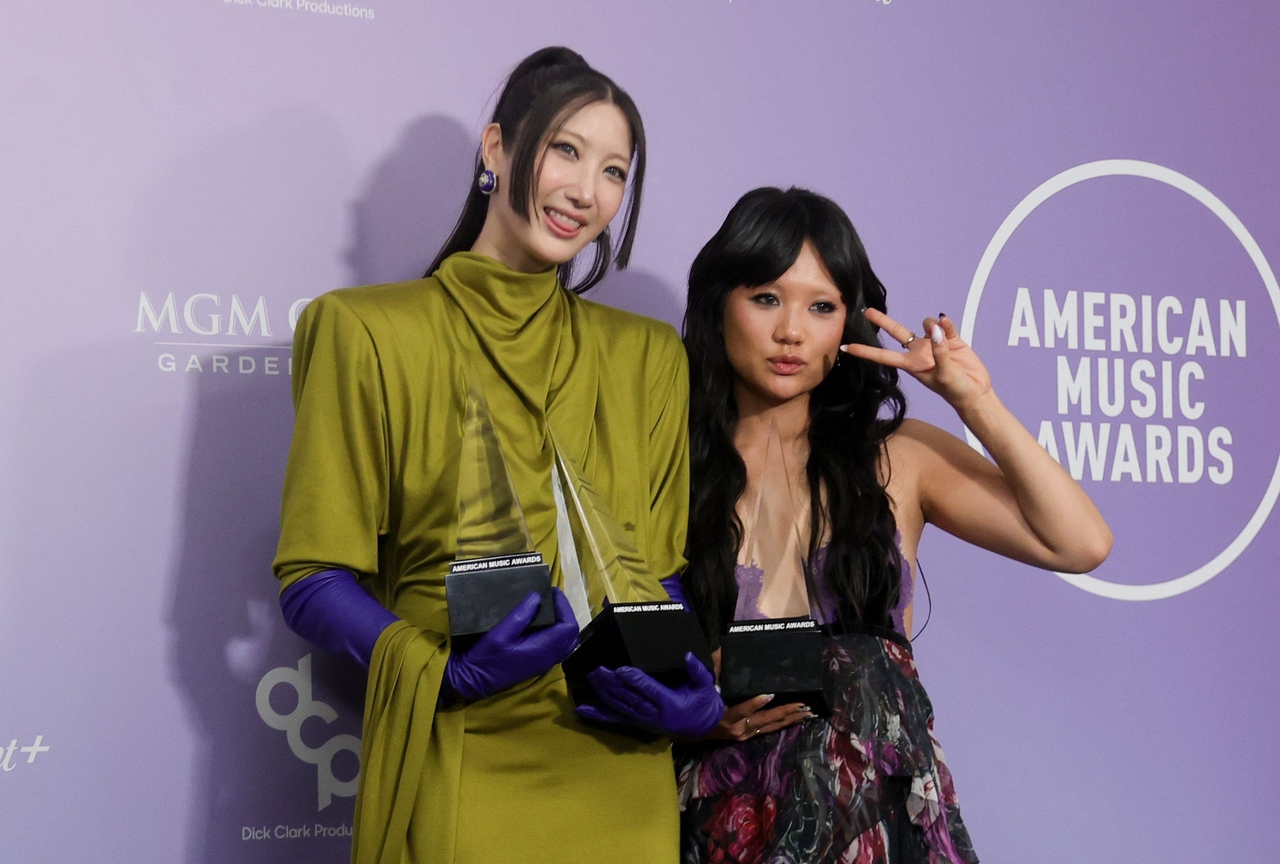
The AMAs have been a recurring gateway for Korean artists into the U.S. mainstream.
PSY cracked the surface in 2012 with “Gangnam Style,” winning the New Media Award and opening a fissure in the barrier. BTS later expanded K-pop’s foothold. This year TWICE underscored K-pop’s longevity in North America by winning Best Female K-Pop Artist.
The brightest new acts warrant attention. Global girl group KATSEYE, produced by HYBE and Geffen Records, swept three major categories — New Artist of the Year, Breakthrough Pop Artist, and Best Music Video for “Gnarly.” Their wins suggest K-pop’s high-level training systems have been successfully adapted to mainstream pop standards.
KATSEYE thanked their global fandom, the EYEKONS, saying, “This is unreal. We wouldn’t be here without you.”
Members Lala and Daniela, representing the group’s multinational lineup, underscored their commitment to diversity and cultural representation, thanking fans in multiple languages — English, Tamil (“Nandri”) and Spanish (“Gracias”) — before adding, “We did it. Thank you so much.”
 The night’s most striking upset came from a cross-media phenomenon. The main OST “Golden,” from Netflix’s animated hit K-Pop Demon Hunters and performed by Lee Jae, Audrey Nuna and Ray Ami, beat mainstream heavyweight Taylor Swift for Song of the Year. The trio also won Best Vocal Performance, Best Pop Song and Best Soundtrack, completing a four-award sweep. The success capped a phenomenon that reached 500 million global views and spent eight consecutive weeks at No. 1 on Billboard.
Lee Jae said, “We’ve finally closed the gate,” referencing the show’s plot and crediting fans for propelling the song and series worldwide. Ray Ami grew emotional as he listed friends, family and collaborators, thanking the K-Pop Demon Hunters team for a life-changing year.














Most Commented