
May 22 — At the HMG Driving Experience Center in Taean, testers took the Tasman Intensive program for a spin
Drivers tackled steep inclines, water crossings and mountain off-road sections using X‑Trek, DBC and the Ground View monitor
Price and fuel economy are realistic drawbacks… but if you live for rough trails and camping, it’s undeniably appealing
Scritch-scratch—scritch. Thick branches scraped the roof and sides as we passed. When the tires hit a puddle, muddy water fanned out and a spray of pebbles pinged the underbody and door panels. The rattles and vibrations climbed into the cabin. On a public road I’d have pulled over to check, but here, that was part of the point.
I looked up to a narrow ribbon of dense forest, mud and standing water. For a second it felt like I’d driven straight into the jungle of Jurassic World. The star of the scene wasn’t a dinosaur—it was Kia’s first proper pickup, the Tasman.
On May 22 I test-drove the Tasman as part of the Tasman Intensive program at the HMG Driving Experience Center in Taean, South Chungcheong.
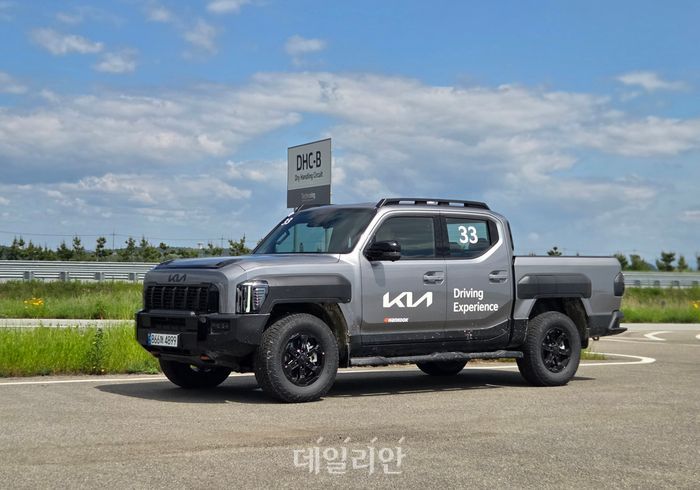
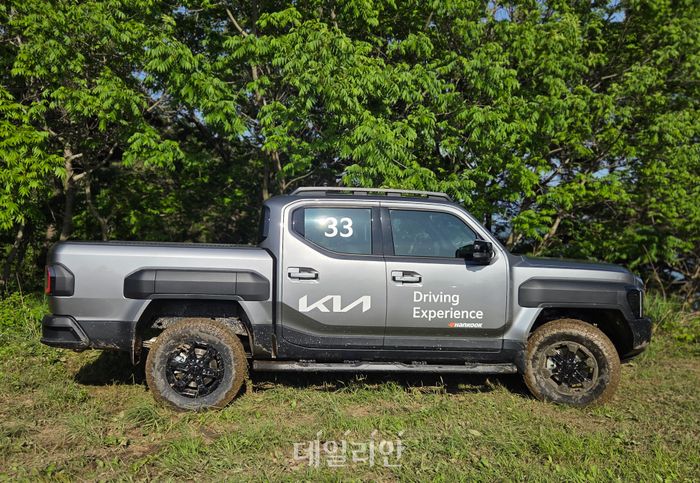
The Tasman Intensive pairs the off-road–focused Tasman X‑Pro with a purpose-built course, a mountain off-road section and an overnight camping experience. Unlike a standard test drive that only checks ride comfort and cabin quiet on paved roads, this program lets you feel how the Tasman performs on real tough terrain and how useful it is for outdoor recreation.
The first section threw logs and a 30cm bump at us. Each wheel climbing a hump made the body rock hard side to side, and my body shifted with it in the driver’s seat. On pavement these would be road hazards—here they’re the point: the Tasman’s wheels are meant to roll right over them.
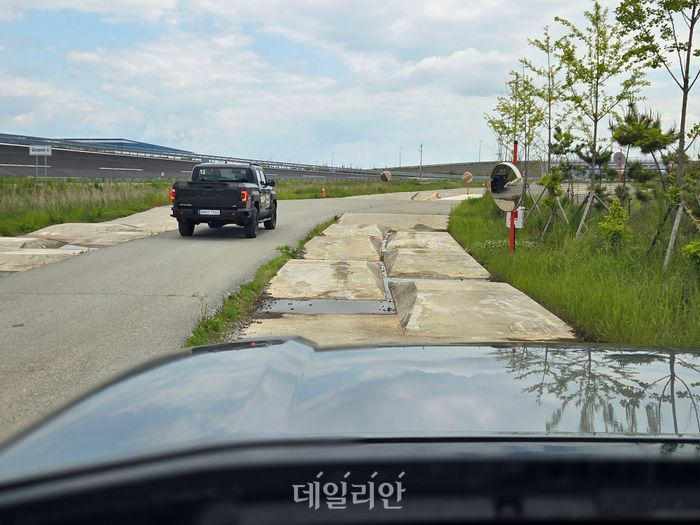
The steering wheel didn’t stay peacefully in my hands. Every time a front wheel rode up a log or bump, the wheel kicked left and right and the roughness came through to my fingertips. It felt like gripping a wriggling eel and trying not to let go. The surprise sent a chill down my spine, but it came with a thrill. Directly steering the truck swung me between tension, fear and a weird kind of joy.
Next up was a 70% incline. Call it a 70% grade all you want—sitting in the driver’s seat it looked like a cliff. The instructors warned this is normally reserved for pros, which only pumped up the nerves.
Following the instructor’s lead, I flipped on X‑Trek mode. X‑Trek is low-speed cruise control for rough terrain: it holds the speed you want automatically. When I lifted off the brake, the Tasman inched forward without me touching the accelerator.
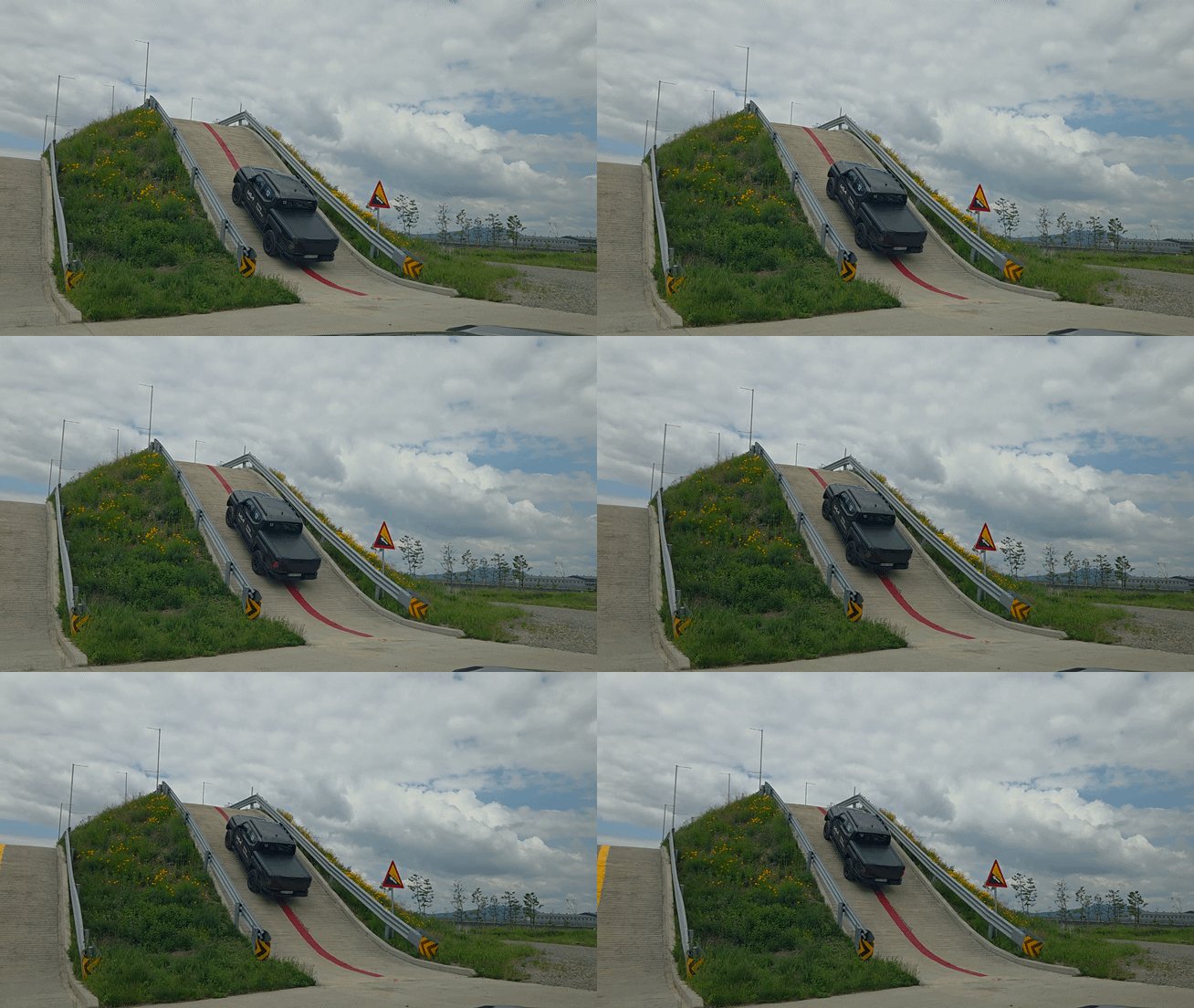
As the truck began to climb, more sky than road filled the windshield. The angle made it feel like we were heading straight up—don’t worry, we weren’t planning to visit the heavens. I had to focus: keep us centered by switching my gaze between the road ahead and the monitor. X‑Trek handled the gas and brakes; I just had to steer.
The descent was even more dramatic. As the body tipped over the crest and pointed downhill, I braced like I do for the first drop on a roller coaster. Still, the truck didn’t run away. The Tasman held a low speed on its own, so I could concentrate on steering. The fact Kia opened this segment to regular participants felt like a vote of confidence in the truck’s off-road chops.
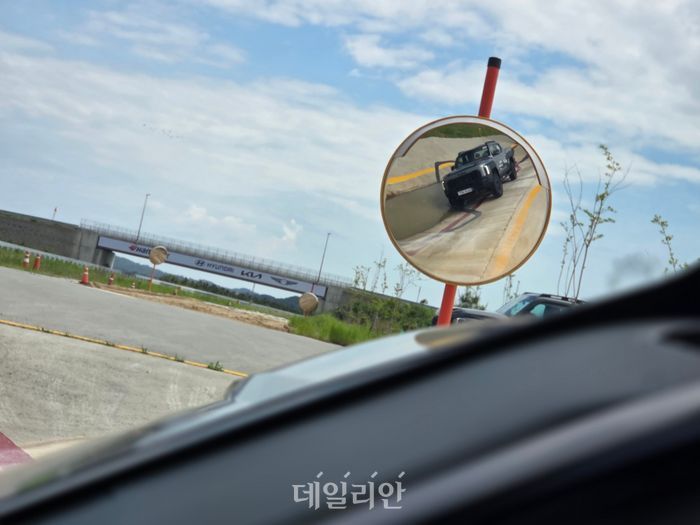
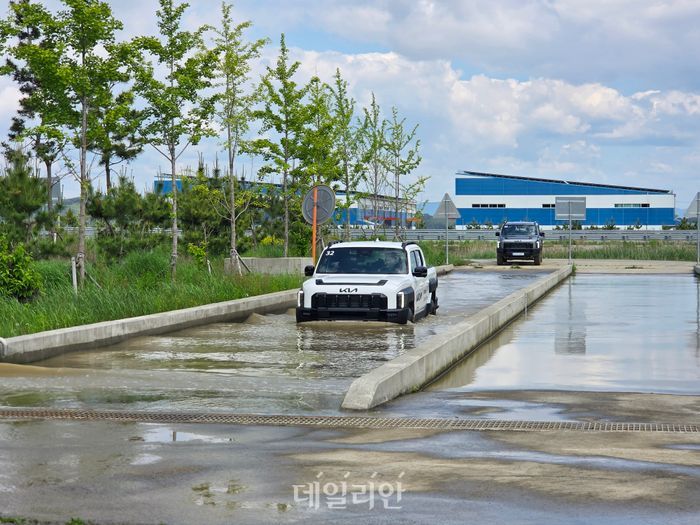
The route moved on to sand, gravel and mud. The Tasman switched terrain modes with each surface change so power was distributed and the wheels didn’t spin. On the lateral-tilt section the body leaned dramatically, like it was riding a wall, and my weight slid toward the opposite side. The final water crossing was 45cm (about 17.7 in) deep—enough to make a normal car nervous before the wheels even dipped, but the Tasman drove through like it was nothing.
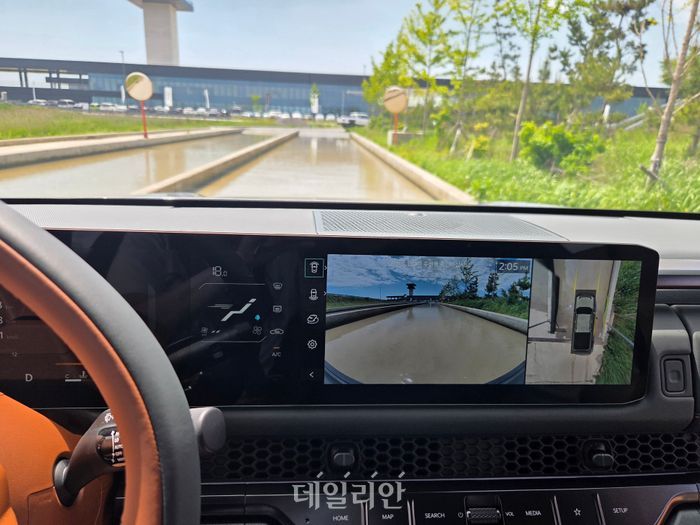
After checking basic maneuvers and core features on the center’s off-road course, we headed out to the mountain off-road track beyond the facility.
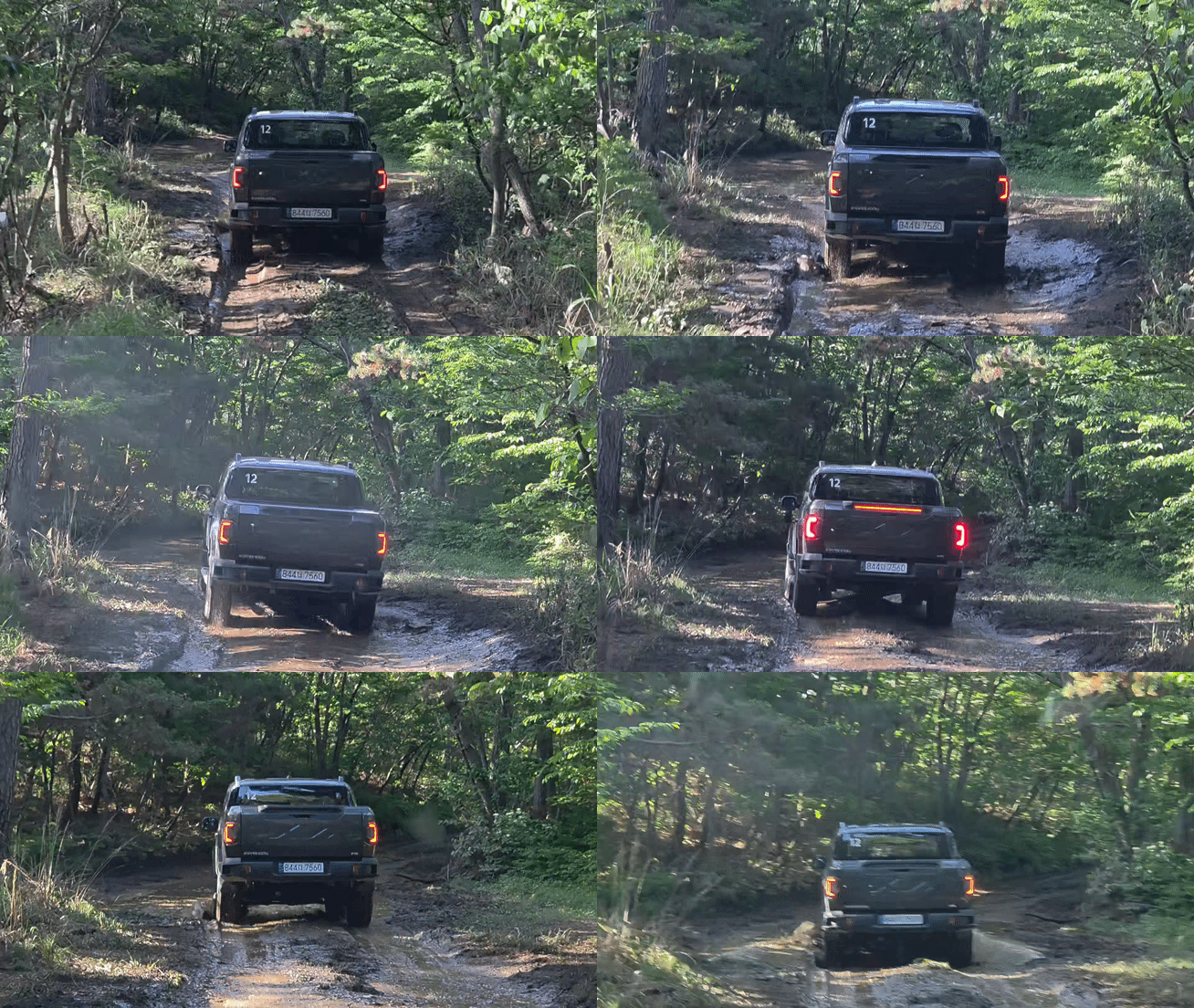
Outside, the vibe shifted immediately. The mountain course allowed no slack. The forest trail narrowed and the surface became wildly unpredictable. Rain from a few days earlier left muddy patches, and the instructor warned the truck could slide slightly no matter how carefully you drove.
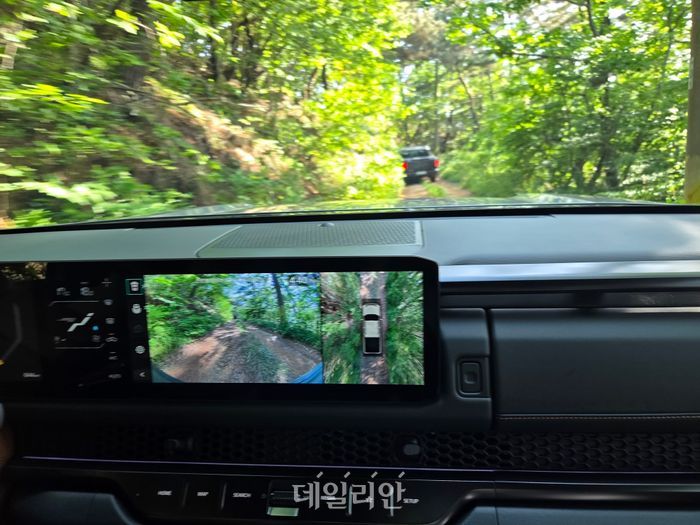
One stretch ran along a cliff with the sea far below. A small drift to the right felt like it could send you over the edge. The center console even displayed the Tasman’s dimensions—5.4m long, 1.9m wide and 1.9m high—like a helpful diagram. On narrow mountain tracks that size gave equal parts reassurance and pressure.
I leaned on the surround-view and ground-view monitors. Driving slowly while checking blind spots and the terrain under the front wheels on the screens made tight spots manageable—things you can’t see from the windshield alone.
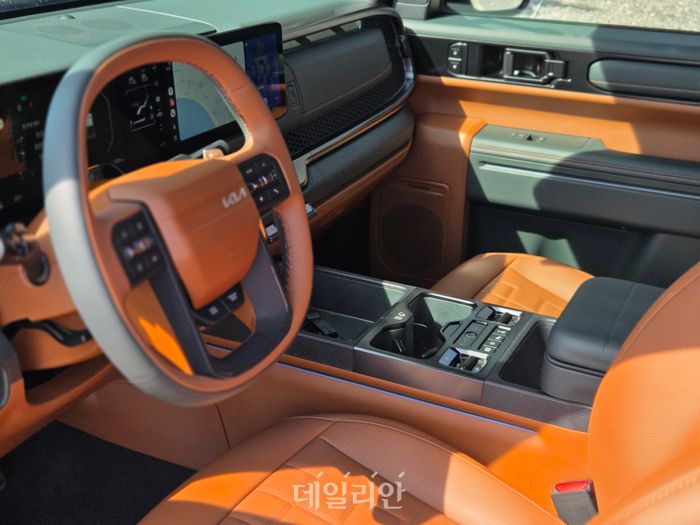
On descents, DBC kept the truck in check. DBC maintains a set slow speed on steep downgrades so you don’t have to hold the brake pedal. I didn’t have to ride the brake and the truck didn’t pick up runaway speed, letting me focus on steering.
The instructor then turned DBC off so we could feel the difference. Confidence vanished the moment the feature was disabled. My toes tightened. The truck didn’t go berserk, but suddenly I had to manage speed myself. The calm with DBC on wasn’t accidental.
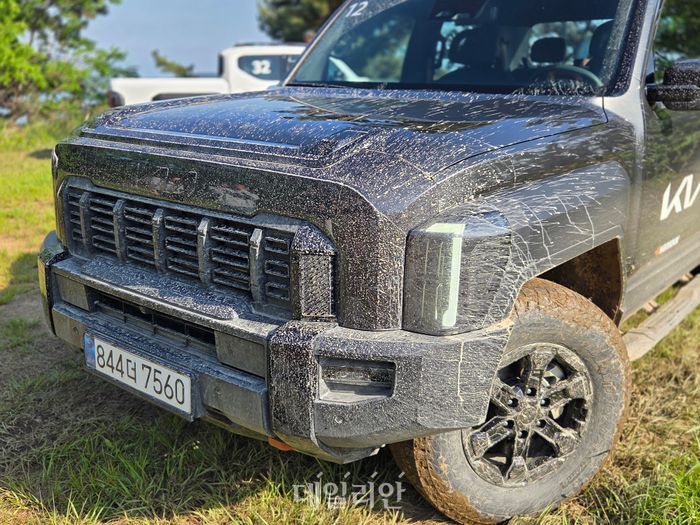
When the run ended safely, the lead instructor’s vehicle was already caked in mud. I wondered if Jane felt that same awe when she first met Tarzan: rough and raw, yet strangely magnetic.
On the mountain trail, the Tasman felt like testosterone personified—rugged, unapologetic. Normally I’d panic at the thought of scratches or grime, but oddly, the mud-splattered pickup felt truer to itself than a showroom-polished model. A mud-drenched truck looked more natural and cooler than a gleaming display car.
I also felt a little braver. Normally I’d break into a sweat at the thought of nudging a parking-lot post, yet minutes earlier I’d driven past cliffs, mud and puddles. Credit goes to the truck, but I felt more daring for having driven it. I caught myself thinking, Maybe life would get a little more fun with this truck.
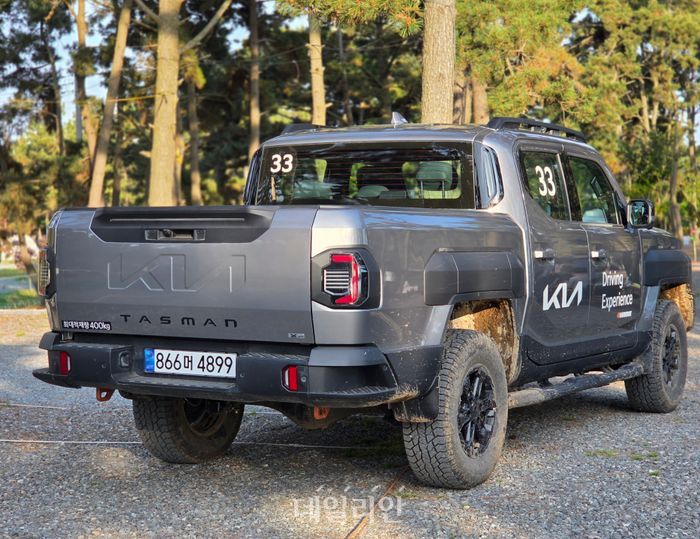
Back in the real world, the calculator comes out. Kia lists the Tasman starting at 37,500,000 KRW for the Dynamic, 41,100,000 KRW for the Adventure and 44,900,000 KRW for the Extreme, while the X‑Pro we tested is 52,400,000 KRW (Dynamic ≈ $28,125; Adventure ≈ $30,825; Extreme ≈ $33,675; X‑Pro ≈ $39,300). Combined fuel economy for the base model with 17‑inch wheels, 2WD and no built-in cam is 8.6 km/L (about 20.2 mpg US). If your life is daily city commutes, the size, parking and fuel costs will likely be top of mind.
Still, my excitement didn’t vanish entirely. Price and fuel economy tug at reason, but what the Tasman delivered that day rattled that reason in the best way.
▲Who it’s for
-If you want to rebrand your procrastinated car washes as off-road vibes
-If you love rough trails but sleep better knowing tech-assisted safety systems are watching your back
-If camping isn’t a weekend hobby but a lifestyle, sign on the dotted line
▲What to watch
-If you never go off-road, many of these features could be expensive buttons with no use
© Dailian Co., Ltd. Unauthorized reproduction and redistribution prohibited
- [Exclusive] Samsung Electronics sues six global shipping companies one after another…this time Wan Hai
- [Local election field] Tears at Park Geun‑hye’s handshake, Tesla jobs at Choo Kyung‑ho…Daegu captured two voter sentiments, day and night
- [Local election field] \”Only Oh Se‑hoon can win\”—Did Oh’s ‘desperation’ resonate with street voters?
- Government weighs canceling Starbucks’ state commendation…decision likely to stand
- That woman must be mortified: revealing leggings, but the real issue was elsewhere














Most Commented