
Translation result
Met at Lotte Hotel Seoul on the 22nd
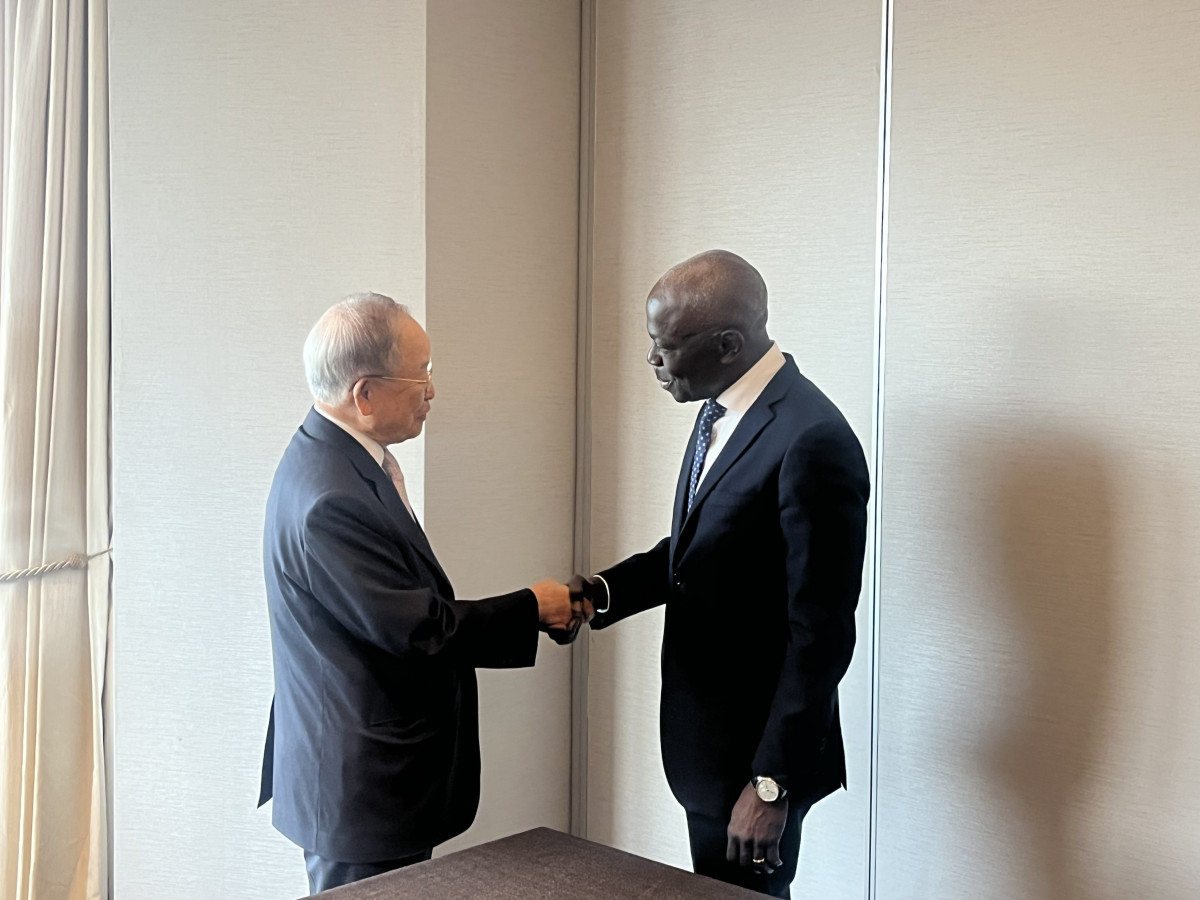
Son Kyung-sik, chairman of the Korea Employers Federation, told ILO Director-General Gilbert Houngbo that advances in artificial intelligence should translate into productivity gains and the creation of quality jobs. He also warned that the recently revised labor union law and the dispute over Samsung Electronics’ performance-pay talks have heightened uncertainty in labor-management relations.
According to the Federation on the 22nd, Son met with Houngbo during the latter’s recent visit to South Korea. They exchanged views on global AI cooperation initiatives and on current challenges in Korea’s labor market and industrial relations.
The meeting was held as part of the South Korean government’s push to establish a “Global AI Hub.” On the 21st, Seoul issued a joint statement launching the hub with nine international organizations, including the ILO, and several multilateral development banks.
Son described the AI cooperation platform, which includes UN agencies such as the ILO, as “a highly significant project,” and welcomed Korea’s role as a gateway for international AI collaboration given the country’s leadership in the technology.
He said that under the “AI for ALL” vision, the government and private sector plan to work with the international community to extend the benefits of AI across society. “We hope AI advances translate into higher productivity and the creation of quality jobs,” he said.
He added that the initiative aligns with the ILO Director‑General’s report, “Using AI for Quality Jobs,” and stressed that the Korea Employers Federation is actively engaging in social dialogue with labor and government as a social partner to manage the AI transition effectively.
The meeting also addressed issues in Korea’s labor market and industrial relations.
The revised labor union law, which took effect in March, expands the range of entities that can participate in bargaining. Because Korea’s industrial structure often involves primary contractors, subcontractors and sub-subcontractors, the law now enables bargaining between unions at primary contractors and those at sub-subcontractors. That change has triggered a sharp increase in bargaining demands directed at primary contractors.
“On the ground, uncertainty about who can bargain and what can be bargained over has grown, and overall confusion in labor-management relations has intensified,” Son said.
The Federation also raised the dispute over Samsung Electronics’ performance-pay negotiations. With the global semiconductor boom, Samsung’s operating profit this year is expected to be around 300 trillion KRW (approximately 225 billion USD), and unions have pressed for a share of those gains, the Federation said.
“The semiconductor industry requires large, forward-looking investments,” Son said. “Union demands for profit-sharing could create uncertainty for companies and for the national economy.”
He noted that, although the dispute has not led to strikes, fairness concerns have continued to unsettle labor-management relations even after agreements are reached. “This raises equity issues across companies and industries, and it has deepened conflicts among divisions within firms,” he said.
“Business leaders are concerned these developments could spread across labor relations more broadly,” he added.
Son plans to attend next month’s ILO conference as a representative of Korea’s business community. “I hope the conference yields balanced discussions that reflect each country’s circumstances and the perspectives of labor, management and government,” he said, expressing his wish for a successful meeting.











Most Commented