
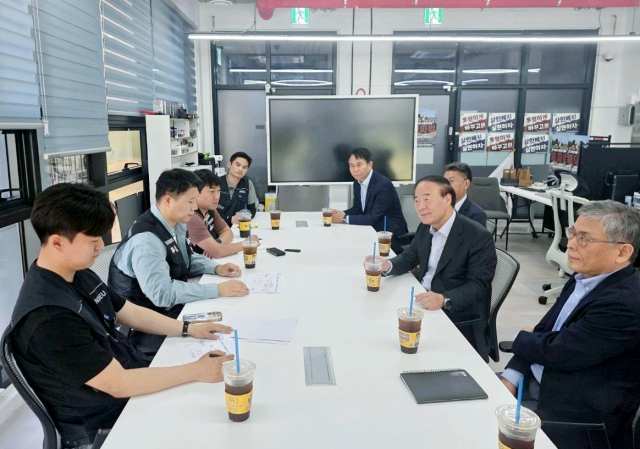
Moral-hazard allegations continue to swirl around the cross-company labor union leading the Samsung Electronics general strike. As members accuse the leadership of opaque operations and pursuit of private gain, criticism of Chairman Choi Seung-ho’s leadership has spread both inside and outside the labor movement.
◆’Sneaking’ a new allowance into the strike vote
Member anger over the executive’s management flared after the general meeting in March, when delegates approved a new officer allowance. The leadership pushed the change through alongside the sensitive strike authorization vote, inserting a provision to allocate 5% of monthly dues to executive allowances. Because the allowance clause appeared at the end of the materials explaining the rule change, many members reportedly voted “yes” without realizing a portion of their dues would be redirected to the executive. Members have criticized the move as a tactic that smuggled an unrelated measure into a high-stakes strike vote.
Under the new rule, roughly 35 million KRW of the 700 million KRW in monthly dues paid by about 70,000 members will be allocated to executive allowances (700,000,000 KRW ≈ $525,000; 35,000,000 KRW ≈ $26,250). Reports say Chairman Choi receives about 10 million KRW a month from that fund (10,000,000 KRW ≈ $7,500). If the executive expands its ranks and raises the allocation rate, allowances could grow to 10% of dues — about 70 million KRW a month (70,000,000 KRW ≈ $52,500). Executives also continue to receive their company salaries under the time-off system while collecting these union allowances, prompting employees to flood internal boards with complaints questioning whether leaders are drawing company pay and then using members’ money for an allowances “party.”
The environment that enabled these excesses stems from a distorted governance structure. Under labor law, major actions such as budget execution and charter amendments should be checked by a delegates’ council elected by members, but the cross-company union has not held a single delegates’ election in nearly three years since its founding.
Delayed accounting disclosures, allegations of private use of rented luxury vehicles, and questions about payments for personal lodging have compounded suspicions of embezzlement and improper use of members’ dues.
◆’Overseas trip’ immediately after the rally — Chairman Choi’s leadership in crisis
Chairman Choi’s personal conduct has also drawn scrutiny. After telling a strike rally in Pyeongtaek on April 23 that a general strike could inflict losses of between 20 trillion and 30 trillion KRW on the company (approximately $15 billion to $22.5 billion), he reportedly took a weeklong vacation to Thailand in business class. The planned strike date of May 21 was less than a month away. While in Thailand on April 27, he posted on the union website warning that anyone who sided with management during the strike could no longer be regarded as a colleague — a message criticized as an attempt to pressure potential nonparticipants.
Industry observers said it was hard to reconcile a leader pressing for internal unity from a resort abroad during a dispute that has national implications. One observer suggested the behavior looked less like a fight over survival and more like an effort to secure a larger share.
After President Lee Jae-myung warned that excessive demands by some organized workers can harm other workers, Chairman Choi directed the comment at other unions, posting on a community board that the president was referring to LG Uplus. LG Uplus’ bonus demand falls short of 30 million KRW per person (30,000,000 KRW ≈ $22,500), while demands from Samsung’s DS division amount to roughly 600 million KRW per person (600,000,000 KRW ≈ $450,000). The Public Transport Workers’ Union’s LG Uplus branch expressed deep regret and anger and demanded a formal apology; the cross-company union issued a written apology on May 7.
On May 17, the Federation of Korean Trade Unions (FKTU) urged reflection, saying a union’s role carries a social responsibility to consider inequality and disparities across the entire labor market.












Most Commented