
Translation result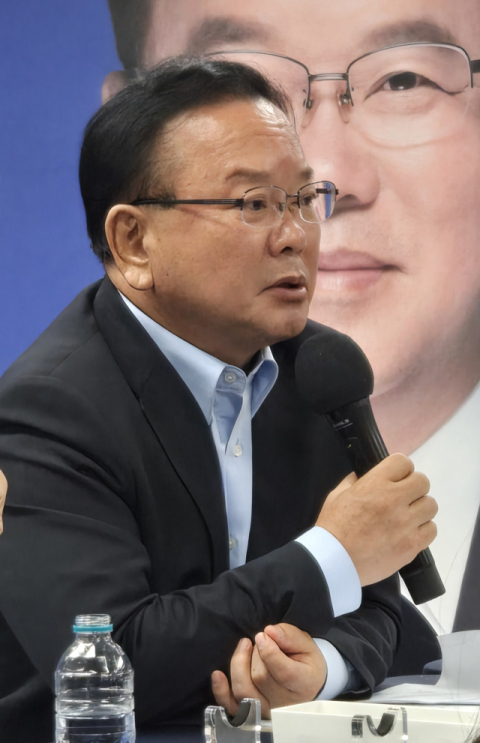
On the 11th, Kim Bu-gyeom, the Democratic Party’s candidate for Daegu mayor, again urged full party backing for his platform, asking, “If the Democratic Party only takes votes and then washes its hands, will the people of Daegu forgive us?” He said that if People Power Party lawmakers and a Democratic mayor work together, they can overcome most central government obstacles and present South Korea’s first notable example of effective cooperative governance.
That evening at his campaign office in Dalseo District, Daegu, Kim held a press briefing and said Han Byung-do, the Democratic Party’s floor leader, has pledged to form a legislative support task force (TF) to advance long-standing local projects.
He said he will press the floor leader to follow through on the leadership’s promises, adding, “Unless someone plans to quit politics in Daegu, those who want to grow the party must keep their promises.”
Kim noted that many central government ministers who will decide major policies affecting Daegu are juniors he has mentored. He said he intends to confront them directly, telling them Daegu has no way forward unless they act, and to push them to deliver — a pressure he hopes will spark a clear revival for the city.
Responding to Choo Kyung-ho’s demand that he state his position on the so‑called “fabricated-indictment special prosecutor bill,” Kim retorted, “If the Daegu mayor gets dragged into a political fight and confronts the president or the ruling party, who will take responsibility for Daegu’s future?”
He said that at the last candidate nomination meeting he urged contenders not to withdraw unless they truly intended to fight in this difficult race, and he noted that, in the end, the party stepped back.
On the question of converting the Daegu–Gyeongbuk New Airport into a national project, Kim pointed out that the decision was made as a donation-to-transfer arrangement when he served as deputy prime minister for the economy, and he asked sharply whether Choo’s position has changed since then.
Answering critics who asked what he had done for Daegu as prime minister, Kim said, “During my time as prime minister, Daegu’s central government funding grew at an average rate of more than 10%.”
He added, “I’m sorry to say this, but the opposing candidate, Choo Kyung-ho, oversaw only 1–2% growth when he was deputy prime minister.” Kim accused Choo of miscalculating revenue estimates, which led to cuts in transfers to local governments and provoked strong backlash from municipal authorities.
On his recent pledge to build Daegu Metro Line 4 (the EXCO Line) as a monorail rather than the existing AGT (automated guideway transit) system, Kim warned that AGT cannot reach EXCO and the logistics complex. He said the four-lane road from Daegu Technical High School to the back gate of Kyungpook National University would require decking for an AGT, and nearby residents would likely block such construction.
He added that, in the long term, a monorail would be compatible with Line 3 and that the sunk costs — roughly 20–30 billion KRW (about 15–22.5 million USD) — are absorbable. For that reason, and because public acceptance is higher, he concluded the city must pursue the monorail option.








Most Commented